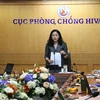
Professor Mai Trong Khoa (right) (Photo: suckhoedoisong.vn)
 Hanoi (VNA) - With the adoption of cutting-edge technology at a comparatively low cost, Professor Mai Trong Khoa - Director of the Nuclear Medicine and Oncology Center, at Bach Mai Hospital - and colleagues have saved many cancer patients “at death’s door”.
One of the patients, Do Quoc Hung, also a doctor - former head of the C7 Division of the National Cardiovascular Institute - has now totally recuperated.
Five years ago, he was diagnosed with terminal lung cancer.
“In Hung’s case, where cancerous tumours had spread throughout his body, a surgical operation could not be performed. Old-school radiotherapy was out of the question since full-body radiation might be too punishing to endure and would just do more harm than good,” Khoa said.
Traditional treatment methods administered to late stage cancer patients could merely seek to treat symptoms and improve their physical condition; however the disorder itself remained incurable.
However, the latest methods have exhibited encouraging and promising results.
With the new “2-in-1” PET-CT scan technique (positron emission tomography–computed tomography), doctors can detect the early onset of cancer via signs of abnormal metabolic activity, even when tumours have not yet formed.
The imaging technique also provides clear in-depth images that reveal the exact location of tumours, or to where they have metastasized.
Based on this data, doctors can make early and more accurate diagnosis and offer a more efficient treatment regimen.
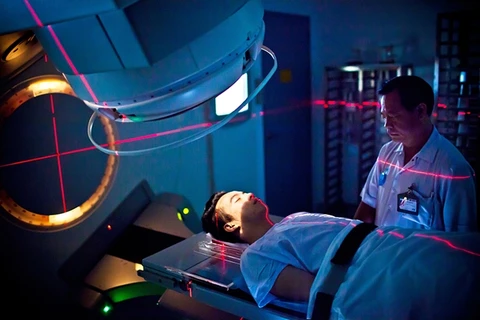
Simultaneously, the application of radio-surgery using a rotating gamma knife (convergent funnel-shaped radiation beams dispersed into different directions) will precisely attack and destroy tumours without damaging healthy cells.
Thus, hitherto inoperable or unresponsive tumours that lie in deep or hidden locations can now be eliminated.
Next, selective internal radiation therapy (SIRT) is able to safely deliver a high dose of radiation directly into the cancerous area no matter how ‘high risk’ the location, for example, in the brain.
Lastly, radioactive drugs injected into the body can approach and destroy cancer cells.
According to Dr. Khoa, this combined regimen is the only hope for patients with metastasis cancers not amenable to surgery or full-body radiotherapy.
Strictly following all these treatments, Professor Hung has survived his stage IVB lung cancer.
“If the cancer doesn’t recur in five years, the patient can be considered ‘cured’”, said Khoa on Hung’s condition. “It is also worth mentioning, the world’s most advanced techniques that we are utilising come with very ‘Vietnamese’ price tags - only one tenth to a half of that in developed nations.”
For example, radio-surgery using a gamma knife in the US costs 25,000 USD a session, in Vietnam, the cost is just 2,000 USD; an intensity modulated radiotherapy session costs 10,000 USD in Singapore, while in Vietnam, it is around 2,000 USD.
According to Khoa’s calculation, if covered by health insurance, the patients will need to pay just 30 million VND-40 million VND (up to 1,700 USD) to get access to modern cancer treatment methods.
This affordability means more lives will be saved from cancer.
To date, hundreds of thousands of cancer patients have been treated with the world’s latest methods right here in Vietnam.-VNA