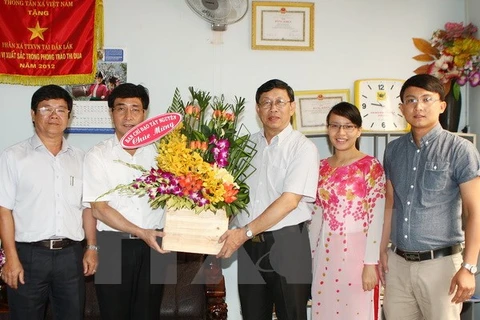
Ho Quang Loi, Permanent Vice Chairman of the Vietnam Journalists’ Association (Photo: internet)
Hanoi (VNA) – The 2016 Press Law is not written for journalists only, Ho Quang Loi, Permanent Vice Chairman of the Vietnam Journalists’ Association, speaks to the media on the occasion of Vietnam Journalist’s Day (June 21).
* In your opinion, how will the changes in the 2016 Press Law affect Vietnam’s press?
Vietnam is one of a few countries to have adopted a press law, indicating the special attention of the Party and State to the national press. The law will provide a legal basis for a healthy, active and effective press to help the nation respond to the demands of the country’s renewal and international integration.
The 2016 Press Law, with its six chapters and 61 articles – 25 more than the old law - goes into effect on January 1, 2017.
An important change in the revised law is that it states clearly the right to press freedom and citizens’ rights to express their ideas in the media. The law also stipulates what the press can’t do.
The 2016 Press Law also covers the responsibility of organisations and officials to provide information to the media, with special rules for journalists about information confidentiality, particularly information relating to national security.
In other words, the 2016 Press Law will provide favourable conditions and tools for the media to do its jobs.
However, the law is also an effective legal framework guiding the journalists how to perform their duties. In other words, the Press Law is not only for journalists but for the whole society.
* Do you think the law responds to changes in the modern press and technology?
As I have mentioned above, the 2016 Press Law ensures the right to freedom, including press freedom for all citizens and their rights to access information.
No law is perfect, but the 2016 Press Law ensures the basic conditions to make Vietnamese society more civilised and democratic.
However, the booming social media poses acute challenges for the national press. This has become a global issue, not only in Vietnam. We can’t say that the 2016 Press Law will be the only good and effective tool in the management of the press and communication in Vietnam. That’s why we call upon all Vietnamese media to act with integrity and professionalism.
* In your opinion, what challenges face traditional media in light of the rapid development of social media?
We’re living in an era of fast development of digital technology and social media. We should look at it objectively and comprehensively and acknowledge its positives while criticising its negatives.
All these require good professional skills. What’s more important, all journalists must be honest in writing their stories. This is vital.
To that end, journalists should have deep knowledge of the country’s Constitution, particularly the Chapter on Human Rights, including freedom of speech and freedom of press.
In addition, all journalists must thoroughly understand the 2016 Press Law and adhere to its do’s and don’ts.
* Would you elaborate on the required professional ethics for Vietnamese journalists?
A book on professional ethics for Vietnamese press workers is in the process of revision to make it conform with the 2013 National Constitution and the 2016 Press Law and to adapt it to the fast changing life in our country.
I just want to emphasise again that “journalistic ethics are the core – a matter vital to his/her career”.
We’re in the course of building a press for the homeland and the people and for the general public.
* What do you think about the impact of the new Press Law on the development of the Vietnamese media?
I’m confident it will serve as a firm foundation for the Vietnamese press to develop along the path charted out by the Party and Government. The Vietnamese press will carry out its role of providing timely and reliable information to the readers.
Living in an era of fast changing social media, the Vietnamese press is facing both opportunities and challenges. Journalists must therefore exert further efforts to keep up to date with the fast changing world – yet conform to our unique Vietnamese conditions.-VNA