Nearly zero percent, which will open up huge opportunities for the steel industry. Steel output for exports is expected to increase by 35 per cent against the current figure. (Source: VNS)
The Vietnamese business community must develop new business strategies in order to be more competitive after the Trans-Pacific Partnership (TPP) takes effect, delegates heard at a conference.
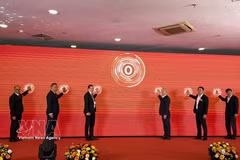
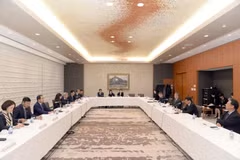
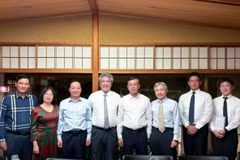
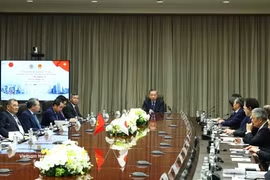
The conference was organised in Hanoi on October 17 by the Party Committee of the Central Business Bloc which comprises 33 corporations, groups and banks, including major State-owned enterprises.
"TPP will open a new market of 800 million people, with TPP members representing 40 percent of global GDP and 30 percent of international trade purchases," Tran Quoc Khanh, Deputy Minister of Trade and Industry, and Head of Vietnamese TPP negotiation delegation, was quoted as saying in the Sai Gon Giai Phong (Liberated Saigon) newspaper.
"Under the TPP, almost all import taxes will be eliminated, but there will be more challenges for the Vietnamese business community," he said. "The business community, especially the Central Business Bloc, must reform to take advantage of the opportunity."
Bui Van Cuong, Secretary of the Party Committee of the Central Business Bloc, said the bloc's members all played an important role in the national economy in the electricity, coal, oil & gas, minerals, airline and railway sectors.
These enterprises contribute one-third of the national budget and provide jobs for 1.3 million workers.
The business bloc has 50 investment projects outside of Vietnam with total registered capital of nearly 5 billion USD, with 4 billion USD implemented.
At the seminar, the Central Business Bloc's corporations, groups and banks shared their readiness for international integration.
Most of them said they were aware of the opportunities and challenges as Vietnam joins the ASEAN Economic Community (AEC) and takes part in several Free Trade Agreements (FTA), especially the Trans-Pacific Partnership.
Speaking at the event, Pham Ngoc Minh, Deputy General Director of Vietnam Airlines, said the airline had prepared to cope with severe competition from international airlines, focusing on providing excellent services by choosing state-of-the-art aircraft and hiring foreign experts and pilots.
In the last three years, Vietnam Airlines replaced all of its aircraft with wide-body planes, which are more environmentally friendly and consume less fuel.
"We believe Vietnam Airlines will take the lead in its products in the Southeast Asian region.
The airline will be as good as Thai airlines by 2020," Minh said.
However, Vietnam Airlines would find it difficult to become a global airline due to a lack of financial capacity.
Minh said the goal would be to cooperate with other airlines that do not have the same route map as Vietnam Airlines.
"Vietnamese businesses should work together to compete better. Cooperation would help companies create the most competitive products," Minh said.
Vo Sy Luc, Chairman of the Board of Directors of the Vietnam Rubber Group, said Vietnamese rubber output had reached 1 million tonnes, accounting for about 8 percent of the world's rubber output, which is 3-4 million tonnes lower than Thailand and Indonesia. The challenge facing the rubber industry is a lack of consistent quality management.
To integrate successfully, the Government needs to develop a programme to manage the quality of rubber and create a brand for Vietnamese rubber that is internationally recognised.
The industry is facing difficulties due to a drop in prices. This year, the industry is expected to earn a profit of around 2 trillion VND (90 million USD).
To help the industry compete in the international market, the Vietnam Rubber Group suggested that the Government continue support for the industry by offering tax and land incentives for rubber plantations.
Also speaking at the event, Nghiem Xuan Da, General Director of Vietnam Steel Corporation, said the steel industry heavily depended on imported raw materials (70-80 percent).
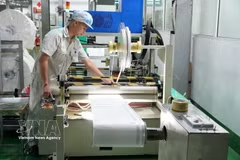
After the TPP takes effect, import tariffs will be reduced to nearly zero percent, which will open up huge opportunities for the steel industry.
Steel output for exports is expected to increase by 35 percent against the current figure.
However, Da noted that opportunities under the TPP would not be shared equally among industries.
Steel businesses are expected to face stiff competition with cheap imported steel, especially from China.
Vietnamese steel is vulnerable to steel imports because the former does not have much added value, while Vietnamese steel businesses lack skills and financial capacity. The industry is also facing a number of dumping lawsuits, which have seriously affected steel exports.
Da suggested that the Government provide support to restructure the steel industry, such as low interest rates for medium- and long-term loans and foreign-currency loans for investment and import of raw materials.
Government agencies should also help businesses cope with international trade lawsuits, especially dumping cases, to reduce the challenges facing the industry.
Nguyen Thien Nhan, Chairman of the Central Committee of the Vietnamese Fatherland Front, told businesses and their representatives that there should be more dialogue between enterprises, ministries and other parties to devise the most effective solutions to compete as the TPP takes effect.
Nhan said the Ministry of Industry and Trade and other relevant sectors and associations must listen to suggestions made by enterprises.
Each enterprise should be active in conducting research on new business strategies to take advantage of TPP opportunities. Companies in each industry must work together more closely as well, he said.
"For instance, the concern about being sued for dumping steel. We need to overcome this worry. In order to do that, we should consult international experts with deep knowledge about commercial conflicts," Nhan said.
In order to help society, the business community must learn as much as possible about the TPP, and outline the advantages and challenges of each sector so that enterprises could make thorough preparations, he said.-VNA