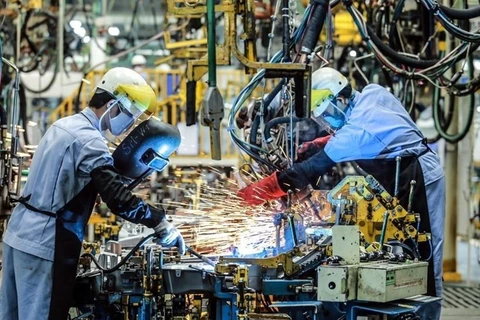
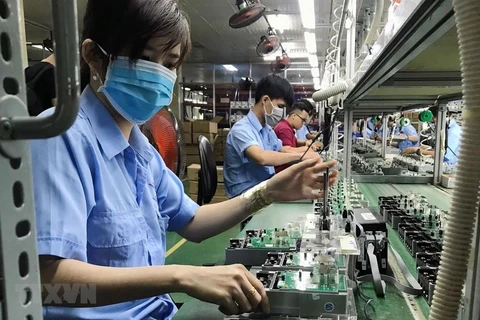
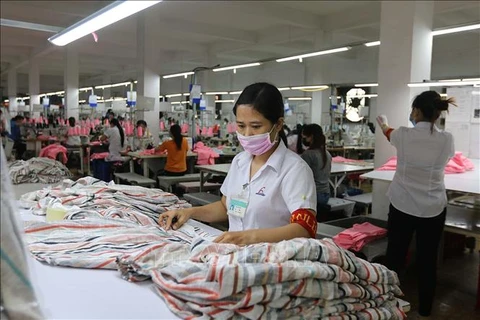
Vietnam has more than 12,000 newly-established enterprises with a total registered capital of 103.7 trillion VND (4.44 billion USD) in May. (Photo: VNA)
 Hanoi (VNA) – Vietnam had more than 12,000 newly-established enterprises with a total registered capital of 103.7 trillion VND (4.44 billion USD) in May, according to the General Statistics Office (GSO).
These figures were sharply down by 24.2% and 32.9% in the number of newly registered enterprises and the registered capital respectively from the previous month, reflecting a downward trend in the business climate among individuals and enterprises as difficulties and risks facing the economy may last long.
Besides, 33,000 enterprises returned to operation, down 7.4% over the same period last year, bringing the total number of newly established enterprises and those returning to operation in the five months period to nearly 95,000, a fall of 3.7% compared the same period last year. On average, nearly 19,000 businesses were newly established and returned to operation every month.
In the first five months of this year, there were 623 newly established enterprises in the agriculture, forestry and fishery sectors, down 31.8% compared to the same period last year; 14,800 enterprises in industry and construction, down 8.2%; and 46,500 enterprises in the service sector, up 1.4%.
In general, in the period under review, there were 55,200 enterprises temporarily suspending business, up 20.3% over the same period last year; 25,500 halted operating and waited for dissolution procedures, up 34.1%; and 7,300 enterprises completed dissolution procedures, up 6.5%. On average, 17,600 businesses withdrew from the market every month.
Recently, the government issued a resolution dated April 21, 2023, on a number of key policies and solutions to support businesses to proactively adapt, recover quickly and develop sustainably until the end of 2025.
Besides, the central bank's reduction in interest rates is also a positive move to support businesses and stimulate credit demand to help the economy grow in the coming time along with the Government's fiscal policies.
Many manufacturing enterprises also suggested that, in order to reduce costs for businesses, the government should continue to strengthen simplification and transparency of customs procedures to reduce costs and increase predictability for businesses./.