Honeydew melon grown using advanced farming techniques in Ninh Thuan province’s Ninh Son district. (Photo: VNA)
 Ninh Thuan (VNS/VNA) - The south-central province of Ninh Thuan has done well in developing its rural areas after 10 years of implementing the national programme on building new-style rural areas, according to its steering committee for the programme.
The annual income of rural people has climbed to nearly 26 million VND (1,120 USD) now, 2.16 times the 2011 figure.
Of its 47 rural communes, 26 meet all 19 criteria set under the programme.
The criteria are related to planning, infrastructure, transport, irrigation, electricity, income, education and training, healthcare, environment, food safety, social security, culture and others.
Ninh Phuoc district became the first district to be acknowledged last year.
Quang Dai Hoang, an ethnic Cham living in the district’s Phuoc Hau commune, said: “The material and spiritual lives of people have been enhanced.”
Most houses here have been repaired or built well, he said.
Most roads in Ninh Phuoc are paved with cement or asphalt and all rural roads are lit at night, he said.
The district mobilised more than 2.3 trillion VND (98.9 million USD) from various sources, including 425 billion VND from the people, for the programme in the last 10 years.
Dang Kim Cuong, Director of the provincial Department of Agriculture and Rural Development, said the programme has been implemented widely, and rural people have actively participated in it.
They have contributed labour, money and land for building infrastructure facilities and participate in monitoring, managing and using infrastructure, thus improving the quality of implementation of the programme, he said.
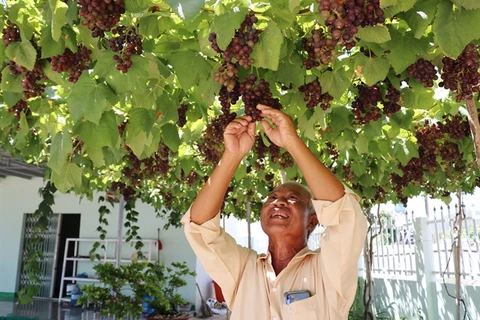
The province has boosted the use of advanced farming techniques and created favourable conditions for farmers, co-operatives and companies to develop linkages in producing and consuming key agricultural products like grape, jujube, asparagus, goats, sheep, and cows.
Though it has the least rainfall in the country, it is the largest producer of grape, jujube, goat, and sheep. It has more than 138,000 goats and nearly 130,000 sheep, according to the department.
Its livestock are prized for their quality because they eat mostly natural food, grazing in pastures.
To help farmers improve their incomes from raising goats and sheep, the province has increasingly piloted and taught them new techniques, improved strains and zoned pastures for them.
Its goats have a collective brand name while its sheep have been geographical indication certification from the National Office of Intellectual Property.
Association contributions
The province’s associations, unions and organisations have carried out many movements to achieve the programme criteria.
They have also carried out many advocacy activities to increase awareness of the benefits of the programme in rural areas.
Besides teaching farmers about advanced farming techniques and efficient models, the province Farmers Association has also organised many activities and contests to attract farmers to the programme.
A contest called “Farmers compete together in combination with building new style-rural areas” has attracted farmers to the programme and increased their awareness of building new-style rural areas.
The province’s Women’s Union at all levels has carried out various activities and movements to implement the programme criteria such as income, transport, environment and food safety, and social security.
They have taught vocational skills to more than 6,600 members and found jobs for more than 7,680 since 2010.
Besides helping members find jobs, the province’s Women’s Union has also organised courses in legal regulations such as the Law on Marriage and Family, the Law on Domestic Violence Prevention and Control, the Law on Gender Equality and others to ensure social security and protect the environment.
Nguyen Thi Ngan Hanh, Vice Chairwoman of the provincial Women’s Union, said: “During the implementation of the programme the province’s women’s unions at all levels combined the advocacy of the programme with implementation.”
They were determined that advocacy should be done regularly and long term, she added.
In 2021-2025, the province plans to mobilise 4.2 trillion VND (180 million USD) from various sources to implement the programme on building new-style rural areas.
The province aims to have three entire districts and 75 percent of its communes recognised as new-style rural areas by 2025, and increase the rural income 1.8 fold from 2020.
To meet the targets, the province will focus on teaching vocational skills and providing jobs and speed up the restructure of agriculture production towards adapting to climate change.
It will teach farmers advanced techniques and develop linkages between farmers and companies to ensure outlets for the former’s produce.
It will focus on implementing policies to develop rural services and restructuring the rural economy towards increasing the proportion of services and industry and reducing the rate of agriculture./.
VNA