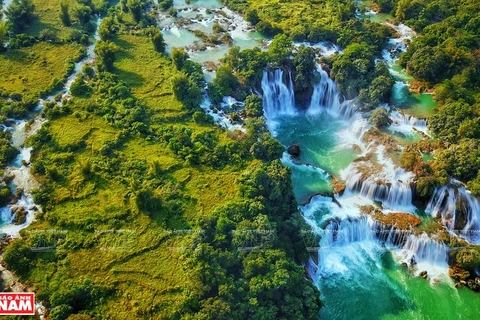
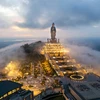
Ban Gioc Waterfall on Quay Son River in Dam Thuy commune, Trung Khanh district, Cao Bang province (Source: VNA)
 Cao Bang (VNS/VNA) - Non Nuoc Cao Bang Global Geopark is an exceptional area in which it is possible to explore the history of the Earth for more than 500 million years. It’s also a land of tangible and intangible cultural heritage sites.
"Nang ve nuoi cai cung con
De anh di tray Nuoc non Cao Bang”
(Go back home and take care of our children and our mother
Let me go and have a venture in the majestic nature of Cao Bang)
This popular Vietnamese folk song explains that Cao Bang is a magnificent land filled with attractions. One such mystical place is Non Nuoc Cao Bang Global Geopark, one of the most impressive attractions of the province, which has been recognised as a UNESCO global geopark, the second of its kind in Vietnam.
Located in the north of Vietnam, 300km from Hanoi, Non Nuoc Cao Bang UNESCO Global Geopark covers 3,000sq.km. It covers six districts of Ha Quang, Tra Linh, Quang Yen, Trung Khanh, Ha Lang, Phuc Hoa, and part of Hoa An, Nguyen Binh and Thach An districts. The geopark is home to nine ethnic groups including Tay, Nung, Mong, Dao and San Chay.
The geopark is an exceptional territory which offers insights into the history of our planet across more than 500 million years through protected sites. Fossils, marine sediment, volcanic and plutonic rocks and minerals are witness to the remarkable evolution and changes of our planet, and they constitute an exceptional geological heritage.
It is also a land of tangible and intangible cultural heritage sites and special historical monuments. The area is also well-known for its high biological diversity with abundant endemic plant and animal species and ecosystems.
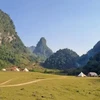
There are three main routes to explore the geopark, including going to the east to experience traditional cultures, north to see history and freedom, and west to experience Phia Oac, the mountain of transformations.
Wonderland to the east
The path to the route east is winding with one side green limestone mountains, and the other an abyss covered by white mist. Little wild flowers in many colours in the wind, fresh cool air, yellow sunlight, imposing scenes, and ethnic Tay girls in black costumes working happily in the rice fields created a painting of a peaceful rural life, harmoniously blended with nature. Ma Phuc Pass was the first site on the route.
Located in Cao Xuyen cillage, Quoc Toan commune, Tra Linh district, more than 3.5km long at an altitude of 700m above sea level, the pass is one of the most beautiful in Cao Bang.
Tran Van Tan, Director of the Institute of Geosciences and Natural Resources under the Ministry of Environment and Natural Resources, said the pass winds between two high limestone mountain ranges and constitutes, at its bottom, an exceptional geosite. Here, in contact with limestone (white rock) can be seen a blackish green rock with rounded shape – the so-called pillow basalt.
“Besides the exceptional geological interest, Ma Phuc is also a place of intangible heritage,” said Chu Thi Vinh, Vice Chairwoman of the Tra Linh District People’s Committee.
“According to legend, in the 11th century, a leader of the Nung people named Nung Tri Cao led local people to fight against the Chinese Song army from the north. Once returning from a patrol along the border, at Quoc Toan commune of present day Tra Linh district, he faced this high, winding and steep pass, and his horse was crippled and could not continue. The mountain was since named An Lai, literally meaning to stop, and the pass was named Ma Phuc, literally meaning a kneeling horse,” Vinh said.
Leaving Ma Phuc Pass, visitors can travel to Angel Eye Mountain in Quoc Toan commune, Tra Linh district.
Angel Eye Mountain or Phia Piot in Tay language means a mountain with a through-going hole, which is 50m in diameter and 50m above the lake.
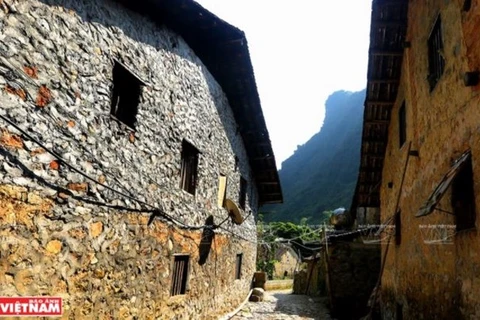
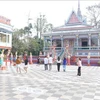
After a walk of about 15 minutes, we saw Tay people in Ban Danh hamlet with stilt houses, yin and yang tiled roofs, stone fences, paddy fields of rice and maize, water buffaloes and cows, and the surrounding green and mature karst landscape. This helped us relax and recover from our daily stresses.
At the end of the route going to the east, we reached Ban Gioc Waterfall, a must-see place in Cao Bang.
Located on the Quay Sơn River at Dam Thuy commune, Trung Khanh district, Ban Gioc Waterfall is the fourth largest waterfall in the world at an international border, after Iguazu Falls between Brazil and Argentina, Victoria Falls between Zambia and Zimbabwe, and Niagara Falls between the US and Canada.
Tran Thi Xuan Quynh, member of the management board of the Non Nuoc Cao Bang UNESCO Global Geopark, said Ban Gioc Fall is approximately 300 wide and 35m high, with three cascades. It runs between Vietnam and China.
Historical experience to the north
From Cao Bang city, heading to the north, passing vast fragrant paddy rice fields which were in harvest time, tourists can visit historical sites that tell of the revolutionary life of President Ho Chi Minh after he came back to Vietnam on January 28, 1941.
The jade tranquil Lenin Stream which softly and peacefully meanders at the foot of the rampart – like Karl Marx Mountain, is worth a visit.
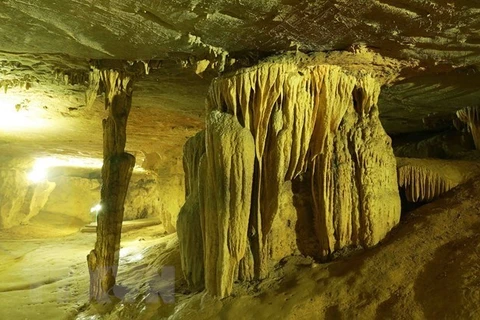
Crossing a small bridge, walking 15 minutes and then climbing up for about 50 steps, both natural and artificial, we reached Coc Bo Cave, President Ho Chi Minh's shelter during his time in Pac Bo.
The small, almost dry and quiet reserve, though still having a second entrance, was badly damaged during the border war with China and has been partly restored. The stone bed where President Ho Chi Minh used to sleep is still there.
Mountain of transformations to the west
After recovering with some local food and a good sleep, tourists should head west on the next day to experience Phia Oac, the mountain of transformations.
The route was a highlight, with many attractive sights including Phai Khat Post, beewax brocade by Dao Tien people, Phia Den salmon farm, Ban O and Lung Muoi tungsten mines, Phia Oac-Phia Den National Park and Tran Hung Dao Forest Special National Monument.
The three experience routes give visitors a chance to explore the geopark, as well as local people here. Each of these routes can be visited, with a guide, and will leave a unique and unforgettable experience./.