Many factories are located in Northwestern Industrial Park in HCM City's Cu Chi district (Source: VNA)
 HCM City (VNS/VNA) - The development of Ho Chi Minh City's Northwestern Urban Area is expected to attract increased investment, drive economic growth of neighbouring areas, and strengthen relations with Cambodia and other ASEAN countries.
The city's Northwestern Urban Area, located in Hoc Mon and Cu Chi districts, is on the trans-Asia axis connecting the city and Tay Ninh province with Cambodia via the proposed HCM City - Moc Bai Expressway.
It is located in an area near ring roads No 3 and 4, which connect fast-growing and dynamic localities such as Tây Ninh province’s Trang Bom district, Dong Nai province’s Bien Hoa city, Binh Duong province’s Di An and Thu Dau Mot cities, and Long An province’s Duc Hoa and Duc Hue districts.
The development of the Northwestern Urban Area is expected to be the driving force for growth of these neighbouring areas.
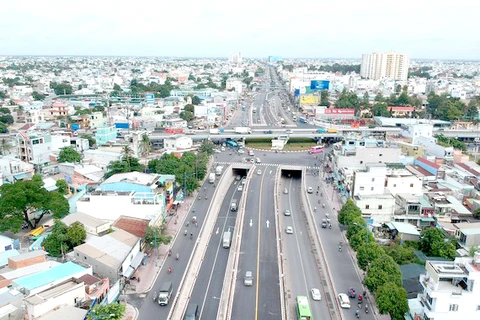
The completion and operation of a double-tunnel project at An Suong intersection between HCM City’s District 12 and Hoc Mon district helps reduce traffic congestion at the city’s northwest gateway.
The new double tunnel plays an important role in removing transport bottlenecks, and improves connections with the city’s Northwestern Urban Area.
HCM City is also implementing several major transport projects connecting to the northwestern urban area, including the HCM City - Moc Bai Expressway project between HCM City and Tay Ninh province, and the Metro Line No 2 project linking Ben Thanh Market in District 1 with Tham Luong Bus Terminal in District 12 and Cu Chi district.
HCM City and Tay Ninh province are working with the Ministry of Transport to start construction of the HCM City- Moc Bai Expressway project later this year or early next year.
The Metro Line No 2 project is speeding up site clearance and compensation for affected households. The HCM City Urban Railway Management Board said that land has been handed over for construction of stations S10 and S11 on Pham Van Bach street in Binh Tan district, and S5 Station on Le Thi Rieng street in District 10.
The Metro Line No 2 project is expected to be completed in 2026.
The Ho Chi Minh Highway section running through Central Highlands connects to HCM City’s Cu Chi district and is being built to link to Long An province, according to the city’s Department of Planning and Architecture.
Waterways that connect the city centre with other provinces along the Sai Gon River and Xang Canal are also being exploited.
Many industrial zones and clusters as well as tourist areas in the city’s northwest section are an important basis for the development of the Northwestern Urban Area.
The Hi-tech Agricultural Park in Cu Chi district, for example, has become a bright spot in science and technology application. It conducts research and applies breeding and tissue culture methods to produce high-quality seedlings, which are provided to farmers in the city and neighboring provinces.
It also provides a wide range of probiotics and fruits in large quantities and ensures food safety for dragon fruit, banana and coconut and other products.
Since 2011, farms in Củ Chi District have offered tourism services, attracting groups of students to visit, study and enjoy real-life work activities and creating more income for locals.
The 650ha Tan PhuTrung Industrial Park near National Highway No 22 and a 100 ha Automotive-Mechanical Industrial Park in the district are expected to attract huge investment in key industries, with priority given to automotive engineering, mechanical engineering, electricity-electronics and supporting industries.
Public land funds are still plentiful in localities in the northwestern area.
Nguyen Thanh Toan, former deputy director of the city’s Department of Planning and Architecture, said that new urban areas will be designed with full functions and technical and social infrastructure to meet the demand of investors.
Investment procedures for a 800ha international university urban area, which will be a key functional area in the Northwestern Urban Area, are being implemented.
Adjustment plan
The municipal People’s Committee has approved the adjustment of the city's Northwestern Urban Area plan.
The area to be adjusted covers over 6,000ha, including Tan Thoi Nhi commune in Hoc Mon district, the communes of Tan An Hoi, Phuoc Hiep, Tan Phu Trung and Tan Thong Hoi and Cu Chi town in Cu Chi district, the Tay Bac Solid Waste Treatment Complex, and An Ha and Tay Cai canals.
The adjustment plan calls for the use of greenery on uncultivated land and construction of sports grounds on uncultivated land for residential areas, and the use of greenery and water surfaces to create spacious recreational areas for residents.
New residential areas will be located along the main road axis.
Infrastructure will be fully developed for new residential areas, creating favourable conditions for sustainable development of new urban areas and making them attractive to investors.
High-rises in new residential areas will be located along the road axes, including National Highway No 22 and the road along Metro Line No 2.
Buildings for commercial and service centres will be located in the centre of the urban area near Metro Line No 2 stations.
The new urban area will be a centre for trade, and health, cultural, education, sport and entertainment services. It is expected to have a population of about 300,000 residents by 2025./.
VNA