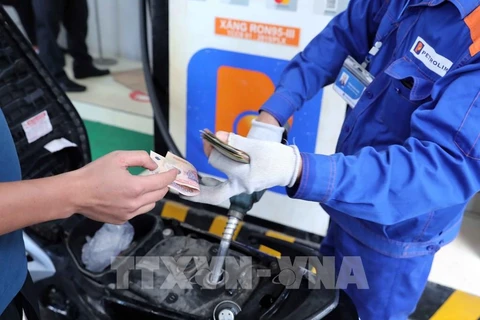
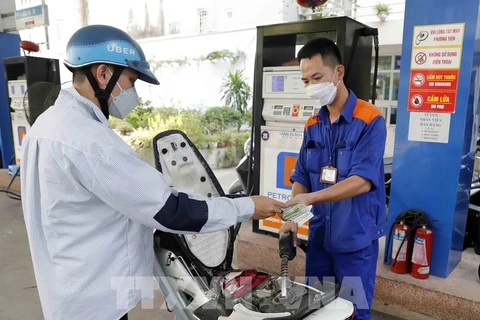
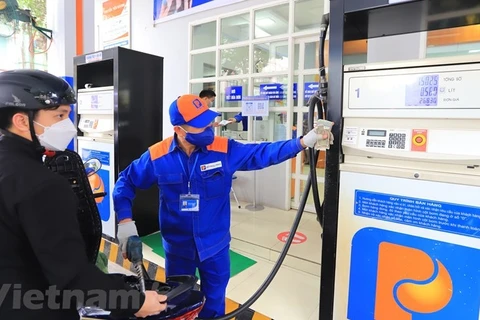
A petrol station in Hanoi (Photo: VNA)
 According to Global Petrol Prices, the average price of gasoline in Vietnam was the 38th cheapest among 168 economies as of August 14.
Specifically, the average petroleum value for Vietnam during the period from May 8 to August 14 was 22,918.50 VND (1.019 USD) per litre, higher than two other countries in Southeast Asia, Malaysia (0.444 USD per litre) and Indonesia (0.871 USD per litre). For comparison, the average price of gasoline in the world for this period was 41,915.75 VND.
Venezuela was the country with the lowest gasoline price in the world, at 0.004 USD per litre.
Countries which had gasoline prices around two times that of Vietnam were mostly developed economies where the income per capita was 10-20 times higher, such as Singapore, the Netherlands, France, Switzerland, Denmark and Norway.
The Ministry of Finance in a recent document in response to National Assembly deputies’ queries about taxes and fees on petroleum said that fuel prices in Vietnam were at a lower level than the region’s and world’s average. Taxes accounted for 10-11% of oil prices and 20-23% of petrol prices in Vietnam, compared to a rate of 45-60% in many other countries.
The highest petroleum price of Vietnam recorded on July 11 was equivalent to only 79% of China’s, 65% of Laos’ and 78% of Cambodia’s, the ministry said.
Many people said that the fairness of petroleum prices should be based on the income per capita of each country.
A report by Vietnam Economy and Strategy Research Centre (VESS) found that petroleum was subject to a value added tax of 10%, import tax of 10%, special consumption tax of 8-10% and environmental protection tax.
Although petroleum retail prices in Vietnam were lower than many countries, they were high with regard to the country’s income per capita compared to some developed countries or countries with similar economic situations such as the US, Russia, Malaysia and Indonesia, VESS said.
When petroleum prices are high, Vietnam might face inflationary risk as petroleum products were considered an input of the economy, VESS said, adding that the existing tax policies on petroleum might no longer be suitable in the context of volatile world gasoline prices.
Economic expert Bui Trinh said that it was difficult to make a comparison between petroleum prices in Vietnam and other countries because each country has a different economic model, different political structure, different consumption level and different levels of income per capita.
Thus, the management of the domestic petroleum market needed to be flexible, he said.
Bui Ngoc Bao, Chairman of the Vietnam Petroleum Association, said that domestic petroleum prices were dependent on global prices because Vietnam still imports petroleum.
Bao said that it was not appropriate to compare the prices of petroleum with the country’s income per capita. He said that, similarly, prices of automobiles in Vietnam were quire high although Vietnam was just a developing economy. Prices also depended on the country’s tax policies, he said.
Petroleum was currently subject to a special consumption tax in Vietnam as the Government aimed to encourage the use of public transport rather than private vehicles, he said.
He said that the current percentage of taxes and fees in prices of around 30% was reasonable.
Improving the transparency of the petroleum market was also important to make petroleum prices more market-based and competitive.
A report of the National Assembly Economic Committee early this year said that the calculation of domestic petroleum retail prices was not suitable to market fluctuations and lack of competition.
According to Pham Ngoc Hung, an industry insider, an exchange should be set up to decide the base price for gasoline based on the bidding prices of wholesalers to increase transparency and prevent a monopoly. The exchange would also help deal with difficulties in petroleum reserves as wholesalers who wanted to participate in the bidding would be required to have warehouses.
Do Huy Trung from the Vietnam Standard and Consumers Association said that the frequency of reviewing and adjusting petroleum prices should be shortened to two times a week to timely reflect the market fluctuations and increase transparency. Currently, petroleum prices were reviewed for adjustments every 10 days./.
VNA