Opportunities could be missed if no sandbox model is developed

Opportunities will slip through Vietnamese firms’ hands if a sandbox is not developed soon, NextTech chairman Nguyen Hoa Binh said at a conference on November 7.
Opportunities could be missed if no sandbox model is developed ảnh 1At the conference (Photo: tinnhanhchungkhoan.vn)

Hanoi (VNS/VNA) -Opportunities will slip through Vietnamese firms’ hands if a sandbox is notdeveloped soon, NextTech chairman Nguyen Hoa Binh said at a conference on November7.

A sandbox is a regulatory fieldwhere technological firms operate and test new ideas to help the local economycatch up with the latest global developments.

New, creative business modelscannot be handled by a traditional legal framework, he said.

For the last 10 years, electronicpayment has become a big sector in Vietnam. But without the support of theState Bank of Vietnam (SBV), this sector wouldn’t have developed, nor wouldfinancial technology (fintech) firms, Binh said.

If new technologies and applications– which prove efficient for society – are not used broadly, there will be morespending and instability for development, he said.

In addition, the State budget maysuffer a big loss of income as the lack of regulations may help foreigntraders evade taxes when doing business via tech apps in Vietnam, he said.

Moreover, foreign investors willbe discouraged when finding investment opportunities in the country as theyfear a lack of regulations will enhance risks, Binh said.

Nguyen Xuan Viet Binh, executiveof e-wallet firm Moca – partner with mobile transport platform Grab, said aregulatory sandbox may force fintech firms to get more creative.

People will be able to getcloser access to comprehensive financial and banking services, encouraging the developmentof a cashless economy in Vietnam, he said.

He suggested the regulatorysandbox should differentiate already existing ideas from brand new ones ascurrent methods should be monitored in the short term to evaluate theirfeasibility and efficiency.

Meanwhile, authorities shouldwatch new business models such as peer-to-peer (P2P) lending in the long termso companies can make the best use of those models, he added.

Businesses can develop theirproducts and services, then the outcomes are evaluated by the public. Anyadvantages and drawbacks would be found, as will solutions, Viet Binh said.

According to Financial Deep Mindgeneral director Bui Viet Dung, a regulatory sandbox should only contains firmswith new business models and technologies and Government agencies should watchthe sandbox closely with risk-hedging solutions.

Ngo Van Duc, a senior official atthe Payment Department of the SBV, acknowledged there was no doubt the fintechsector will grow stronger in Vietnam, however, more could be done to help it.

He said there are no regulationsmentioning the management of fintech firms, so it is necessary to make a placewhere companies are free to test new ideas.

Nguyen Quang Dong, Director ofthe Institute for Policy Studies and Media Development (IPS), suggested theGovernment form a special unit to take care of the development of theregulatory sandbox.

The unit should include differentministries, the SBV and other agencies so they are all held accountable,he said./.
VNA

See more

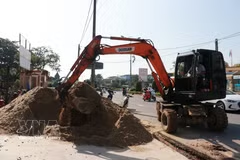
The sidewalks on Hung Vuong street in Quang Tri province are under renovation. (Photo: VNA)

Quang Tri approves 103 priority projects for investment during 2026–2030

The 103 projects are categorised into seven fields, comprising energy; logistics; tourism, services, and trade; green and high-tech agriculture; industry, industrial zones, and production infrastructure; urban development and commercial housing; and healthcare, wellness, and resort services.

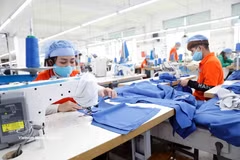
Workers make clothes for export to the Japanese market at Hung Viet Garment Company in Hung Yen province (Photo: VNA)

Vietnam’s textile-garment firms striving to achieve export targets, sustain employment

To achieve the annual target, textile and garment businesses are jointly implementing several core tasks, including diversifying export markets and partners, developing the supporting industries for raw materials and accessories to establish integrated supply chains, investing in technological innovation linked to AI, stepping up high-quality workforce training, promoting green transformation based on circular economy models, and building brands in both domestic and international markets.

Minister of Public Security General Luong Tam Quang (R) receives Choo Hyeong Wook, President and CEO of the Republic of Korea’s SK Innovation in Hanoi on November 16. (Photo: VNA)

Vietnam promotes international cooperation in energy, high technology

Minister of Public Security General Luong Tam Quang called on the RoK's SK Innovation to share experience and work with Vietnamese partners in developing clean and renewable energy, hydrogen, liquefied natural gas, energy storage technologies and carbon emission reduction solutions.

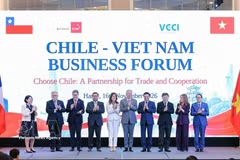
Delegates pose for a photo at the Chile-Vietnam Business Forum in Hanoi on November 16 (Photo: VNA)

Vietnam, Chile seek to expand trade ties

Chilean President José Antonio Kast pointed to potential for cooperation in agriculture and food, and called for stronger technical cooperation, better market access and closer links in innovation, technology, services and sustainable development.

Production of footwear for export at Lefaso Tra Vinh Industrial Investment and Production Joint Stock Company, Tra Cu commune, Vinh Long province (Illustrative image. Source: VNA)

VEFTA implementation requires exporters to restructure supply chains: Experts

Under VEFTA, tariff reductions to zero will be meaningless for Vietnam’s key export sectors, including textiles and garments, footwear, and agricultural and aquatic products, if goods are found to contain banned chemicals, violate rules of origin or lack transparency regarding their carbon footprints.

Deputy Prime Minister Nguyen Van Thang meets with Martin Sommer, head of the IMF’s Article IV consultation mission team to Vietnam, in Hanoi on November 13, 2026. (Photo: VNA)

IMF sees positive growth prospects for Vietnam, urges cautious monetary policy

Martin Sommer, head of the IMF’s Article IV consultation mission team to Vietnam, noted that inflation risks in Vietnam remain under control, but several factors could add to price pressures. He therefore called for cautious monetary policy management and readiness to respond promptly if inflationary pressures increased.

Representatives of the three first-prize-winning startups receive their awards at the event. (Photo: SGGP)

Seven green-tech startups secure 770,000 USD at Net Zero Challenge 2026

In its fourth year, the competition attracted more than 1,100 applications from 80 countries and territories, making it the most competitive edition since its launch in 2023. Nine finalists presented solutions in three categories, namely renewable energy and carbon removal; food systems and sustainable agriculture; and circular economy and waste management.