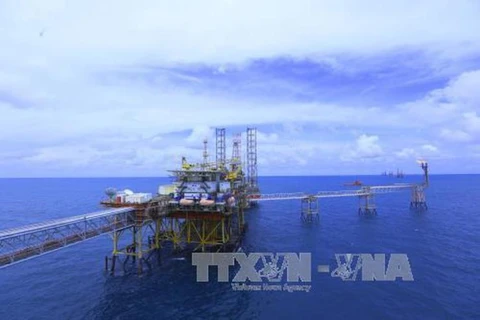
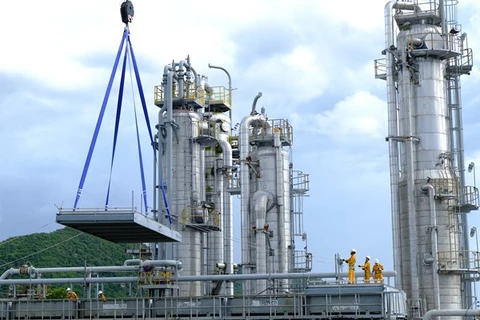
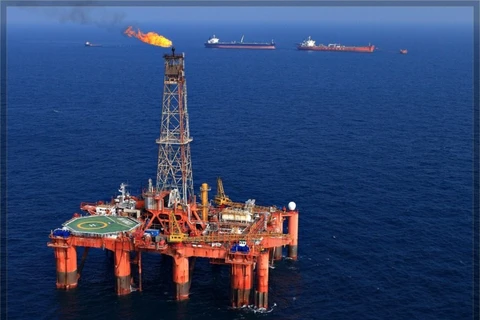
Illustrative image (Source: VNA)
 The group's General Director Le Manh Hung noted that it forms the backbone in energy security, food security, economic security and national defence and security.
Ensuring energy security has been identified as a top goal of the national energy development strategy, as well as the foundation and premise for socio-economic development.
The group has stepped up the exploration and exploitation activities to increase petroleum reserves to ensure its stable supply for industrial production.
Speaking at the inauguration of Song Hau 1 Thermal Power Plant Project in Mai Dam town, Chau Thanh district, the Mekong Delta province of Hau Giang, on July 16, Prime Minister Pham Minh Chinh affirmed Petrovietnam’s important role in ensuring national energy security through thermal power projects.
The consolidated capacity of its power plants reaches 5,405 MW, making up some 10% of the national electricity output. The Dung Quat Oil Refinery operated by Binh Son Refining and Petrochemical JSC (BSR), a wholly-owned subsidiary of Petrovietnam, has met 30% of the national demand.
The group’s total oil output, both at home and abroad, has hit 441.5 million tonnes so far, and its gas output at 174.7 billion cubic metres.
Its crude oil exploitation reached 900,000 tonnes in July, exceeding the plan by 19%. This brings the total figure in the first seven months to 6.38 million tonnes, surpassing the plan by 22% and equal to 73% of the yearly target.
Petroleum processing has also provided essential products of high values for the national economy like chemicals, plastics and fertiliers.
It is running the two biggest fertilier factories – Phu My Fertilizer Plant in the southern province of Ba Ria-Vung Tau and Ca Mau Fertilizer Plant in the Mekong Delta province of Ca Mau, with a combined capacity of about 1.6 million tonnes, meeting more than 70% of the national need.
Over the past years, Petrovietnam has fulfilled its role as the country’s economic locomotive and a tool for the Government to regulate the macro economy. Its major products like petroleum, fertiliers, electricity and liquefied petroleum gas (LPG) have contributed to stabilising the market, ensuring energy security, food security and economic security.
The group contributed 83 trillion VND (3.52 billion USD) to the State budget in 2020, surpassing the set target by 1%. The value was 112.5 trillion VND last year, exceeding the target by 80% and up 36% year-on-year.
In the first seven months of this year, its budget contribution reached 79.6 trillion VND, a year-on-year rise of 47%.
Apart from economic contributions, Petrovietnam has also played a role in safeguarding national sovereignty through its offshore oil rigs.
It has closely coordinated with the Ministry of National Defence, the Ministry of Public Security and relevant agencies to assess investment projects and joint ventures.
At a recent working session with Petrovietnam representatives held in the central province of Quang Ngai, National Assembly Chairman Vuong Dinh Hue affirmed that Petrovietnam is one of the State-owned enterprises playing the most important role in the national economy.
Petrovietnam needs to work hard to accomplish targets set in the Vietnam Oil and Gas Industry Development Strategy until 2025 with a vision towards 2035, and concertedly implement the project on Petrovietnam restructuring, he said.
The top legislator noted that the NA Standing Committee has instructed relevant agencies to collect feedback on the draft Petroleum Law, which is expected to be approved by the legislature during its fourth session in October to create a legal framework for the development of the oil and gas industry in the new situation./.
Apart from economic contributions, Petrovietnam has also played a role in safeguarding national sovereignty through its offshore oil rigs.
It has closely coordinated with the Ministry of National Defence, the Ministry of Public Security and relevant agencies to assess investment projects and joint ventures.
At a recent working session with Petrovietnam representatives held in the central province of Quang Ngai, National Assembly Chairman Vuong Dinh Hue affirmed that Petrovietnam is one of the State-owned enterprises playing the most important role in the national economy.
Petrovietnam needs to work hard to accomplish targets set in the Vietnam Oil and Gas Industry Development Strategy until 2025 with a vision towards 2035, and concertedly implement the project on Petrovietnam restructuring, he said.
The top legislator noted that the NA Standing Committee has instructed relevant agencies to collect feedback on the draft Petroleum Law, which is expected to be approved by the legislature during its fourth session in October to create a legal framework for the development of the oil and gas industry in the new situation./.
VNA