PM orders strict actions against officials hindering Long Thanh airport project

Prime Minister Pham Minh Chinh on December 3 stressed that individuals and organisations that have caused obstructions or delays to the Long Thanh International Airport project in the southern province of Dong Nai must be strictly handled in accordance with legal regulations.

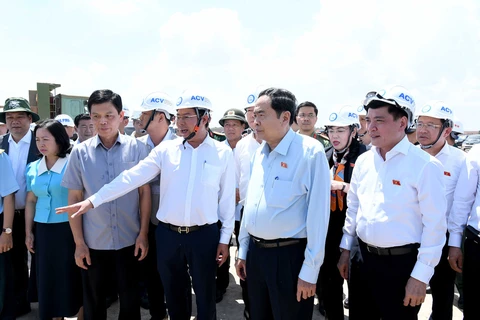
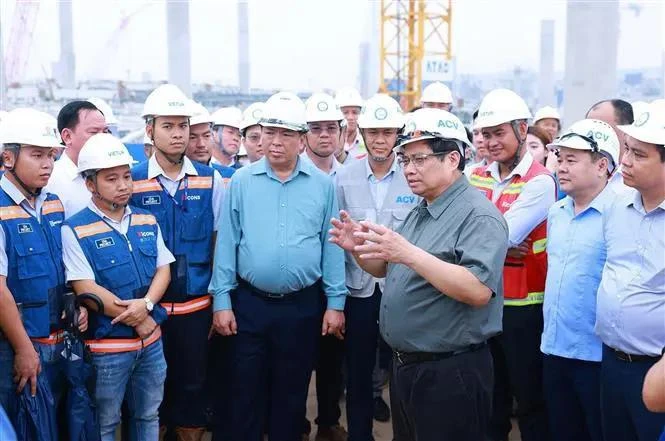
Prime Minister Pham Minh Chinh and representatives of project units at the construction site. (Photo: VNA)

Dong Nai (VNA) – Prime Minister Pham Minh Chinh on December 3 stressed that individuals and organisations that have caused obstructions or delays to the Long Thanh International Airport project in the southern province of Dong Nai must be strictly handled in accordance with legal regulations.

After visiting the construction site on the day, the PM had a working session with representatives of ministries, agencies, the project management board, consultants, localities, and other stakeholders, during which he noted that the project, the largest of its kind in Vietnam so far, holds significant importance to the socio-economic development of the Southeast region and the entire country.

The PM acknowledged the progress on the project but pointed out several lingering issues, such as the land clearance rate remaining stagnant at 98.92% since September 2024, and others regarding investment policy approval and investor selection for component projects.

Underscoring the target of basically completing the project by December 31, 2025, Chinh said current construction efforts remain fragmented and uncoordinated, making it hard to meet the deadline. Given this, he urged maximising all available resources, including equipment, machinery, manpower, and materials, to ensure the concerted implementation of all components, while intensifying supervisions and inspections to ensure project quality and safety, as well as residents’ lives.

Chinh demanded the immediate reassignment or suspension of the officials found responsible for obstructions and delays in the implementation. Notably, the sluggishness in constructing the headquarters for animal and plant quarantine agencies and ground service facilities must be explained and a report on this should be submitted to the PM in this month.

The leader suggested the engagement of local subcontractors and forces like police, military, and youth in project items.

Alongside the implementation of the first phase, work should begin immediately on runway 2, striving for breaking ground in early 2025. At the same time, steps should be taken to finalise the design, allocate the funding, and select contractors to begin the second as soon as the first is completed in 2025.

The PM assigned Deputy PM Tran Hong Ha to directly oversee the project, conducting monthly meetings to monitor and expedite its progress. Minister of Transport Tran Hong Minh and relevant agencies will coordinate in performing tasks.

Regarding transportation infrastructure projects, he basically agreed with the proposals from the agencies and urged accelerating the progress of ongoing projects.

The Ministry of Transport was tasked with working on alternative transportation solutions, such as a metro, subway, or high-speed rail, to connect Long Thanh and Tan Son Nhat airport in Ho Chi Minh City, with a route plan and investment feasibility to be done by the first quarter of 2025.

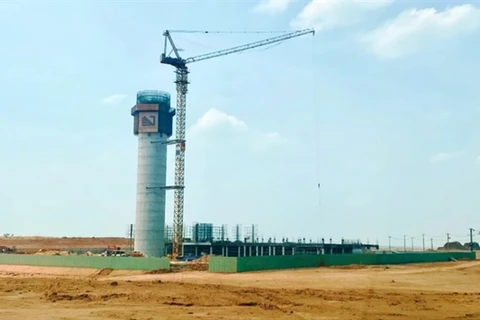
The Long Thanh airport project has total investment of more than 16 billion USD and is implemented in three phases. The first phase, with an investment of over 5.4 billion USD, features one runway and one passenger terminal, and is capable of serving 25 million passengers and 1.2 million tonnes of cargo per year. It is expected to be put into use in 2026./.
VNA

See more

Politburo member and State President Luong Cuong delivers the opening remarks of the 14th National Party Congress on January 20, 2026 (Photo: VNA)

Opening remarks of 14th National Party Congress

The 14th National Party Congress is a momentous event for the country and a historic turning point toward the 100th founding anniversary of the Party (February 3, 1930-2030), concentrating the will, aspirations, and determination of our entire Party, people, and armed forces with the spirit of strategic self-reliance, self-strengthening, and confidence to advance strongly into a new era, for a peaceful, independent, democratic, prosperous, civilised, and happy Vietnam steadily progressing towards socialism.

Deputy Minister of Foreign Affairs Le Thi Thu Hang and non-resident foreign ambassadors at the meeting (Photo: VNA)

Deputy FM hosts non-resident ambassadors attending 14th National Party Congress

The 14th National Party Congress is a milestone in Vietnam’s development, as it not only reviews and assesses 40 years of Doi moi (Renewal), but also sets out orientations for national development in the 2026–2030 period, with a vision to 2045, through strong and right decisions to guide the country into a new era of development.

Professor Zhu Chenming, Honorary Director of the South Asia–Southeast Asia Research Institute under the Yunnan Academy of Social Sciences. (Photo: VNA)

14th National Party Congress: Bridging the past and the future

Zhu said the congress plays a crucial role in shaping Vietnam’s future development, as it discusses development pathways and policy directions to achieve targets set for 2030 and realise the long-term vision towards 2045. The convening of the congress is truly a major political event in the life of the Vietnamese people.

Dr. Kin Phea, Director of the International Relations Institute under the Royal Academy of Cambodia (RAC). (Photo: VNA)

Vietnam’s progress tied to Communist Party of Vietnam leadership: Cambodian expert

In his presentation at a recent seminar hosted by the Vietnamese Embassy in Cambodia, Dr. Kin Phea described the the 14th National Congress of the CPV as a historic and momentous event, saying that with three strategic breakthroughs and six key tasks set for the country’s new revolutionary period, the Congress is seen as a landmark ushering in a new era - the era of the nation’s rise.

General Secretary of the Communist Party of India (CPI) Doraisamy Raja (Photo: VNA)

Vietnam advances creative, adaptive socialism for new era: Indian Communist Party leader

The 14th National Congress of the CPV comes at a critical juncture, as the world faces profound upheavals marked by escalating geopolitical tensions, economic instability, and deep structural crises within global capitalism. Against this backdrop, Vietnam’s decision to pursue a new growth model driven by science, innovation, and digital transformation reflects strategic vision, confidence, and a clear grasp of the requirements of the times.

Deputy Minister of Foreign Affairs Le Thi Thu Hang welcomes journalists and updates them on a number of achievements Vietnam has attained in recent years. (Photo: Ministry of Foreign Affairs)

Deputy Foreign Minister meets int’l journalists covering 14th National Party Congress

Deputy Minister of Foreign Affairs Le Thi Thu Hang said the 14th Congress holds special historical significance, marking a major turning point in the country’s development, as it not only reviews and assesses the achievements of 40 years of Doi moi (Renewal), but also defines goals, vision, and major policy decisions to lead Vietnam into a new era of development.