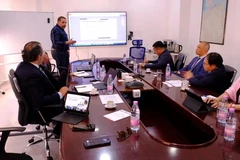
Prime Minister Nguyen Xuan Phuc speaks at the conference (Photo: VNA)
 Dong Nai (VNA) – The southern key economic zone needs to set forth a long-term vision and outline mechanisms and policies to develop in a strong and sustainable manner, maintaining its locomotive role in national socio-economic development, Prime Minister Nguyen Xuan Phuc has said.
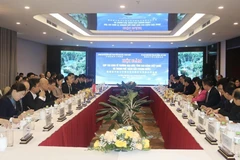
Speaking at a conference on the development of the southern key economic zone in Bien Hoa city, Dong Nai province, on May 6, the leader pointed out signs of sluggish growth in the region.
The PM therefore urged localities in the zone – namely Ho Chi Minh City and Dong Nai, Ba Ria-Vung Tau, Binh Duong, Tay Ninh, Binh Phuoc, Long An, and Tien Giang provinces – to continue with innovations and make the best use of the Fourth Industrial Revolution.
Apart from bettering coordination between ministries, agencies, and localities, the zone should restructure its economy and reform its growth model, while paying attention to high-quality personnel training, sustainable agricultural and rural development, and raising added values, the PM said.
The southern key economic zone is the only one among the nation’s four key economic zones to hold advantages in industrial and service development, he said, noting that the region has favourable conditions to develop science, high technologies, information-technology, and high-quality human resources.
This is the most dynamic zone in the country, with breakthroughs in development and the building of e-government and public administrative centres, the leader said.
On this occasion, PM Phuc asked Dong Nai and the Ministry of Transport to focus on land clearance and resettlement work in preparation for the construction of Long Thanh International Airport in 2020.
Minister of Planning and Investment Nguyen Chi Dung reported that the zone’s gross regional domestic product (GRDP) reached about 2.51 quadrillion VND (107.93 billion USD) in 2018, making up 45.42 percent of the national GDP and 50.9 percent of the total GRDP of the four key economic zones.
HCM City alone contributed around 49.5 percent of the zone’s GRDP and nearly 23 percent of the national GDP.
Last year, the zone’s per capita income was 5,474 USD, 2.12 times higher than the national average, according to the official.
At the conference, Minister of Transport Nguyen Van The spoke of bottlenecks in regional transport, especially the overload at Tan Son Nhat airport, asynchronous connectivity between the Cai Mep-Thi Vai seaport and roads, and the outdated North-South railway.
Dr. Tran Du Lich, former head of the HCM City Institute of Economics, said that transport connectivity and urban development are the most important issues in the region’s economic development.
He suggested the zone integrate special policies, assemble plans for the transport system, and set up research groups.
Speaking at the conference, Deputy Prime Minister Vuong Dinh Hue urged localities to regularly review prioritised projects in service of regional socio-economic development.
Meanwhile, Chairman of the HCM City People’s Committee Nguyen Thanh Phong proposed that the Government soon issue a decree on economic drivers and approve the mechanism on regional and inter-regional coordination. –VNA
Speaking at a conference on the development of the southern key economic zone in Bien Hoa city, Dong Nai province, on May 6, the leader pointed out signs of sluggish growth in the region.
The PM therefore urged localities in the zone – namely Ho Chi Minh City and Dong Nai, Ba Ria-Vung Tau, Binh Duong, Tay Ninh, Binh Phuoc, Long An, and Tien Giang provinces – to continue with innovations and make the best use of the Fourth Industrial Revolution.
Apart from bettering coordination between ministries, agencies, and localities, the zone should restructure its economy and reform its growth model, while paying attention to high-quality personnel training, sustainable agricultural and rural development, and raising added values, the PM said.
The southern key economic zone is the only one among the nation’s four key economic zones to hold advantages in industrial and service development, he said, noting that the region has favourable conditions to develop science, high technologies, information-technology, and high-quality human resources.
This is the most dynamic zone in the country, with breakthroughs in development and the building of e-government and public administrative centres, the leader said.
On this occasion, PM Phuc asked Dong Nai and the Ministry of Transport to focus on land clearance and resettlement work in preparation for the construction of Long Thanh International Airport in 2020.
Minister of Planning and Investment Nguyen Chi Dung reported that the zone’s gross regional domestic product (GRDP) reached about 2.51 quadrillion VND (107.93 billion USD) in 2018, making up 45.42 percent of the national GDP and 50.9 percent of the total GRDP of the four key economic zones.
HCM City alone contributed around 49.5 percent of the zone’s GRDP and nearly 23 percent of the national GDP.
Last year, the zone’s per capita income was 5,474 USD, 2.12 times higher than the national average, according to the official.
At the conference, Minister of Transport Nguyen Van The spoke of bottlenecks in regional transport, especially the overload at Tan Son Nhat airport, asynchronous connectivity between the Cai Mep-Thi Vai seaport and roads, and the outdated North-South railway.
Dr. Tran Du Lich, former head of the HCM City Institute of Economics, said that transport connectivity and urban development are the most important issues in the region’s economic development.
He suggested the zone integrate special policies, assemble plans for the transport system, and set up research groups.
Speaking at the conference, Deputy Prime Minister Vuong Dinh Hue urged localities to regularly review prioritised projects in service of regional socio-economic development.
Meanwhile, Chairman of the HCM City People’s Committee Nguyen Thanh Phong proposed that the Government soon issue a decree on economic drivers and approve the mechanism on regional and inter-regional coordination. –VNA
VNA