Poor, near-poor households to receive housing support

Poor and near-poor households in poor districts nationwide will get financial assistance for housing from August 15 under a circular guiding the implementation of housing support under the National Target Programme on Sustainable Poverty Reduction in the 2021-2025 period.
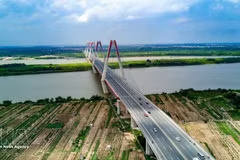
Poor, near-poor households to receive housing support ảnh 1Illustrative image. (Photo: hanoimoi.com.vn)
Hanoi (VNA) – Poor and near-poor households in poor districts nationwide will get financialassistance for housing from August 15 under a circular guiding the implementation ofhousing support under the National Target Programme on Sustainable PovertyReduction in the 2021-2025 period. 

Specifically, eligible families will beprovided with 40 million VND (1,700 USD) for building a new house or 20 millionVND for home repair.

Households eligible for the support policy are those certified as poor householdsaccording to multidimensional poverty standards in the 2021-2025 period or casesof splitting a household into two or more separate households but the periodfrom the time of splitting to the effective time of the decision must be atleast three years.

Housingsupport beneficiaries exclude families that have received assistance under thenational target programme on socio-economic development in ethnic minority-inhabited andmountainous areas in the 2021-2030 period as well as other programmes and projects.

In January, PermanentDeputy Prime Minister Pham Binh Minh signed a decision approving the nationaltarget programme on sustainable poverty reduction for the 2021-2025 period withtotal funding of at least 75 trillion VND.

The overall goal of the programme is to achieve multidimensional, inclusive andsustainable poverty reduction. It will be carried out nationwide, with thefocus on poor districts and extremely disadvantageous communes in lowland andcoastal areas and on islands. The programme targets to reduce thenationwide poverty rate by 1-1.5%, by over 3% among ethnic minority households,and by 4-4.5% in poor districts per year.

The number of poor and near-poor households is expected to halve by2025. All poor districts and communes with extremely difficult conditionsin the lowland, coastal areas and islands will receive assistance to invest inupgrading socio-economic infrastructure, serving locals’ livelihoods, andboosting production and trade, and providing basic social services.

The rate of children from poor and near-poor households going to school at theright age will reach 90%, according to the programme./.
VNA
See more

Students from the VACEO art class perform at the Cultural Fusion - Narellan festival. (Photo: VNA)

Vietnamese in Australia keep heritage alive

Vietnamese dance and traditional music classes organised by the Viet-Aus Culture Exchange Organisation (VACEO) have been held every Saturday afternoon in Bankstown, Sydney.

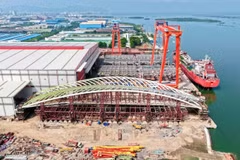
Load testing of the 3,400-tonne main arch structure and supporting frame of the Saigon River pedestrian bridge at the factory (Photo published by VNA)

Saigon River pedestrian bridge set to be joined on October 21

The assembly comprises a main bridge structure weighing about 1,400 tonnes and a specialised steel supporting frame weighing around 2,000 tonnes. During testing, about 30 self-propelled modular transporters were used to lift the assembly 40cm off the ground for technical inspections. Sensors and monitoring equipment recorded key parameters.

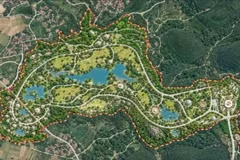
Ba Vi Safari Park. (Photo: Sun Group)

Hanoi breaks ground on 299-hectare safari park

Its key features will include animal habitats modelled on natural ecosystems, veterinary and research facilities, educational exhibitions and recreational areas. Green spaces and water bodies will cover about 81.8% of the site, providing ecological corridors and suitable habitats for wildlife.

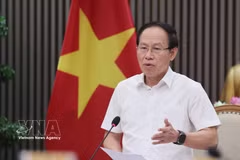
Deputy Prime Minister Le Tien Chau addresses the meeting (Photo: VNA)

Deputy PM asks for highest education quality, safety for students

Regarding the construction of inter-level boarding schools in border communes, all 108 schools under Phase 1 opened for the 2026-2027 academic year, with 40 having completed all construction items. Procedures for groundbreaking at 121 schools under Phase 2 across 17 provinces and cities have been completed, with all projects targeted for completion before August 30, 2027.

Hanoi leaders attend the inauguration and groundbreaking ceremonies for projects. (Photo: VNA)

Hanoi launches 18 key projects worth nearly 4.94 billion USD

The city announced 292 projects with a combined investment of 384.886 trillion VND (14.92 billion USD), including 18 key projects worth 127.46 trillion VND, focusing on transport, infrastructure, environmental protection and public services.

With just a smartphone, a wealth of knowledge spanning tens of thousands of books can now be accessed in an instant. (Photo: Thanh Nien Newspaper)

Vietnam’s first shared digital library platform launched

Vietnam Digital Library Joint Stock Company (ViLiB) launched its “Digital Knowledge Space – Shared Digital Library” platform in Ho Chi Minh City on October 8, enabling libraries, schools and organisations to connect and share digital resources, thereby broadening access to books and knowledge.

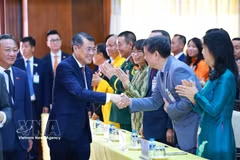
Prime Minister Le Minh Hung are welcomed by staff of the Vietnamese Embassy, representatives of Vietnamese agencies and associations, and members of the Vietnamese community in Laos on October 9, 2026. (Photo: VNA)

Vietnam–Laos special ties nurtured by the people: PM Le Minh Hung

Prime Minister Le Minh Hung urged Vietnamese people in Laos to maintain solidarity, integrate proactively, respect Lao laws and educate younger generations about their national roots and the special Vietnam–Laos relationship. Calling Laos a country undergoing dynamic transformation with emerging opportunities

Vietnamese Deputy Minister of Foreign Affairs Ngo Le Van and his Lao counterpart Anouparb Vongnorke co-chair the conference. (Photo: VNA)

Vietnam, Laos enhance legal awareness among border village leaders

The conference aimed to help officials, specialised forces and village leaders gain a better understanding of border-related policies and laws, thereby enhancing their sense of responsibility for managing and protecting the border line and markers, maintaining public order and promoting economic development in border areas.