Post-harvest loss reduction policies remain inefficient

Minister of Agriculture and Rural Development Cao Duc Phat has warned of slow implementation of Prime Minister’s Decision on support policies to reduce post-harvest losses in agriculture.
Post-harvest loss reduction policies remain inefficient ảnh 1Farmers in Kien Xuong district of Thai Binh province harvest rice (Photo: VNA)

Minister of Agriculture and Rural Development Cao Duc Phat has warned of slow implementation of Prime Minister’s Decision 68/2013/QD-TTg on support policies to reduce post-harvest losses in agriculture. 

Currently, the focus is only on low efficiency rice due to a lack of synchronous measures, he said during a conference to review the realisation of the decision in Hanoi on July 28.

The minister held that losses in rice production come from the process of selecting various varieties, harvest, transport, drying, husking, and storing. However, he said, attention has only been paid to the harvest and storage processes.

Decision 68/2013/QD-TTg was issued as part of the efforts to implement Resolution 48/NQ-CP on mechanisms and policies to reduce post-harvest losses of farm produce and aquatic products.

According to the Department of Agro-forestry-fishery Trade, Processing and Salt Industry, over the past five years, the resolution has helped speed up mechanisation in agricultural production, especially in rice cultivation and harvest, resulting in higher productivity.

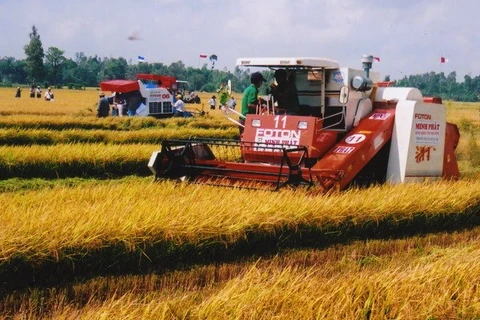
In the Mekong Delta region particularly, combine harvesters have been used in 76 percent of the total rice areas and up to 98 percent in some localities, helping reduce losses to 2 percent from 5-6 percent.

Thanks to support policies, farmers have purchased machines and equipment serving production, processing and storing of agro-forestry and fishery products.

However, deputy head of the department An Van Khanh said mechanisation growth has yet to meet requirements for post-harvest loss reduction. Although losses in rice post-harvest have been reduced, they remain high compared to those of vegetables, aquatic products and sugar.

He held that the number of farmers with access to the policies is low while interest rate of loans for farmers remains high at 8.55 percent per year.

A report by the State Bank of Vietnam showed that by July 30, total lending capital in the programme had reached 3.47 trillion VND (159 million USD) with outstanding loans of 2.44 trillion VND (111 million USD), up 32 percent from that of December 31 last year.

However, the report held that the figures remain low due to limitations in preferential policies for types of machines and equipment designed for post-harvest loss reduction.

Therefore, Minister Cao Duc Phat asked for regulation adjustments towards the expansion of types of agricultural machines and equipment receiving support.

He also pointed out that only 2 of 13 measures to realise Resolution 48 have been institutionalised with a lack of support for enterprises and research facilities in manufacturing and purchasing machines from other countries.

He also urged the Department of Agro-forestry-fishery Trade, Processing and Salt Industry to review the other 11 solutions and define responsibilities of relevant agencies in the slow implementation of the solutions.-VNA
VNA

See more

Visitors explore southern Vietnam's products (Photo: vNA)

Vietnam, Cambodia boost supply chain connectivity

Total two-way trade neared 10.1 billion USD in 2024, up 17.5% year-on-year and jumping to more than 11 billion USD in 2025. Vietnam’s key exports to Cambodia include apparel, iron and steel, petroleum, machinery and equipment, chemicals, and processed food. Its main imports are cashew nuts, rubber, farm produce, and industrial raw materials.

Cao Thanh Dinh, founder and CEO of ANPz Co., Ltd (All Nippon Partners) in Japan (Photo: VNA)

Resolution 68 boosts investor confidence in Vietnam’s long-term outlook

Cao Thanh Dinh, Founder and CEO of ANPz Co., Ltd (All Nippon Partners) in Japan, said that after one year of implementation, Resolution No. 68-NQ/TW of the Politburo on private sector development has sent a positive signal to investors by affirming the private sector as a key driver of sustainable and long-term development.

To promote the local lychee brand, expand consumption markets and enhance the fruit's value, Bac Ninh province is organising various trade promotion activities and experiential tourism programmes during the 2026 lychee season. (Photo: VNA)

Bac Ninh promotes lychee tourism with 36 model orchards

According to the Bac Ninh Centre for Culture and Tourism Promotion, the orchards must comply with VietGAP, GlobalGAP or organic production standards while offering suitable conditions for experiential tourism activities. They are also required to connect with nearby tourist attractions, craft villages and historical sites to form integrated tour routes.

Ha Long-Mong Cai Expressway (Illustrative photo: VNA)

Quang Ninh takes lead in public investment disbursement

As of May 13, the northern province had disbursed more than 5.64 trillion VND (213.9 million USD) in public investment capital, fulfilling 24.2% of its annual target and 54% of its disbursement target of 10.56 trillion VND for the year's first half.

Can Tho, Belarus eye trade, investment opportunities

Can Tho, Belarus eye trade, investment opportunities

Belarusian Consul General in Ho Chi Minh City Alexander Sidoruk said his working visit to Can Tho city exposes ample untapped economic potential. The Belarus side brings strengths in exporting fertilisers, crop protection chemicals, agricultural equipment, and high-tech products, and is interested in importing Vietnamese rice, coffee, rubber, seafood, and dairy products.

Retail fuel prices are simultaneously reduced from 15:00 on May 14. (Photo: VNA)

Retail fuel prices cut from May 14 afternoon

Retail fuel prices were simultaneously reduced from 15:00 on May 14 following the latest adjustment by the Ministry of Industry and Trade (MoIT) and and the Ministry of Finance, with E5RON92 biofuel recording the sharpest decline.

A chip assembly and testing plant of Intel at the Saigon Hi-Tech Park in Ho Chi Minh City (Photo: VNA)

Intel deepens engagement in Vietnam’s semiconductor industry

According to the Saigon Hi-Tech Park (SHTP) management board, Intel has relocated part of its production line from Costa Rica to SHTP as part of its global manufacturing restructuring strategy aimed at improving efficiency and competitiveness.

A customer purchase E10 biofuel petrol at a PVOIL filling station on Thai Thinh street in Hanoi. (Photo: VNA)

Biofuel ready for nationwide rollout

For biofuels, particularly E10, to develop successfully, stronger and more coordinated policies are needed, especially pricing mechanisms capable of creating a sufficiently attractive gap between E10 and mineral-based petrol, an expert has said.