President attends Policy Dialogue on Vietnam-US ties

President Truong Tan Sang has affirmed that the Vietnam-US ties has become an indispensable element in the concerted efforts of the international community to maintain peace, security and development.
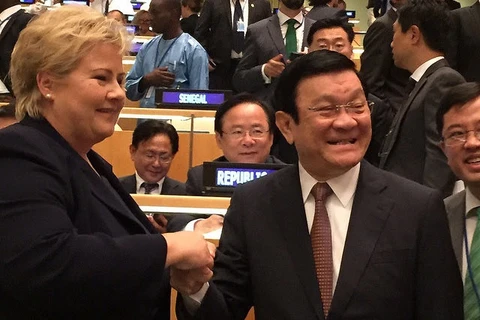
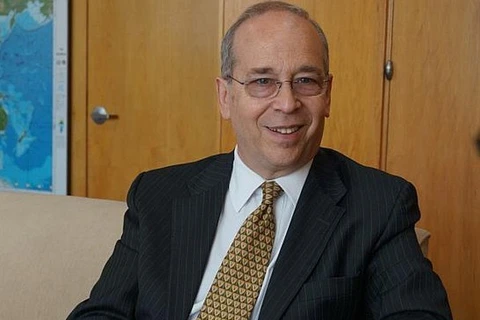
President attends Policy Dialogue on Vietnam-US ties ảnh 1President Truong Tan Sang (L) at the Policy Dialogue (Source: VNA)

President Truong Tan Sang has affirmed that the Vietnam-US ties has become an indispensable element in the concerted efforts of the international community to maintain peace, security and development in the region.

Addressing a Policy Dialogue on Vietnam-US relations hosted by the Asia Society in New York on September 28, he confirmed t hat it is the common interests that became the driving force for the two nations to overcome the war legacies and differences to become comprehensive partners today.

“From the first days of negotiation on normalization, we realized and agreed that apart from major interests in our bilateral relations, our two nations share a common desire and interest in maintaining peace, stability and cooperation for development in Asia Pacific. This common understanding reflects the strategic vision of our leaders resulting in political will needed for our two countries to overcome many obstacles, both internally and externally, to become friends and comprehensive partners like we are today. Our shared interests keep expanding as our cooperation and friendship grow at bilateral, regional and global levels. Today, we both have interests in maintaining peace, security and prosperity in the region. This also covers safety and security of navigation and overflight, law enforcement at sea, maritime environmental protection and dispute resolution through peaceful means on the basis of international law without the use or threat of force. What Viet Nam and the US hope for and work hard to attain is also the common aspiration of all peoples in the region,” the President told the audience, who included Asia Society’s President and CEO Josette Sheeran, Executive Vice President Tom Nagorski, former Australian Prime Minister Kevin Rudd and nearly 100 US government officials, scholars and business people.

The Vietnamese State leader made several proposals on how to take advantage of cooperation opportunities and deepen the bilateral comprehensive partnership efficiently and practically.

He said, “ Bilaterally, the two sides need to work closely to realize the Vietnam – US Joint Vision Statement between General Secretary Nguyen Phu Trong and President Obama in July this year, and the Joint Declaration on Comprehensive Partnership between President Obama and I in July 2013 with 9 pillars of cooperation. I want to emphasie that in this process, the most crucial point is trust building, especially political trust. This is the lesson that we have withdrawn from the past and from differences in ideology, political regime, culture and tradition between the two nations. Vietnam would and only would have such confidence in the US when the US strictly fulfills its commitments to respect the sovereignty, territorial integrity and political regime of Vietnam and take concrete actions to realise the statement “the US wishes for a Vietnam of prosperity, strength and independence”.

He continued, “On our part, we will continue with the comprehensive reform to build Vietnam into a country of “wealthy people, strong nation, just, democratic and advanced society”. In this regard, the fundamental rights and freedoms of the people are increasingly respected and ensured. We have taken efforts to build a law-governed state of the people, by the people and for the people. On external front, Vietnam will continue to pursue the foreign policy of independence, self-reliance, diversification and multilateralization of external relations and comprehensive international integration, being a reliable partner and a responsible member of the international community. Along that line, Vietnam will always attach importance to the relations with the US. We sincerely wish to join hands with the US in building a friendly and long-term partnership for the benefit of the two countries and for peace, stability and development in the region.”

The President added that at the regional level, Vietnam and the US need to cooperate closely with each other, and with other countries to contribute to maintaining peace, stability, cooperation and development in Asia – Pacific through a number of measures.

He elaborated that “First, regional mechanisms should be consolidated, including ARF, EAS, APEC, ADMM+, etc., to safeguard peace, security and development. In 2017, the APEC Summit will be hosted in Vietnam, and we hope that will be an opportunity for the two countries to cooperate and contribute to the goals of economic development in the region. Second, ASEAN’s centrality in regional mechanisms should be upheld. Third, we should exert efforts to conclude TPP negotiations, bringing about development opportunities for its members. Fourth, it is essential to ensure compliance with international law by regional countries, particularly the 1982 UNCLOS, on settlement of maritime disputes, to reinforce the effectiveness of the DOC and to achieve the COC. Fifth, we should cooperate closely within the framework of the Lower Mekong Initiative.”

At the global scale, the two countries need to intensify cooperation and coordination at major multilateral forums, particularly within the UN framework, President Sang said, adding that the two sides should focus on issues of mutual interests such as development cooperation, peace and security, non-proliferation and arms control, anti-terrorism, nuclear safety, cyber security, water security, climate change and sea-level rise.

At the dialogue, the President also answered queries of US officials, scholars and businesses on Vietnam’s development prospects, potential and opportunities of the country when joining TPP negotiations, and its relations with big nations.

The same day, the Vietnamese state leader visited the Associated Press (AP) headquarters in New York, and granted an interview on Vietnam’s socio-economic affairs and foreign policy, and the regional and international situations to the agency.

Also in New York, Deputy Prime Minister and Foreign Minister Pham Binh Minh had a meeting with Secretary-General of the Permanent Court of Arbitration Hugo Hans Siblesz, who pledged that the PCA will support Vietnam in training legal experts and officials.-VNA
VNA

See more

Vietnamese Ambassador to Venezuela Vu Trung My speaks at the event (Photo: VNA)

President Ho Chi Minh’s enduring legacy highlighted at Venezuela commemoration

Vice President of the United Socialist Party of Venezuela (PSUV) Jesús Faria expressed deep admiration for President Ho Chi Minh and Vietnam’s indomitable struggle for national independence. He described President Ho Chi Minh as an immortal symbol of 20th-century national liberation movements, whose legacy continues to inspire leftist parties, progressive movements, and peoples across Latin America, including Venezuela.

Standing Vice Chairman of the municipal People’s Committee Nguyen Loc Ha (R) and EU Ambassador to Vietnam Julien Guerrier. (Photo: VNA)

Ho Chi Minh City, EU boast ample room for sustainable development cooperation

Since the establishment of their diplomatic ties in 1990, Vietnam and the EU have deepened the bilateral ties into one of the bloc’s most dynamic and in-depth partnerships with an ASEAN member, Ha noted, adding that the relationship entered a new chapter in January when the President of European Council’s visit upgraded it to a Comprehensive Strategic Partnership.

Deputy Minister of Foreign Affairs Nguyen Minh Hang speaks at a discussion session on reforming multilateral systems and global governance, held on May 15, 2026, as part of the expanded BRICS Foreign Ministers’ Meeting in India. (Photo: VNA)

Vietnam ready to strengthen BRICS connection with Asia-Pacific

Hang called on countries to act responsibly in accordance with international law and the UN Charter; respect the independence, sovereignty and territorial integrity of states; refrain from using or threatening to use force; and settle disputes peacefully through dialogue. She also underscored the importance of ensuring security, safety and freedom of navigation through straits in line with international law, including the 1982 United Nations Convention on the Law of the Sea (UNCLOS).

Vietnamese Minister of Foreign Affairs Le Hoai Trung (centre), DPRK Vice Minister Pak of Foreign Affairs Sang Gil (left), and Vietnamese Ambassador to the DPRK Le Ba Vinh cut the ribbon to open the exhibition. (Photo: VNA)

Photo exhibition highlights Vietnam–DPRK relations

Visitors at the exhibition were moved by historical photographs dating back nearly 70 years, including images of the founding leader of the DPRK Kim Il Sung personally welcoming President Ho Chi Minh and a CPV delegation at Pyongyang’s Sunan International Airport during their visit to the DPRK from July 8–12, 1957. In return, the DPRK leader paid an official visit to Vietnam from November 27 to December 3, 1958.

Illustrative image (Photo: VNA)

Deputy PM calls for substantive assessment of two-tier local administration operations

Chairing a meeting on the development of a scheme to review the first-year operations of the political system’s organisational apparatus and the two-tier local administration model, Tra emphasised that the review must comprehensively and objectively evaluate the nationwide implementation of administrative unit restructuring and the operation of the new local administration model.

Vietnamese Ambassador to Russia Dang Minh Khoi (right) and First Deputy Chairman of the Federation Council of Russia Andrey Yatskin at their meeting in Moscow on May 14. (Photo: VNA)

Key directions for Vietnam–Russia cooperation in 2026

Vietnamese Ambassador to Russia Dang Minh Khoi had a working session with a delegation from the Russian Federation Council led by First Deputy Chairman Andrey Yatskin, in Moscow on May 14, discussing the expansion of multifaceted cooperation in 2026.

Officials from Cao Bang province of Vietnam and Baise city in the Guangxi Zhuang Autonomous Region of China hold talks on May 15. (Photo: VNA)

Cao Bang, China’s Baise city eye to boost all-around cooperation

Cao Bang province of Vietnam and Baise city in the Guangxi Zhuang Autonomous Region of China are exploring a “red tourism” route linking Pac Bo and Meng Mo (China) to promote revolutionary tradition education and strengthen bilateral friendship. They are also stepping up cooperation in human resource development through training exchanges and efforts to improve workforce quality.

Atsaphangthong Siphandone (centre), Secretary of the Vientiane Party Committee and Chairman of the municipal People’s Council, speaks at the working session. (Photo: VNA)

Ho Chi Minh City, Vientiane strengthen cooperation for 2026–2030

Under the MoU, the two sides will strengthen cooperation in politics – diplomacy, security – defence, legal and judicial affairs, economic affairs, education, culture and society, cooperation among mass organisations and socio-political organisations, and development support.

Politburo member and Minister of Foreign Affairs Le Hoai Trung (left) meets with Jo Yong Won, Chairman of the Standing Committee of the Supreme People's Assembly (SPA) and Chairman of the SPA of the Democratic People's Republic of Korea, in Pyongyang on May 15. (Photo: VNA)

Vietnam wishes to unceasingly develop ties with DPRK: Foreign Minister

Jo Yong Won, Chairman of the Standing Committee of the Supreme People's Assembly (SPA) and Chairman of the SPA of the Democratic People's Republic of Korea (DPRK), expressed confidence that under the leadership of the CPV, headed by General Secretary and President Lam, Vietnam will successfully achieve the strategic goals set forth at the 14th National Party Congress.

New Hungarian Prime Minister Peter Magyar (front) at the swearing-in ceremony of the new Government in Budapest on May 12, 2026. (Photo: Xinhua/VNA)

Congratulations to newly-elected Hungarian leaders

Prime Minister Le Minh Hung and National Assembly Chairman Tran Thanh Man on May 15 sent messages of congratulations to Magyar Péter and Forsthoffer Ágnes on their election as Prime Minister and Speaker of the National Assembly of Hungary, respectively.

Ministers and deputy ministers from BRICS member and partner countries pose for a group photo while attending the Expanded BRICS Foreign Ministers' Meeting in India on May 14. (Photo: VNA)

Vietnam proposes key cooperation orientations at BRICS Foreign Ministers' Meeting

Deputy Foreign Minister Nguyen Minh Hang shared Vietnam’s approach to building an independent and self-reliant economy linked to deep international integration, while proposing several key areas for enhanced cooperation between BRICS and partner countries at the Expanded BRICS Foreign Ministers' Meeting that opened on May 14 in India.

Dr Anatoly Sokolov from the Oriental Research Institute under the Russian Academy of Sciences in an interview with the Vietnam News Agency (VNA)'s correspondent in Russia. (Photo: VNA)

President Ho Chi Minh’s experience in Soviet Union crucial to Vietnam’s revolution: Russian scholar

The Russian scholar emphasised that Ho Chi Minh’s years in the Soviet Union provided him with essential experience in organising the masses and conducting political work for revolutionary purposes. This knowledge proved crucial when he later successfully led the August Revolution in 1945, establishing the Democratic Republic of Vietnam - the first people’s democratic state in Southeast Asia - without relying on external assistance. The victory became a powerful inspiration for national liberation movements across colonised countries worldwide, he added