Private economic sector – important driver of economy

Just one month after the founding of the Democratic Republic of Vietnam, on October 13, 1945, President Ho Chi Minh wrote a letter to the industrial and business circles in the country, in which he stressed their great role in the cause of national construction.
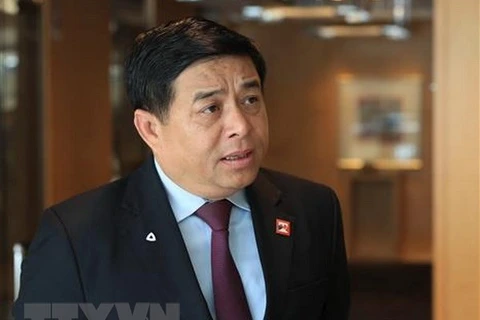
Private economic sector – important driver of economy ảnh 1President Ho Chi Minh’s thinking on the position and role of the industrial and business circles has been concretised in many guidelines and policies (Photo: VNA)

Hanoi (VNA) – Just one month after the founding of the Democratic Republicof Vietnam, on October 13, 1945, President Ho Chi Minh wrote a letter to the industrialand business circles in the country, in which he stressed their great role inthe cause of national construction.

“Whileother segments of the nation are working to regain full independence for thecountry, the industrial and business circles should work to build a firm andprosperous economy and finance. The Government, the people and I myself will doour best to help the industrial and business circles in this constructioncause,” he wrote.

Thereality over the past more than 70 years has proven that the President’s letterremains relevant nowadays, demonstrating his sound strategic guideline andinstruction to the cause of national construction, especially in the currenttrend of international economic integration.

PresidentHo Chi Minh’s thinking on the position and role of the industrial and businesscircles has been concretised in many guidelines and policies. The 6th National Party Congress (in December 1986) initiated the Doi Moi (Renewal) processwith a policy on multiple economic sectors.

Later,the 7th National Party Congress, and especially the second plenum ofthe 7th –tenure Party Central Committee attached importance to theprivate economic sector and encouraged its development without any limitationon scale and areas of operation in fields not banned by the law.

The8th National Party Congress (in July 1996) continued to affirm thelong-term consistency of the multi-sectoral economy policy based on equal treatmentfor all economic sectors.

Theissue of private economic sector was repeatedly tabled for discussion at the 9th,10th, 11th and 12th National Party Congressesin order to complete the policies and mechanisms facilitating the sector’sdevelopment in all economic branches and fields, and turning it into animportant driver of the national economy.

Theposition of the private economic sector has been affirmed not only in the Party’sdocuments but also in the 2013 Constitution. Article 51 of the constitutionstipulates: “1. The Vietnamese economy is a socialist-oriented marketeconomy with varied forms of ownership and economic sectors; the state economyplays the leading role. 

2. All economicsectors are important components of the national economy. Entities in differenteconomic sectors are equal before law and shall cooperate and compete with oneanother in accordance with law. 

3. The State shallencourage and create the conditions for businesspeople, enterprises or otherindividuals or organisations to carry out investment, production or businessactivities; and develop economic branches in a sustainable manner in order tocontribute to national construction. The legal property of individuals andorganisations engaged in investment, production or business activities isprotected by law and is not subjected to nationalisation.”

Continuing to affirm the position and role of the private economicsector in the socialist-oriented market economy, the 12th NationalParty Congress emphasized the completion of mechanisms and policies to encourageand facilitate the development of the private economic sector in most economicbranches and fields, turning it into an important driver of the economy.

The 12th National Party Congress’s viewpoint that the privateeconomic sector is an important driver of the national economy demonstrated abreakthrough in the Party’s perception compared to the previous period when theprivate economic sector was considered one of the drivers of the economy.

The fourth plenum of the 12th-tenure Party Central Committeecontinued to require boosting the private economic sector’s development in bothquantity and quality, so that it really becomes an important driving force ofthe economy.

The fifth plenum of the 12th-tenure Party Central Committeeissued thematic resolutions on perfecting institutions of thesocialist-oriented market economy, and on restructuring, reforming andenhancing the efficiency of State-owned enterprises. In particular, the plenumissued Resolution 10/NQ-TW (June 2017) on developing the private economicsector into an important driving force of the socialist-oriented market economy.The resolution is said to be a drastic step in renewing the thinking on the privateeconomic sector towards creating conditions for this sector to gain equalaccess to all opportunities and resources, particularly capital, land andnatural resources.

The resolution defined the general goal of developing the privateeconomic sector in a healthy, effective and sustainable manner, turning it intoan important driving force of the socialist-oriented market economy, helpingachieve rapid and sustainable socio-economic development, constant improve the people’sliving conditions, realize social progress and equity, ensure nationaldefence-security and early turn the country into an industrialised nation towardsmodernity.

To concretise the Party’s resolution, the Government issued Resolution98-NQ/CP on October 3, 2019 on a plan of actions to implement Resolution10/NQ-TW. The Government defined concrete tasks to develop the private economicsector, focusing on three major policies: creating favourable environment forthe private economic sector to develop; assisting the sector in innovation,technology modernization, human resources development and enhancement ofproductivity; and enhancing efficiency and effectiveness of State management.

Over the past two years, with the spirit of accompanying enterprises,the entire political system has taken drastic actions to support thedevelopment of the private economic sector. Many new mechanisms and policieshave been promulgated and solutions undertaken, all towards bettering the businessenvironment and timely tackling difficulties and obstacles for the developmentof the private economic sector in accordance with the Party’s guideline andpolicies./.
VNA

See more

The meeting between the Quang Ninh delegation and Siemens Mobility (Photo published by VNA)

Quang Ninh seeks cooperation, investment opportunities in Germany

A Quang Ninh official praised the collaboration between Siemens Mobility and VinSpeed in developing the Hanoi–Quang Ninh high-speed railway and expressed his hope that the project will pave the way for future cooperation between Siemens Mobility and Quang Ninh in modern railway development and workforce training.

At the 10th intersessional meeting of UNCITRAL Working Group III in Ninh Binh province on September 7, 2026. (Photo: VNA)

Vietnam hosts UNCITRAL Working Group III intersessional meeting for first time

By hosting the 10th UNCITRAL Working Group III intersessional meeting, Vietnam wishes to continue playing an active and proactive role in UNCITRAL in general and Working Group III in particular, working alongside the international community to strengthen cooperation, share experience and contribute to the development of the international legal framework.

An Asian customer with a Vietnamese coconut product served with straws (Photo: VNA)

Vietnam’s agricultural exports: Shifting from volume to value

Vietnam has about 1.2 million hectares of fruit-growing areas, producing around 13 million tonnes a year. Its fruits are exported to more than 60 countries, including major markets such as the US, the EU, Japan, the Republic of Korea and China. The country is also among the world’s leading exporters of rice, cashew nuts, pepper and coffee, with its products reaching more than 150 countries, including markets with stringent standards.

A modern production line at Hana Micron Vina Co. Ltd., a wholly invested by the Republic of Korea, in Van Trung Industrial Park in Bac Ninh province (Photo: VNA)

Northern Vietnam attracts 80.5% of new manufacturing FDI in first half

John Campbell, Director and Head of Industrial Services at Savills Vietnam, said investment in electronics and semiconductors continued to concentrate in northern localities, which have developed relatively complete manufacturing ecosystems encompassing industrial infrastructure, technical labour and supplier networks.

At the 2025 K–Vietnam Pop-up Festa in Dalat (K-Market Vietnam 2025) held in the central province of Lam Dong on November 8, 2025. The event features a series of cultural and trade exchange activities between Vietnam and the RoK, with more than 100 Lam Dong and Korean enterprises showcasing typical products from both sides. (Photo: VNA)

Vietnam, RoK seek to expand trade cooperation

The Ministry of Industry and Trade’s Department of Foreign Markets said Korean companies showed strong interest in Vietnam International Sourcing (VIS 2026), covering food, logistics, digital technology, mechanics, shipbuilding, seafood and distribution.

According to the Vietnam Coffee Cocoa Association (Vicofa), Vietnam exported nearly 1.7 million tonnes of coffee in the first eight months of 2026, earning more than 6 billion USD. (Photo: VNA)

Vietnamese coffee exports poised for strong finish toward year-end

According to the Vietnam Coffee Cocoa Association (Vicofa), Vietnam exported nearly 1.7 million tonnes of coffee in the first eight months, earning more than 6 billion USD. Export volume rose by over 10% year on year, while export value fell by 11.2% due to lower export prices.

Ciputra is one of the landmark projects representing the presence of Indonesian investment in Vietnam since the first wave of FDI. (Photo: bietthu-ciputra.vn)

Foreign capital seeks stronger foothold in Vietnam through M&A

Foreign investors carried out 1,815 capital contribution and share purchase transactions in Vietnam in the first seven months of 2026, with total capital exceeding 6.5 billion USD. While the number of transactions fell 8.4% year-on-year, their value rose 61.6%.

At the Vietnam- Myanmar Business Forum in Hanoi on September 6 (Photo: VNA)

Myanmar President pledges to facilitate Vietnamese investment

Myanmar calls for Vietnam's cooperation in digital infrastructure development, cybersecurity, digital transformation, public services, information technology, and digital payment systems, as well as in fostering an innovation-driven business environment.

Using AI to search and process legal information (Photo: VNA)

Legal profession reshaped in age of artificial intelligence

In Ho Chi Minh City, digital transformation in the legal profession is not simply about introducing more technology into professional practice. It must also create ways of working that ensure technology serves people, while lawyers retain control and responsibility for the quality of legal services. This is particularly important in a metropolis with a large-scale economy and diverse legal needs.

Activities in Chan May Bay, part of the Chan May–Lang Co Economic Zone in Hue city. (Photo: VNA)

Hue steps up investment drive in Chan May–Lang Co Economic Zone

Covering more than 27,000ha, the Chan May–Lang Co Economic Zone is emerging as a key economic, urban, industrial and eco-tourism centre in southeastern Hue, with functional areas dedicated to seaports, industry, non-tariff activities, urban development and tourism.

The Ministry of National Defence's inter-agency inspection team visits La Gi Fish Port in Phuoc Hoi ward, Lam Dong province. (Photo: VNA)

Lam Dong's IUU fishing prevention efforts inspected

According to the Lam Dong provincial IUU Fishing Prevention Steering Committee, all 8,177 fishing vessels measuring at least 6 metres in length have been registered and updated in the national fisheries database VNFishbase.

A member of Minh Quang Cooperative in Hung Yen province works on a farm. (Photo: VNA)

Vietnam aims to link half of farm cooperatives with enterprises by 2030

The Ministry of Agriculture and Environment will promote links between cooperatives, enterprises, science and technology organisations and other economic entities along with carrying out programmes to develop concentrated agricultural, forestry and fisheries raw material areas and enhance value chain production.

The night-time economy is increasingly seen as an important avenue for Vietnam’s tourism sector to extend visitors’ stays (Photo: VNA)

Revitalising growth momentum for night-time economy

The night-time economy has moved beyond being merely an add-on service to become a new growth driver for tourism. Night-time activities can “awaken” familiar heritage spaces and breathe new life into them. Art, light and music experiences after dark can create distinctive attractions while meeting the desire of middle- and high-end visitors to explore cultural depth.