Officials, Party members and residents of the northern province of Ninh Binh have made meaningful contributions of ideas to draft documents of the upcoming 14th National Party Congress, showing their trust in the Party’s leadership and hope that the congress will chart the right course for rapid, sustainable national development.
The Government and the Prime Minister accomplished all eight tasks assigned by the Constitution during the 2021–2026 tenure, said Permanent Deputy Prime Minister Nguyen Hoa Binh.
Prime Minister Pham Minh Chinh underscored the private sector’s role as a key driver of the socialist-oriented market economy during the plenary session of the Vietnam Private Economic Landscape Programme 2025 (ViPEL 2025) in Hanoi on October 10.
Vietnam’s stock market has emerged as a key driver of economic growth, serving as a channel for medium- and long-term capital mobilisation and a launchpad for businesses to enhance governance and financial transparency, said insiders.
Since the 1990s, Vietnam’s private sector has made notable gains, contributing over 30% of State revenues and spawning domestic firms with global and regional reach.
In the decades-long struggle against US imperialists, the Communist Party of Vietnam played a central role by formulating sound ideologies, adapting strategies over time, and uniting national and international forces. The Party’s leadership in ensuring political stability and social order has continued to provide Vietnam with the most crucial environment for socio-economic development, thereby sustaining the country’s standing in both regional and international arenas.
This message from Party General Secretary To Lam in his recent article "Developing private economic sector – A lever for a prosperous Vietnam" marks a turning point in the awareness about the private economic sector’s important role while touching on the aspiration for groundbreaking development of the country's most dynamic economic industry today.
General Secretary of the Communist Party of Vietnam (CPV) Central Committee To Lam has laid stress on the critical role of the CPV Central Committee’s Commission for Economic Affairs in perfecting institutions for the development of the socialist-oriented market economy as well as outlining pivotal guidelines for national economic management.
Prime Minister Pham Minh Chinh on September 9 chaired a meeting between permanent cabinet members and the standing board of the sub-committee for socio-economic affairs of the 14th National Party Congress, during which the participants gave opinions on a draft report evaluating the five-year implementation of the socio-economic development strategy for 2021-2030 and defining orientations and tasks for 2026-2030.
Implementing the renewal process, Vietnam has transitioned from a centrally planned economy to a market one, while actively and comprehensively integrating into the international community and promoting industrialisation and modernisation, according to insiders.
Cuba’s official media all published news about the passing of General Secretary of the Communist Party of Vietnam Nguyen Phu Trong, a great brother and friend of the Cuban people, on July 20, the first day the Latin American nation mourned the Vietnamese Party chief.
A conference held in Ha Long city in the northern province of Quang Ninh on April 15 provided a panorama of Vietnam’s private economic sector, and how to turn it into an important driving force of the socialist-oriented market economy.
Prime Minister Pham Minh Chinh requested developing the collective economy in terms of both quanity and quality while chairing a forum on the cooperative economy and cooperatives in Hanoi on February 2.
Prime Minister Pham Minh Chinh on January 11 asked the Ministry of Planning and Investment (MPI) to constantly keep a sharp and reformed mindset, quickly grasp issues emerging in Vietnam and the world, and have foresight to advise the Party, State, people, and businesses about major socio-economic policies.
Deputy Prime Minister Tran Hong Ha chaired a meeting in Hanoi on November 28 with ministries, agencies and localities to review the 10-year implementation of a Resolution on basic and comprehensive reform in education and training, meeting the requirements of industrialisation and modernisation in the context of the socialist-oriented market economy and global integration.
A conference to review the implementation of Resolution No.29-ND/TW of the 11th Party Central Committee on fundamental and comprehensive innovation in education and training, serving industrialisation and modernisation in the socialist-oriented market economy during international integration in the northern province of Tuyen Quang over the last ten years was held recently by the provincial Party C
Vietnam will focus on developing its private sector to turn it into an important driving force for the socialist-oriented market economy, contributing to rapid and sustainable socio-economic development and improving the economy's self-reliance.
Vietnam is striving to become a developed nation with high income, full and harmonious socialist-oriented market economy institutions, and a fair, democratic and civilised society by 2050, according to the National Master Plan for the 2021-2030 period with a vision to 2050.
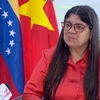
Venezuelan Ambassador to Vietnam Tatiana Pugh Moreno has expressed her impression on Vietnam’s incredible recovery post the COVID-19 pandemic, saying that it is thanks to strengths brought about by the socialist-oriented market economy.
The Communist Party of Vietnam (CPV) and the Lao People’s Revolutionary Party (LPRP) held their ninth theoretical workshop in Vientiane on December 8, focusing on experiences in handling economic and financial issues.