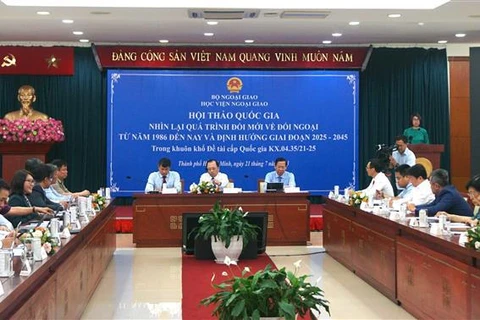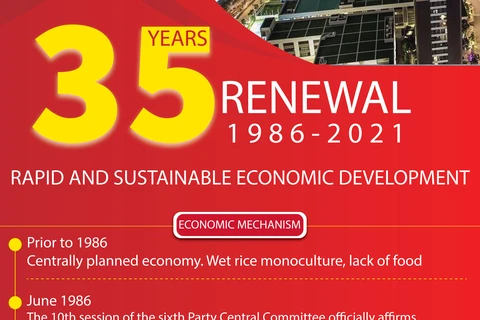
Hanoi (VNA) - Implementing the renewal process, Vietnam has transitioned from a centrally planned economy to a market one, while actively and comprehensively integrating into the international community and promoting industrialisation and modernisation, according to insiders.
Along with Vietnam's distinctive and innovative approach, carried out by Vietnamese people, the country has achieved significant accomplishments in implementing the renewal policy and developing a socialist-oriented market economy.
Efforts towards trade liberalisation, particularly since joining the World Trade Organisation (WTO) in 2007, have further enhanced Vietnam's role and position in the region and the world.
Major changes in renewal cause
One of the fundamental characteristics of a socialist-oriented market economy is the establishment of an economic system that fully harnesses the roles of various economic sectors. In Vietnam, throughout the years of renewal, the state-owned enterprises (SOEs), the collective economy, the cooperative economy, the private sector, and foreign-invested enterprises have all operated within the framework of a socialist-oriented market economy.

From initially recognising and allowing the existence and development of only two forms of ownership - state ownership and collective ownership, and two economic sectors - state and collective economies, there has now been an acknowledgment of the objective existence of various forms of ownership and multiple economic sectors. This represents a breakthrough in economic thinking, helping to unleash the production potential previously constrained under the centrally planned economy, thereby helping mobilise comprehensive resources for national development. In this context, the constructive role of the state, and the roles of SOEs as well as the private sector are seen as pillars that contribute to the economic strength of the nation.
All of these points have been affirmed by late Party General Secretary Nguyen Phu Trong in his article entitled “Some theoretical and practical issues on socialism and the path to socialism in Vietnam”.
At the recent third session of the steering committee tasked with reviewing theoretical and practical issues related to Vietnam's 40-year socialist-oriented Doi Moi (renewal) process, State President To Lam reiterated General Secretary Trong's statement: “Our country has never had such fortune, potential, position and international prestige as it does today.” Lam affirmed that this is indeed the result of 40 years of renewal.
The development of a socialist-oriented market economy has brought about noticeable, profound, and positive changes in Vietnam. The economy has grown, workforce been strengthened, poverty rapidly alleviated, and people's living standards improved with many social issues being addressed. Political and social stability has been maintained, national defence and security ensured, international relations and integration increasingly expanded, the nation's power and influence enhanced, and public confidence in the Party's leadership reinforced.
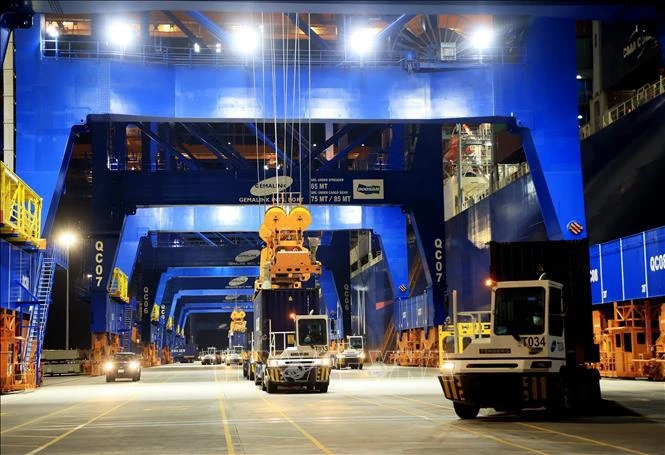
In addition, from being a close-door economy, Vietnam has become a globally integrated economy, emerging as a major global trade partner with total import-export turnover nearing 700 billion USD and foreign investment amounting to 23 billion USD last year, the highest ever for Vietnam, even amidst the contraction in major markets and disruptions in global supply chains, said Nguyen Xuan Thang, Politburo member, Director of the Ho Chi Minh National Academy of Politics (HCMA) and Chairman of the Central Theory Council.
From a country suffering from chronical food shortages, Vietnam today has not only ensured food security but also become one of the world's leading exporters of rice and many other agricultural products. The rapid development of industry and services demonstrates that the building of a socialist-oriented market economy is not only effective in economic terms but also addressing social issues well.
Thang also said that the economy's adaptability and resilience have increasingly improved. In recent times, with the principle of safe adaptation, Vietnam successfully navigated the negative impacts of the COVID-19 pandemic, receiving high praise from the international community and becoming a beacon of stability, recovery, and economic development amidst domestic and global difficulties.
The achievements and efforts in the renewal process have enabled Vietnam to effectively adapt and respond to external shocks, including the economic recovery after the pandemic and the capacity to address the impacts of tensions in the Middle East.
Many international organisations and experts continue to highly assess the results and outlook of Vietnam's economy. Paulo Medas, head of the International Monetary Fund (IMF)’s 2024 Article IV Mission to Vietnam, forecast the Vietnamese economy will continue to recover, and may expand by over 6% for the whole year.
Intensive and comprehensive integration
According to the Ministry of Industry and Trade, 72 countries have to date recognised Vietnam as a market economy, including major economies such as Canada, Australia, Japan, the Republic of Korea, and the UK. Additionally, Vietnam has also participated in 16 bilateral and multilateral free trade agreements with over 60 partners across all continents, including the Comprehensive and Progressive Agreement for Trans-Pacific Partnership (CPTPP), the EU-Vietnam Free Trade Agreement (EVFTA), and the Vietnam-US Bilateral Trade Agreement.
Vietnam has played and will continue to play a crucial role in trade relations with the US which is a significant and major market for Vietnam. According to the Ministry of Industry and Trade, from 2021 to 2023, the annual trade turnover between the two countries consistently exceeded 100 billion USD.
This indicates that the bilateral trade between Vietnam and the US has shown notable growth in trade volume, and it is expected to continue expanding in the coming years, especially after the two countries upgraded their diplomatic relationship to a comprehensive strategic partnership.
The upgrade of the bilateral relationship to a comprehensive strategic partnership on September 10, 2023, serves as a milestone, opening up numerous opportunities for bilateral economic, trade, and investment cooperation. It represents both an inevitable trend towards peace and cooperation, and sustainable development for both Vietnam and the US./.