Collective economy’s contribution to national economy remains modest: minister

The expansion of the collective economic sector is equivalent to just about half of the overall economic growth. This sector’s contribution to the GDP has also declined continually, from 8 percent in 2001 to 3.6 percent in 2020.
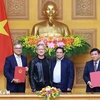
Collective economy’s contribution to national economy remains modest: minister ảnh 1Minister of Planning and Investment Nguyen Chi Dung addresses the national conference reviewing the 20-year implementation of Resolution No. 13/NQ-TW on the collective economy. (Photo: VietnamPlus)

Hanoi (VNA) – Some lessons could be learnt from the implementation of the Party Central Committee’s resolution on the collective economy and from the development of this sector over the last 20 years. The consensus in thought and theory is an important prerequisite for the consensus in action, thus creating conditions for resources to be focused on developing the collective economy.

Ministry of Planning and Investment Nguyen Chi Dung made the remark while addressing a national conference on February 15 that reviewed the 20-year implementation of Resolution No. 13/NQ-TW on the collective economy, issued at the fifth plenum of the 9th-tenure Party Central Committee on March 18, 2002, and the 10-year enforcement of the Law on Cooperatives.

Potential yet to be fully tapped

Minister Dung said Resolution No. 13 had made a precise assessment of the situation and identified the focal requirements, orientations, and tasks for the collective economy development. It has been carried out seriously, resulting in certain initial outcomes.

However, he noted, the collective economic sector has yet to have its potential and advantages fully tapped and yet to become a stepping stone for the national economy.

In particular, this sector’s growth remains modest, equivalent to about half of the overall economic expansion, while its contribution to the GDP has declined continually, dropping to 3.6 percent in 2020 from 8 percent in 2001, failing to achieve the targets set in the resolution.

He blamed that fact on unsystematic research activities on cooperatives and the lack of specialised research and training institutions, adding that knowledge about the collective economy hasn’t yet been included in the curricula of universities, colleges, and vocational schools as demanded in the resolution.

The resolution requested specialised bodies on the collective economy management be established so as to monitor and guide the implementation of related policies.

But such management agencies haven’t met requirements, Dung pointed out, their staff haven’t gained a good grasp of the sector or fulfilled their role in advising the Party and State regarding the collective economy management. In addition, legal regulations and policies on cooperatives still contain many barriers to the development of cooperatives.

Collective economy’s contribution to national economy remains modest: minister ảnh 2The national conference reviewing the 20-year implementation of Resolution No. 13/NQ-TW on the collective economy and the 10-year enforcement of the Law on Cooperatives. (Photo: VietnamPlus)

Developing collective economy - an inevitable trend

The official held that the collective economy, including cooperatives, must be developed in a truly dynamic, effective, and sustainable manner in the time ahead, adding the collective economy and cooperatives form an important part of the national economy.

To achieve the set targets, he said it is necessary to concurrently carry out some tasks and solutions, including raising the consensus on and awareness of the collective economy.

Developing the collective economy is an inevitable need and trend during the development of a socialist-oriented market economy. Therefore, the role of local Party committees and administrations, along with the coordination among ministries, sectors, and organisations, in this regard must be further enhanced, according to Dung.

Meanwhile, state agencies should press on with overhauling regulations, creating an optimal environment for the sector to grow, and consolidating the management apparatus, he said, recommending attention be paid to improving transparency and applying information technology to management.

Human is the decisive factor, so the management staff must have high professional capacity as well as political steadfastness so that the collective economy can develop healthily and in the right direction.

The minister urged thorough settlement of outstanding problems along with the formation of new-style collective economic models that match the Fourth Industrial Revolution and Vietnam’s international economic integration process.

The Vietnam Fatherland Front and organisations also need to have a thorough grasp of the Party’s viewpoints and guidelines, the State’s policies and laws to help boost the collective economy and effectively implement the resolution, he added./.
VNA

See more

Milk collection at a dairy farm operated by Vinamilk at the Nhon Tan concentrated farming zone in An Nhon Tay commune, Gia Lai province. (Photo: VNA)

Self-reliance in raw materials fuels Vietnam’s dairy growth

The strategy targets annual industry growth of 12-14% by 2030, with processed liquid milk output reaching 4.2 billion litres annually. Domestic fresh milk production is projected to hit 2.6 billion litres per year, meeting 60-65% of processing demand, while milk powder output is expected to reach 245,000 tonnes annually. Per capita milk consumption is targeted at 40 litres per year.

Quang Ninh gives in principle approval to first offshore wind power plant

Quang Ninh gives in principle approval to first offshore wind power plant

Covering an area of 11.95 ha of land and water surface, the project is expected to have a designed capacity of 50 MW and will be implemented in nearshore waters of the Co To special zone. Its key components include wind turbines, a substation, a 110kV transmission line, and related auxiliary facilities.

At Nghi Son 2 thermal power plant in Thanh Hoa province. (Photo: VNA)

Vietnam’s national standards strategy for 2026–2035 approved

The strategy envisions a modern, open standards system welded to international norms, serving as a piece of soft institutional infrastructure, a policy tool and a technical backbone for state governance. It also casts standards as an engine of innovation, digital transformation, green transition and sustainable development.

Shrimp harvesting in Ca Mau province (Photo: VNA)

Vietnamese shrimp sector seeks distinct path in global race

Nguyen Duy Hoa, Deputy Technical Director of Cargill Vietnam, said Vietnam cannot compete with Ecuador on costs nor match India in scale. Instead, the country should focus on value rather than volume or price competition, prioritising quality improvement, technology adoption and value-added products.

Wind turbine No. 3 at the V1-3 site of the Duyen Hai Wind Power Plant in Truong Long Hoa ward, Vinh Long province.(Photo: VNA)

Retail market seen driving double-digit growth

Domestic consumption is being regarded as one of the key drivers for sustaining economic growth. Following the Government’s Resolution No. 88/NQ-CP on promoting the domestic market and stimulating consumption, many retailers have accelerated the expansion of distribution systems, invested in technology and improved supply chains.

Cargo containers are handled at Gemalink International Port, Ho Chi Minh City. (Illustrative photo: VNA)

Government delegation for international economic, trade negotiations established

The delegation is tasked with assisting the Prime Minister in directing ministries, sectors and localities in the negotiation, signing, coordination of ratification and approval, as well as implementation of international treaties and agreements on economic and trade matters involving the Vietnamese State and Government.

Lotte Mart Vietnam is currently distributing around 900 private-label products manufactured in Vietnam under the retailer’s strict quality control. (Photo: VNA)

RoK steps up trade cooperation with Vietnam, Malaysia

The Korean business delegation's trip aims to provide Korean firms with information on import – export trends across the ASEAN region and developments in local markets, while also offering opportunities to explore the latest industry trends and technologies.

An overview of the Vietnam-China Green Industry Cooperation and Exchange Programme held in Beijing.(Photo: VNA)

Vietnam, China boost cooperation in green industry development

The Vietnamese Embassy in China, in coordination with the International Cooperation Centre under China’s National Development and Reform Commission (NDRC), on May 18 organised the Vietnam–China Green Industry Cooperation and Exchange Programme in Beijing to strengthen policy exchanges, share experience, and promote substantive cooperation in green industry amid climate change and growing global environmental challenges.

The infrastructure of Thang Long 3 Industrial Park in Phu Tho province is comprehensive and modern, creating favourable conditions for businesses and investors. (Photo: VNA)

Strong economic conglomerates drive domestic economic growth

In manufacturing, THACO has built one of Southeast Asia’s largest automobile and mechanical engineering ecosystems in Quang Nam province, while VinFast has become Vietnam’s first electric vehicle producer, establishing a major factory in Hai Phong, listing on Nasdaq and expanding into North America, Europe and Southeast Asia.

Producing garments for export to the EU market at TDT Thai Nguyen Garment Company. (Photo: VNA)

Vietnam’s textile industry draws high-tech FDI amid green, smart shift

With export turnover rising steadily in recent years and a target of 50 billion USD by 2026, Vietnam remains among the world’s top three textile exporters. Beyond its traditional appeal as a low-cost manufacturing base, the country is now positioning itself as a strategic hub for high-value and technology-driven investment.

An FDI enterprise invests in factory facilities at Chau Duc Industrial Park, a project spanning approximately 2,290 ha. (Photo: VNA)

Ho Chi Minh City targets next-generation, high-value FDI

The southern economic hub attracted nearly 3.3 billion USD in FDI during the first four months of 2026, marking a sharp year-on-year increase of 227.1%. The total included 539 newly licensed projects with registered capital exceeding 791.8 million USD and 58 existing projects adding 259.3 million USD in supplementary investment.

The VinFast electric vehicle charging station at the CT1 apartment complex of 103 Hospital in Hanoi. (Photo: VNA)

Vietnam accelerates drive to master EV technologies

By the end of 2025, Vietnam had established 28 standards and technical regulations related to charging stations, charging equipment and batteries. The legal framework is expected to be fully completed in the third quarter of 2026.

Duyen Hai Wind Power Plant in Truong Long Hoa ward, Vinh Long province. (Photo: VNA)

Energy sector seen as key pillar for Vietnam’s green, double-digit growth ambitions

Chairman of the Vietnam National Industry-Energy Group (Petrovietnam) Le Ngoc Son said Vietnam’s energy demand will continue rising sharply, creating enormous pressure on power generation investment. To sustain GDP growth of around 10%, electricity demand is expected to increase by 12-15% annually, requiring an additional 7,000-8,000 MW of new capacity each year.

A view of the Lien Chieu Container Port construction project in Da Nang city (Photo: VNA)

Logistics set to drive Vietnam’s rise in global supply chains

Amid sweeping restructuring in global trade driven by digitalisation, green transition and geopolitical shifts, logistics is no longer a back-end function. It is increasingly a decisive factor in economic performance, especially as Vietnam deepens integration into international supply chains. The challenge now extends beyond faster delivery to building a modern and interconnected logistics ecosystem capable of organising supply chains at a regional scale.