Productivity key to economic growth

Renovating the growth model and raising productivity are the key tasks to develop Vietnam’s economy, said Vu Tien Loc, chairman of the Vietnam Chamber of Commerce and Industry (VCCI).
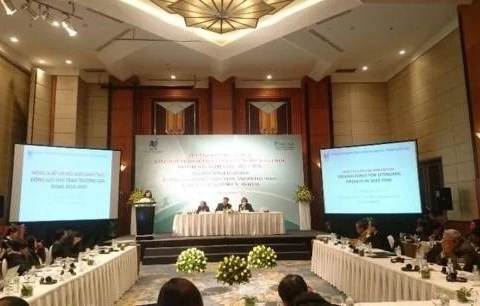
Productivity key to economic growth ảnh 1

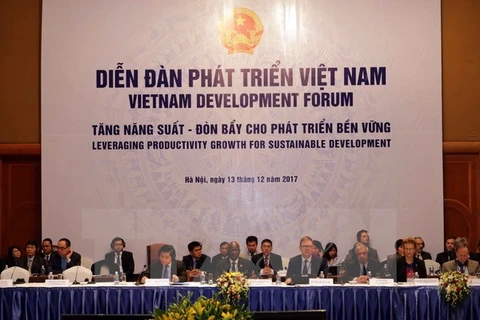
Participants discuss the key task of raising productivity to develop the national economy. (Photo: enternews.vn)


Hanoi (VNA) - Renovating thegrowth model and raising productivity are the key tasks to develop Vietnam’seconomy, said Vu Tien Loc, chairman of the Vietnam Chamber of Commerce andIndustry (VCCI), at a conference held in Hanoi on January 22.

The issue of competitiveness isincreasingly receiving the attention of governments in many nations. Raising Vietnam’scompetitiveness is also a major concern of the Vietnamese Party and the State.

A country’s overall competitiveness isaffected by many factors, such as the brands, market share, productivity,living standards and institutional quality.

However, according to VCCI’s researchresults, productivity is the core driving force that accounts for thedifference in competitiveness among nations, Loc said.

Despite the increase in its competitivenessranking, Vietnam’s labour productivity is only equal to 87 percent of that in Laos.In addition, exports of Vietnamese rice are lower than in Cambodia, althoughLao and Cambodia are two of the least developed countries in the region. Locsaid this situation is a big problem for Vietnam.

Because many criteria affect the economy’scompetitiveness, VCCI proposes to formulate an analytical framework for Vietnam’snational competitiveness, including economic factors and the strengths of thecountry. This framework will aim not to create a new ranking but to providesolutions to promote the productivity and competitiveness of Vietnam, Locadded.

VCCI’s chairman also proposed to conductresearch on six issues to improve productivity for the national economy.

The first issue is policy. Currently, theGovernment has taken drastic action on legal reform and reform ofadministrative procedures.

The second area is industrial policy andthe development of markets, which are ineffective and unable to lead theeconomy at the moment.

The third topic is the transfer of publicservices. Fourthly, the equitisation and restructuring of State-ownedenterprises (SOEs) is an important issue because SOEs are currently notoperating effectively.

Fifth, shifting agricultural activities toindustry and service is a key factor because 40 percent of GDP and 60 percentof labour is in agriculture. If the shift is to be successful, it is importantto promote productivity.

The sixth issue is the transformation ofindividual business households into enterprises, as this could help improvelabour productivity in the country.

Loc also suggested training programmes toenhance the management capacity of the leaders of small and micro businesses,as such enterprises will be the drivers of the world economy, especially withthe development of the Industrial Revolution 4.0.

The event was organised by VCCI incooperation with the Central Theoretical Council.- VNA
VNA
See more

Ahmad Haikal Hasan, Head of the Halal Product Assurance Organising Agency (BPJPH) of Indonesia, speaks at the seminar (Photo: VNA)

Indonesia ready to cooperate with Vietnam in halal sector

Ahmad Haikal Hasan, Head of the Halal Product Assurance Organising Agency (BPJPH) of Indonesia, described Vietnam as a “potential supplier” of halal products with the capacity to play a larger role in the market, particularly in the fast-moving consumer goods (FMCG) sector. He revealed a plan to visit Vietnam next week to discuss the country’s progress in the global halal industry.

Delegates perform the opening ceremony. (Photo: VNA)

Thailand Week 2026 opens in Hanoi

The event brings together more than 100 companies, including Thai enterprises and Vietnamese importers, across about 120 booths. It features a wide range of Thai products aligned with consumer trends in Vietnam, including food and beverages, health and beauty, mother-and-baby and pet products, fashion and jewellery, household goods and tourism services.

Illustrative image (Photo: VNA)

Vietnam remains Singapore’s third-largest seafood supplier in 2025

Data released by the Accounting and Corporate Regulatory Authority of Singapore (ACRA) show that Singapore spent 125.5 million SGD (97.7 million USD) importing seafood from Vietnam last year, up 10.7% year on year, accounting for 10.3% of the city-state’s total seafood import market.

Workers assemble mobile phone components at Diem Thuy Industrial Park in the northern province of Thai Nguyen. (Photo: VNA)

Electronics exports surpass 107 billion USD in 2025

With an export turnover of 107.75 billion USD in 2025, computers, electronic products and components not only maintained their position as Vietnam’s largest export by value, but also contributed more than half of the overall increase in the country’s export turnover in 2025.

Experts said that Vietnam’s economic outlook continues to be underpinned by stable foreign direct investment inflows and public investment, which is playing an important role in driving growth. (Photo: thoibaotaichinh.vn)

Foreign investors maintain strong confidence in Vietnam’s market

Looking ahead to 2026, prospects remain bright as manufacturing, economic growth and foreign investment in Vietnam are expected to stay robust, with the country forecast to post the highest growth rate in the region this year, according to Adam Sitkoff, Executive Director of the American Chamber of Commerce (AmCham) in Vietnam.

Toy production at a Hong Kong-invested factory (Photo: VNA)

Vietnam targets deeper market penetration in Hong Kong in 2026

Vietnam-Hong Kong trade hit 62.3 billion USD in the first 11 months of 2025, soaring 73.1% annually. Vietnamese exports to Hong Kong amounted to 36.8 billion USD, a 90.6% hike, ranking fourth among Hong Kong’s import sources, while imports from Hong Kong stood at 25.5 billion USD, up 52.9% and ranking third.

Vietnam’s start-up market enters restructuring phase

Vietnam’s start-up market enters restructuring phase

In 2026, venture capital inflows into Vietnam’s start-up ecosystem are expected to recover gradually, though in a more selective manner. VinVentures forecasts that capital will focus on start-ups that have survived the rigorous screening of 2024–2025, possess clear business models, strong commercialisation capacity, and the ability to generate real cash flows.