Profits shrink for hydropower sector but rise for thermal plants

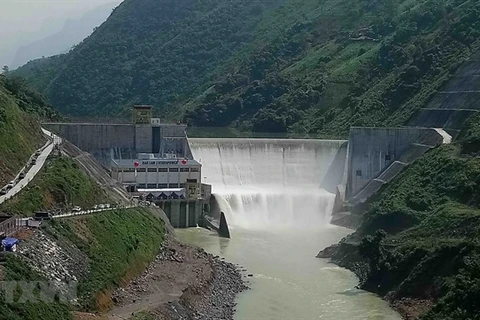
Hydropower plants have seen poor business performance in the first quarter of 2019, which could give coal-powered and gas-powered thermo-electric plants more opportunities to produce electricity.
Profits shrink for hydropower sector but rise for thermal plants ảnh 1An overview of the Pha Lai Thermal Power Co Ltd in the northern province of Hai Duong. (Photo: vietnambiz.vn)

Hanoi (VNS/VNA) -
Hydropower plants have seen poorbusiness performance in the first quarter of 2019, which could give coal-poweredand gas-powered thermo-electric plants more opportunities to produceelectricity.

To ensure demand is met, the country's largest power group VietnamElectricity (EVN) will need to mobilise more power from these plants and alsofrom some solar projects that are expected to be operational in 2019.

At the end of the first quarter, the profits of most hydropowerbusinesses slumped. Sa San 4A Hydropower JSC saw profit drop by 60 percentto 8.7 billion VND (372,000 USD). The company attributed the low profit tounfavourable weather conditions which made the machines less stable.

Southern Hydropower JSC and Vinh Son-Song Hinh HydropowerJSC also reported profit reductions of more than 50 percent. Gia Lai HydropowerJSC and Song Vang Hydropower JSC saw profits fall by 34 percent and 43 percent,respectively.

Some other units in the hydropower segment recorded modestprofit growth including Nam Mu Hydropower JSC and Hydro Power JSC – PowerNo 3, up 3.3 and 4.4 percent, respectively.

The poor results could be due in part to the return of the ElNiño weather phenomenon to Vietnam at the end of 2018, which causedwidespread drought in the central region.

Over the last 10 years, there have rarely been threeconsecutive years of heavy rainfall. After lots of precipitation in 2017 andmost of 2018, rainfall is likely to be down this year, according to BaoViet Securities Co (BVSC). This would mean less power is generated byhydropower plants.

This provides an opportunity for thermal-power businessesas EVN faces the need to mobilise more power from other sources.

Some thermal power units enjoyed positive businessresults in the first quarter amid the hydropower downturn.

Pha Lai Thermal Power Co Ltd saw net profit increase by27 percent to reach 242.6 billion VND (10.42 million USD) thanks to animproved gross profit margin, up from 14.7 percent to 19.4 percent.

Ninh Binh Thermal Power reported a net profit riseof 21 percent. PetroVietnam Power Corporation, which owns many coal andgas thermal power plants, reported profit of nearly 916 billion VND (39.4million USD), up by 17 percent.

Electricity enterprises have also been focusing on solarpower and other sources of renewable energy.

In the first quarter of the year, Gia Lai ElectricityJSC recorded profit 16.8 percent higher than in Q1 2018. The openingof two solar power plants in the central province of Thua Thien-Hue and theCentral Highlands Province of Gia Lai contributed to the higher profit. Asmuch as 51 percent of the revenue came from solar power while the sharefrom hydropower decreased from 87 percent to 47 percent.

To encourage the development of renewable energy in Vietnam,Prime Minister Nguyen Xuan Phuc issued Decision 11/2017/QD-TTg on April 11,2017 about mechanisms to encourage solar power projects. It tookeffect on June 1, 2017 and will last until June 30, 2019.

For solar power projects connected to the national powergrid before June 30, 2019, Vietnam Electricity (EVN) will buy the entirepower output at 2,086 VND (9.35 US cents) per kWh for 20 years.

This means that if solar projects are not connected to thegrid before the June deadline, the purchasing price of electricity theygenerate could be lower and will not be fixed.

As a result, a series of businesses such as Sao Mai Group,Thanh Thanh Cong and Bamboo Capital have rushed tofinish solar projects to enjoy the preferential rate.-VNS/VNA

VNA
See more

Illustrative image (Photo: VNA)

Australia announces import conditions for Vietnamese pomelos

Australia’s formal publication provides an important legal basis, marking the completion of the review, assessment and agreement on technical requirements for fresh Vietnamese pomelos. This represents a significant step forward in market access, creating favourable conditions for relevant agencies, localities and businesses to prepare for export activities in the coming time.

Containers of fresh Vietnamese durian for export are subject to a full-chain traceability system. (Photo: VNA)

First “green lane” durian shipment exported to China

​Under the “green lane” process, quality control begins at the cultivation stage, including soil sampling and monitoring, and continues through harvesting and processing, with traceability labels attached to trees and applied to fruit at the time of picking. It also allows plant quarantine procedures and the issuance of certificates of origin (C/O) directly in the localities where the orchards are located.

Delegates at the Vietnam Expo 2026 (Photo: VNA)

Vietnam pushes for deeper auto supply chain ties with RoK

The RoK stood as Vietnam’s largest foreign investor with more than 95.2 billion USD in registered capital as of February 2026, or about 18% of all foreign cash flowing in, with thousands of active projects. In January-February alone, the RoK led the pack with nearly 2 billion USD in pledges, grabbing a whopping 32.7% of total registered capital and showing no signs of slowing down.

More than 600 tourism firms, 15 countries and territories, and 34 provinces and cities are promoting destinations and introducing tourism products at the fair (Photo: VNA)

Digital transformation key to elevating Vietnam’s tourism: official

Speaking at the opening of the Vietnam International Travel Mart (VITM) 2026 in Hanoi on April 10, Deputy Minister of Culture, Sports and Tourism Ho An Phong noted that despite challenges in 2025, Vietnam largely fulfilled its socio-economic development goals. Tourism remained a bright spot, recording 21.5 million foreign arrivals and 135.5 million domestic visitors, with total revenue exceeding 1 quadrillion VND (37.9 billion USD).

A drone sprays fertiliser over rice fields. (Photo: VNA)

Low-altitude economy emerges as new growth driver for Vietnam

The UAV technology is particularly effective in addressing challenges faced by ground infrastructure, especially in densely populated urban areas and remote regions. Smart aerial devices also enable real-time data collection, improving governance, decision-making and digital transformation across industries.

Passengers at Cat Bi Airport in Hai Phong city (Photo: VNA)

Aviation sector ensures fuel supply for April 30–May 1 peak

Aviation fuel suppliers are actively negotiating and diversifying supply sources both domestically and internationally, while strengthening coordination, storage and distribution capacity to meet immediate demand. These efforts aim to support airlines in optimising operations and maintaining stable flight schedules.

A session at the Vietnam–Australia Green Transition Forum 2026. (Photo: VNA)

Green transition offers opportunities for stronger Vietnam–Australia cooperation

Under the theme "Accelerating decarbonisation in agriculture and manufacturing – Unlocking trade and investment opportunities", the forum gathered nearly 200 researchers, experts and businesses involved in policy development, investment, research and innovation. Participants exchanged insights and explored ways to translate the cooperation potential between Vietnam and Australia into practical business opportunities.