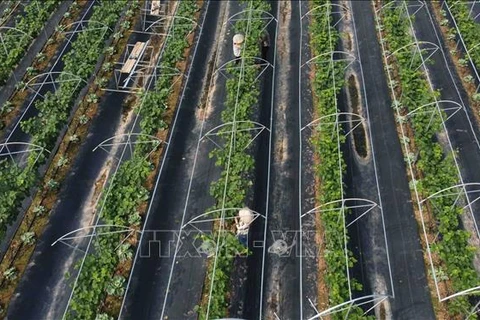
Clever watering system is applied in some grape orchards during dry season. (Photo: VNA)
 Hanoi (VNA) - Promoting public-private partnerships will help improve sustainability in the agricultural sector, according to experts speaking at an event in Hanoi on December 5.
The expansion of the public-private partnership (PPP) model was essential to developing a green, innovative and value-added sector, while attracting investment capital from the private sector, as well as domestic and foreign enterprises, said Minister of Agriculture and Rural Development Le Minh Hoan.
The minister was speaking at a conference on the Partnership for Sustainable Agriculture in Vietnam (PSAV) with the theme “Adding Green and Value to Agriculture”, held by the Ministry of Agriculture and Rural Development (MARD).
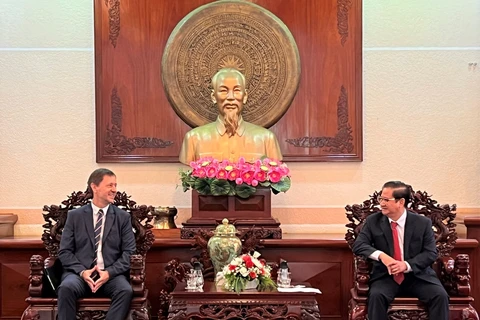
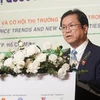
 At the Partnership for Sustainable Agriculture in Vietnam (PSAV) with the theme “Adding Green and Value to Agriculture” (Photo: VietnamPlus)
 The Minister of Agriculture and Rural Development said that the new global economy required agricultural products to be produced responsibly, especially in biodiversity conservation and emissions reduction to mitigate and adapt to the impacts of climate change.
In light of global challenges facing the agricultural sector, innovation in agriculture needed development, while innovative initiatives needed disseminating to improve productivity and sustainability in the food supply chain.
With the Strategy for Agriculture and Rural Development to 2030 and a vision to 2050, Vietnam advocates accelerating agricultural restructuring, transforming from a "production mindset" to an "economic mindset", towards the “green values” created from “green transformation, green consumption, green economy”.
Along with the goal of maintaining and improving productivity and output, agriculture needs to develop integrated "multi-value" to create added value based on effective exploitation of scientific and technological resources, innovation, digital transformation and organisation to connect agriculture with the processing industry, markets, exports, and global value chains.
At COP26, Vietnam also announced a national commitment to be carbon neutral by 2050. The agricultural sector plays an important role in laying the groundwork for this goal and ensuring a sustainable roadmap for national long-term food security.
Binu Jacob, General Director of Nestlé Vietnam Co., Ltd., said that reducing the use of pesticides while still improving productivity had made great strides, however, this was still not enough.
As food security becomes increasingly important, ensuring a sustainable food supply was an important priority, he said.
However, agriculture was also a factor that still accounted for a large proportion of emissions, said the general director.
To deal with these impacts, it was necessary for the participation of all parties, especially the public and private sectors, he added.
Nestlé Vietnam Co., Ltd. continued to co-operate with the MARD and partners to bring sustainable Vietnamese agriculture to reality, he added.
In addition, Nguyen Do Anh Tuan, Director of PSAV Secretariat, Director of International Co-operation Department, Ministry of Agriculture and Rural Development, signed a Memorandum of Understanding on co-operation with Grow Asia and Syngenta Vietnam.
This Memorandum of Understanding helps the parties strengthen co-operation in the form of a public-private partnership for Vietnam’s agriculture sector in line with the Strategy for Agriculture and Rural Development./.
| Deputy Prime Minister Le Van Thanh has signed a strategy for sustainable development of agriculture and rural areas for 2021 - 2030, with a vision to 2050. The general goal is to develop cash crop cultivation based on local advantages; oriented towards high productivity, quality, effectiveness, sustainability, and competitiveness; firmly guarantees national food security; and substantially helps with socio-economic stability, natural disaster and epidemic prevention and control, climate change response, and effective implementation of international commitments on greenhouse gas emission reduction. The strategy also aims to improve income, life quality, role, and stature of agricultural stakeholders; create non-agriculture jobs to help rural residents alleviate poverty and ensure equal development opportunities among the regions; comprehensively develop rural areas; uphold and bring into play the national cultural identity; and combine agricultural and rural economic development with new-style countryside building. Among the detailed targets for 2030, agriculture - forestry - fisheries are expected to achieve GDP growth of 2.5 - 3 percent, an increase of 5.5 - 6 percent in labour productivity, and exports rise of 5 - 6 percent each year on average. Besides, the strategy looks to raise rural residents’ income by 2.5 - 3 times from 2020, bring down the multidimensional household poverty rate by 1 - 1.5 percent annually, reduce the percentage of agricultural workers to less than 20 percent of the total workers in society, and increase the rate of trained agricultural workers to over 70 percent. It also targets at least 90 percent of the communes nationwide recognised as new-style rural areas, environmentally friendly agriculture adapted to climate change, and greenhouse gas emissions down 10 percent from 2020./. |