Quality inspections tightened for steel imports

Imported steel must be sampled for quality inspection to be eligible for customs clearance, according to the Joint Circular No 44 issued by two ministries involved in the process.
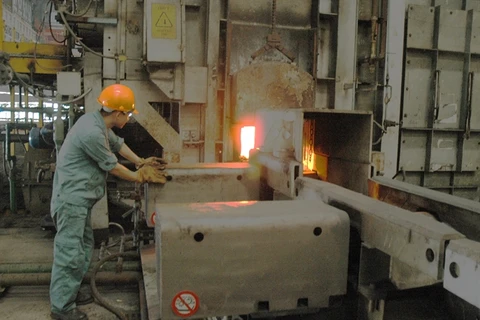
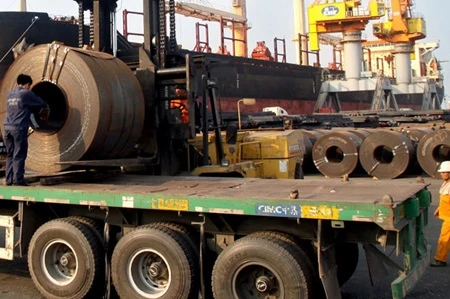
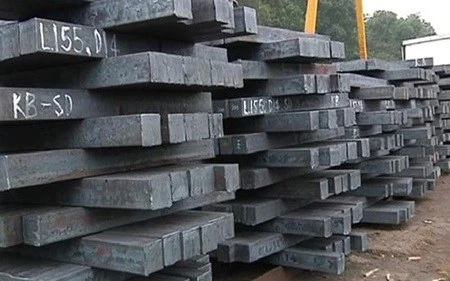
Quality inspections tightened for steel imports ảnh 1A worker loads imported steel in Hai Phong Port. (Source: VNA)

Hanoi (VNA) - Imported steel must be sampled for quality inspection to be eligible for customs clearance, according to the Joint Circular No 44 issued by two ministries involved in the process.

The circular, issued by the Ministry of Industry and Trade (MoIT) and the Ministry of Science and Technology (MoST), which officially took effect on March 21, was to tighten controls over steel imports and prevent low-quality products from entering Vietnam.

Specifically, before being imported into Vietnam, steel would be subject to inspection of metal components and mechanical and physical quality. Inspection results would serve as a basis for customs clearance. Based on the applied standards, the authorities will assess whether the consignments are eligible for import to Vietnam or not. Products with conformity announcements or certificates would be exempted from inspection.

Steel under the HS code of 7224.10.00 and 7224.90.00 is required to have a declaration paper on imported steel certified by the MoIT.

Meanwhile, domestic producers would be required to apply quality management systems to assure product quality.

In addition to regular inspections, quality inspection would be carried out when there is a claim or information in the press about poor-quality products.

For special kinds of steel, export-import companies must show a product list issued by the Department of Heavy Industry under the MoIT and a copy of an import certificate issued by the ministry.

The Customs Department and the departments of Industry and Trade and the departments of Science and Technology in major cities and provinces are responsible for handling imported steel products which failed to meet the nation’s quality standards. The departments must also keep an eye on imported steel and provide the number of products imported into the country.

Meanwhile, steel importers will be held accountable for the quality which must meet the country’s standards.

The finance ministry has sent a document to the HCM City’s Party Committee Secretary Dinh La Thang answering some issues relating to the one-shop customs mechanism and special check-ups on imported steel.

The ministry said there was a tariff difference in imported steel. Instances of trade fraud have been noticed in imports as businesses importing rolled steel, containing 0.0008 percent boron (Bo) element, were labelled as metal to enjoy a tax preferential of zero percent.

Upon the proposal from Vietnam Steel Association in October, exporters took advantage of the tariff levels to avail tax arrears. Around 1 million tonnes of steel billets was imported as metal into Vietnam.

The association asked for stricter check-ups and control on the steel billets imported from China.

The ministry affirmed that the tightening on imported steel has been a non-tariff solution to limit import of cheaper products.

The MoIT has issued a temporary decision against imported steel billets and coated steel to protect domestic companies after domestic manufacturers sent their appeal to the ministry, demanding the implementation of measures to prevent imported coated steel sheets from being sold at cheap prices in Vietnam, causing huge losses to local steel producers.

Steel billets and coated steel will be imposed a tariff of 23.3 percent and 14.2 percent, respectively, within 200 days.

The tariff will not be imposed on commodities originating from an underdeveloped country if total volume of its imported goods into Vietnam do not exceed 3 percent of the whole investigated goods.-VNA
VNA

See more

A Phu Tho civil servant guides a local how to switch from presumptive tax mechanism to tax sef-declaration. (Photo: VNA)

📝OP-ED: Vietnam’s tax reform: Fair play, not revenue squeeze

At a time when social media disinformation grows more sophisticated, transparency and public disclosure are the most potent counter to distortions. Facts, data and real-world results deliver the strongest rebuttal to attempts that twist reality and erode trust in tax administration reform.

Experts are expected to analyse opportunities for boosting exports and investment cooperation between Vietnam and South American countries at the coming seminar. (Illustrative photo: VNA)

Seminar on trade promotion in South American market to take place in Hanoi

A seminar on opportunities and challenges in developing the South American market will be held in Hanoi on May 28. It aims to provide updates on the economic outlook, market trends and import demand in South America, particularly in Argentina and Chile, amid continued fluctuations in global supply chains.

A view of the second Asia Agri Food International 2026 in Ho Chi Minh City on May 19 (Photo: VNA)

India pushes stronger agri-food cooperation with Vietnam

Experts noted that Vietnam has established itself as one of Southeast Asia’s leading agricultural product exporters, while India remains a major global supplier of agricultural and food products. By combining India’s production capacity and technological strengths with Vietnam’s dynamic processing and export ecosystem, the two countries can build more resilient supply chains in the region.

A panel discussion at the Meet Australia 2026 programme on May 19 (Photo: VNA)

Meet Australia 2026 promotes sustainable partnership opportunities

Meet Australia 2026 is not only a trade and investment promotion event but also a forum connecting trust, vision and action between Vietnam and Australia, as well as between national-level cooperation orientations and development needs of localities and businesses from both countries.

A customer purchases E10 biofuel petrol at a PVOIL station on Thai Thinh street in Hanoi. (Photo: VNA)

Authorities ordered to closely monitor rollout of E10 biofuel from June 1

According to the agency, the move is aimed at ensuring the effective and synchronised implementation of the E10 transition roadmap under Circular No. 50/2025/TT-BCT, issued by the Ministry of Industry and Trade on November 7, 2025. The plan seeks to avoid delays or supply disruptions that could affect the domestic fuel market.

Vietnamese Trade Counsellor in India Bui Trung Thuong speaks at the forum. (Photo: VNA)

Vietnam, India promote digital economy cooperation towards 25 bln USD trade target

With the strengthened Comprehensive Strategic Partnership, the rapid growth of digital economies in both countries and complementary strengths in technology, manufacturing and markets, Vietnam and India are well positioned to build a deeply connected digital trade ecosystem and enhance their participation in global value chains.

“Vietnam Economic Day” in St. Petersburg attracts crowds (Photo: VNA)

Vietnam showcases economic potential, investment opportunities in St. Petersburg

Vietnamese Ambassador to Russia Dang Minh Khoi stressed that economic cooperation between Vietnam and Russia is entering a new phase with promising opportunities for growth. He praised this year’s programme for combining a business roundtable, a youth business forum and traditional cultural and culinary activities, creating both an academic platform for dialogue and an opportunity to deepen mutual understanding between the two countries' people.

Lien Minh Agricultural Cooperative in Thai Nguyen province, provides stable employment for hundreds of its members. (Photo: VNA)

Private economic sector poised for breakthrough growth

More than a year after the Politburo's Resolution No. 68-NQ/TW on private sector development came into effect, expectations now extend beyond increasing the number of enterprises. The goal is to build a stronger business community with greater resilience, larger ambitions and the capacity to compete in global supply chains.

Milk collection at a dairy farm operated by Vinamilk at the Nhon Tan concentrated farming zone in An Nhon Tay commune, Gia Lai province. (Photo: VNA)

Self-reliance in raw materials fuels Vietnam’s dairy growth

The strategy targets annual industry growth of 12-14% by 2030, with processed liquid milk output reaching 4.2 billion litres annually. Domestic fresh milk production is projected to hit 2.6 billion litres per year, meeting 60-65% of processing demand, while milk powder output is expected to reach 245,000 tonnes annually. Per capita milk consumption is targeted at 40 litres per year.