Quality key for retail goods, hears seminar

Vietnamese producers of consumer goods should invest more in improving product quality and develop close links among themselves to negotiate better with foreign-owned retailers, a seminar heard.
Quality key for retail goods, hears seminar ảnh 1A consumer selects kids' clothing (Photo: VNA)

HCM City (VNA) - Vietnamese producers of consumer goods should invest more in improving product quality and develop close links among themselves to negotiate better with foreign-owned retailers, a seminar heard in HCM City on June 3.

Pham Ngoc Hung, deputy chairman of the HCM City Union of Business Associations (HUBA), said recently many producers have complained that they are struggling to sell to foreign-owned supermarkets mainly because the latter demand excessive discounts.

“Many businesses said they do not earn profits, even make losses from selling their products to supermarkets, but still strive to distribute their products through supermarket to sustain their brands.”

Local retailers have also suffered from the massive influx of foreign retailers, who now control more than 50 percent of the retail market, he said.

Le Thanh Lam, deputy general director of Saigon Food, said though the supermarket network has expanded rapidly in recent years, it remains inadequate compared to businesses’ need to take their products to the market.

“If one business wants to withdraw its products from a supermarket’s shelves, many others queue up to offer theirs, leading to a lopsided relationship.”

Local retailers ask producers for a discount of up to 10 percent, but it is 10-30 percent at foreign supermarkets, she said.

The lack of close links among local firms and their lack of experience in negotiating with foreign retailers always put them at a disadvantage to foreign supermarkets, she said.

Nguyen Phu Chien, general director of Bibica, said foreign supermarkets refuse to accept any changes in contracts with businesses, while the cost of transporting products are increasing relentlessly.

Chien, Lam and others at the seminar agreed that local producers should join hands to negotiate with foreign retailers.

Nguyen Ngoc Hoa, deputy chairman of the city Department of Industry and Trade, said producers should invest more in technology to make quality products with unique features that satisfy customers’ needs.

“If your products are good, customers will seek your products when they go to supermarkets, and no retailer will dare to refuse your products.”

He said businesses should be more dynamic in expanding both traditional and modern distribution networks, especially in rural areas.

Hung said that with its population of 90 million, of whom 60 percent are young consumers, and modern trade channels accounting for just for 25 percent of retail business, the country is an attractive retail market for foreign investors.

A lot of foreign retailers have entered the domestic market, he said.

Meanwhile, imports from countries like Japan, Malaysia, the Republic of Korea, and Thailand are becoming more and more popular, threatening local producers, he said.

If the country does not have a suitable strategy for the retail market, it would be dominated by foreign investors, he said.

Foreign retailers in Vietnam are obliged to go through an “economic needs test” before they are allowed to open a new store larger than 500 square meters. But in most places authorities have not implemented it well.

Hoa said the ENT would not slow down the entry of foreign retailers since they have other ways like mergers and acquisitions to penetrate the Vietnamese market.

The Government should intensify checks to crack down on unfair business practices in the retail market, quickly make a development scheme to develop the retail system, help local businesses find sites to expand their distribution networks and invest in improving their technologies, he said.-VNA

VNA

See more

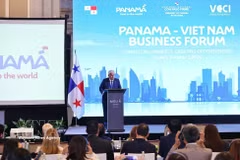
Panamanian President José Raúl Mulino speaks at the Panama-Vietnam Business Forum on October 7 in Hanoi. (Photo: VNA)

Vietnam, Panama seek to expand economic cooperation

In the presence of President Mulino, VCCI and the Chamber of Commerce, Industries and Agriculture of Panama signed a memorandum of understanding (MoU) to strengthen cooperation, enhance trade and investment promotion programmes, and support bilateral investment and trade.

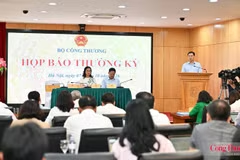
Ministry updates on Vietnam-US reciprocal trade agreement talks

Ministry updates on Vietnam-US reciprocal trade agreement talks

The US is one of Vietnam’s major trading partners and holds paramount importance to the country’s exports. The conclusion of the bilateral trade agreement will help establish a stable and balanced trade framework toward sustainable development and open up greater opportunities for cooperation between the two countries.

MICE visitors enjoy services at Song Be Golf Resort in Ho Chi Minh City. (Photo: VNA)

Ho Chi Minh City shifts MICE tourism from venues to experiences

Ho Chi Minh City boasts significant advantages for MICE tourism, with the central area offering strengths in finance, trade and services; Binh Duong in industry, exhibitions and business connectivity; and Ba Ria-Vung Tau and Con Dao in marine tourism, resorts, ecology and distinctive experiences.

National Brand products are on display at the Vietnam National Brand International Forum. (Photo: VNA)

Vietnam's national brand value jumps 45% to over 462 bln USD

Deputy Minister of Industry and Trade Luong Hoang Thai outlined Vietnam's National Brand Programme 's achievements, the role of business community and plans for brand development in a press interview ahead of the 10th Vietnam National Brand Product recognition ceremony on October 16.

Khanh Hoa province possesses significant advantages for renewable energy projects and new energy sectors. (Photo: VNA)

New value chains from two industrial – renewable energy centres

To implement the revised Power Development Plan VIII, the Ministry of Industry and Trade has proposed establishing two inter-regional renewable energy industrial and service centres in the northern and southern regions to develop the renewable energy sector and a complete value chain.

WB Senior Environmental Specialist and Task Team Leader Stephen Ling speaks at the working session (Photo; VNA)

Ca Mau, WB cooperate in sustainable fisheries development

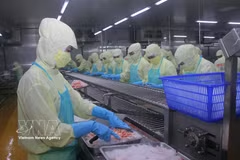
Scheduled to run from 2026 to 2029, the project aims to develop the local fisheries sector and deepen global integration, while adapting to climate change and protecting the environment through infrastructure upgrades, technological innovation, and better management and production capacity.

Vice President of the Vietnamese National Assembly Nguyen Hong Dien speaks at the forum. (Photo: Vietnam Trade Promotion Agency)

Tanzanian businesses seek greater cooperation, investment opportunities with Vietnam

Attending the forum during his working visit to Tanzania, Vice President of the National Assembly Nguyen Hong Dien said the two economies were highly complementary. Tanzania has strengths in natural resources, agriculture, energy, its domestic market and its strategic position in East Africa, while Vietnam has advantages in manufacturing and processing, high-tech agriculture, electronics, telecommunications and international trade.

The automatic ticketing system that uses electronic identification, authentication, biometric recognition and cashless payment for passengers on the Cat Linh-Ha Dong railway line in Hanoi. (Photo: VNA)

Cashless payments open gateway to financial inclusion

Cashless payments continued to grow rapidly in the first eight months of 2026. The number and value of cashless transactions rose 34.56% and 13.26% year-on-year, respectively, while online transactions increased 46.57% in number and 21.77% in value.