Quang Ngai province is located in the central coastal region, borderingKon Tum province and the Truong Son mountain range to the west, QuangNam to the north, Binh Dinh to the south and the East Sea to the east,with a coastline of more than 140km.
It boastsnumerous clean and beautiful beaches, including Khe Hai, Nho Na, AnCuong and Thanh Thuy in Binh Son district, My Khe in Quang Ngai city,Minh Tan in Mo Duc district and Sa Huynh in Duc Pho district.Additionally, visitors can explore the beautiful beaches of Ly Sonisland district, which comprises Lon (Big) island and Be (Small) island.
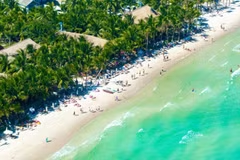
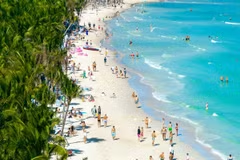
The first beach to explore is My Khe beachin Quang Ngai city. My Khe beach was previously part of Co Luy village,Tinh Khe commune in Son Tinh district, but was merged with the city ofQuang Ngai in April 2014. The beach lies approximately 14km northeast ofthe city centre and is reachable via Highway 24B and near Sa Kyport. It is approximately 16km from Dung Quat port and 3km from thehistorical site of My Son.
The beach is 7km longand ideal for swimming with its smooth sands and a slight slope. A deepgreen poplar forest grows next to the beach, which is close to the KinhRiver, renowned for its nipa palm forest. The forest was used as arevolutionary base for officers and guerilla fighters from Tinh Khecommune and Son Tinh district during wartime.
My Khe beach has become popular with tourists in recent years.
On the way to My Khe beach, tourists can visit the historical site ofMy Son, where photographs and relics of the US troops’ massacre of 504citizens are on display. They can also pay their respect to nationalhero Truong Dinh at his temple in Tinh Khe commune and to the formeracting President Huynh Thuc Khang at his tomb on Thien An mountain.
Quang Ngai province is now working on a master plan to develop the342ha My Khe tourism resort, which includes My Khe hotel, anentertainment complex and a camping site.
SaHuynh beach is located in Pho Thach and Pho Chau communes, in thesouthernmost part of the province, 60km south of Quang Ngai city. SaHuynh was previously called Sa Hoang, which means yellow sand, after thecolour of the beach. However, it was changed to Sa Huynh since the word“hoang” is associated with Lord Nguyen Hoang under the Nguyen dynasty.
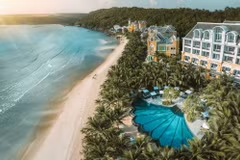
Sa Huynh is the most beautiful and cleanestbeach in Quang Ngai. It is famous for its salt fields, which areimportant not just for the province but the entire central region.
The beach is easy to access, since the Highway 1A passes it to thenorth and south. Many hotels have been built along the beach to provideaccommodation.
Sa Huynh beach is nearly 6km long with no reef. It is ideal for swimming and playing.
Sa Huynh beach borders Chau Me beach and cliffs in the south, and DaoKhi (Monkey Island) in the northeast, attracting a large number ofvisitors at the weekend and during holidays.
Additionally, Sa Huynh is renowned for its “mam nhum”, a sauce made fromsea urchins which was offered to the King as a specialty.
Visitors to Sa Huynh can try the local dishes Cua Huynh De or HoangDe (King crab). Each weighs 0.5-1kg and is bright red.
When visiting Sa Huynh, tourists should stop by the Sa Huynh CulturalMuseum to gain insight into the region’s ancient culture, one of thethree cradles of civilisation in Vietnam, alongside Dong Son and Ooc Eocultures. Therefore, a visit to the museum is an indispensable part ofany tour.
Khe Hai or Thien Dang beaches in BinhThanh commune, Binh Son district, 35km north of Quang Ngai city, bordersRang beach in Quang Nam province. Khe Hai beach boasts blue waters andsmooth white sands with vast casuarina groves. In the west is a mountainprojecting into the sea like a semi-circular bow embracing the coast.
From Khe Hai, visitors can go by boat to Hon Traand Hon Ong islets to explore caves and rock pools, collect shells, andfish.
Heading south to Binh Tri and Binh Chaucommunes, visitors arrive at Nho Na Bay and the untouched beaches ofThanh Thuy, Le Thuy and An Cuong, as well as Ba Lang An Cape and My HanBay with blue waters, soft waves and yellow sand banks. These arebeaches attractive to holiday makers.
Anotherchoice for tourists to Quang Nam province is that a voyage by takingspeedboat from Sa Ky port to Ly Son island. In the most famousdestination visitors can visit the beaches in the East (An Hai district)or go to Be island (An Binh commune), 3 nautical miles from Ly Sonisland, to explore pristine landscapes, clear blue waters, andmagnificent coral reefs.
Tourists can alsovisit a number of tourist attractions and historical sites, includingthe 300-year-old Hang pagoda, Duc pagoda with a 27-metre Bodhisattvastatue overlooking Be island, the impressive architecture of Lang Chanhtemple, and An Hai and An Vinh communal houses, where local residentshold the traditional “Le khao le the linh Hoang Sa” ceremony tocommemorate the sailors of the Hoang Sa (Paracel) flotilla.
Visitors can also climb up the national flagpole at Thoi Loi peak,from where they can enjoy a panoramic view over Ly Son island, itsvillages, and its local speciality onion and garlic fields. They canalso visit a dozen of ancient houses, and the Hoang Sa and Bac Haimonument and gallery in the district.
Inrecent years, in addition to visiting the famous beaches, tourists havecome to see the Dung Quat Oil Refinery, the first of its kind inVietnam.-VNA