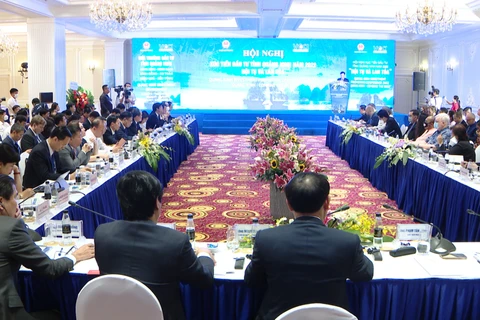
Quang Ninh works hard on sustainable import-export development (Photo: VNA)
 Their efforts have contributed to promoting production and business activities and sustainable socio-economic development.
Over the recent years, Quang Ninh has focused on promoting sustainable development and developing harmonious and modern infrastructure, especially in traffic. Local highways, seaports, and airport are connected with industrial parks, economic zones, and border gates.
These helps create an impetus for the locality to further develop strongly, enhance trade connection and regional linkages, speed up international integration, and trade facilitation.
The only locality having land and sea borders with China, Quang Ninh boasts a strength in promoting cross-border trade.
Efforts to maintain “safe green zone”
To promote this advantage, the locality has paid attention to concertedly implementing measures to prevent and control the COVID-19 pandemic and strengthen import-export activities, with a special focus on proactively building pandemic prevention plans and maintaining a "safe green zone" for border gates and border crossings.
All-level meetings and talks with authorities of Chinese localities have been maintained regularly, aiming to restore customs clearance and import-export activities between the two sides.
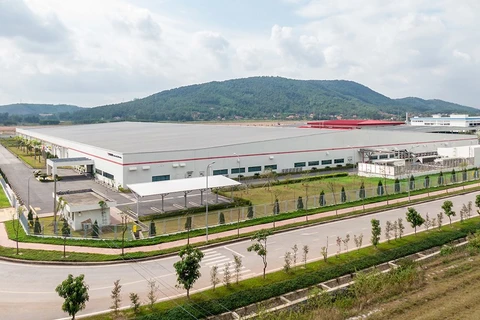
 Illustrative image (Photo: baoquangninh.com.vn)
 Notably, the import-export turnover through Mong Cai city, a border economic zone in Quang Ninh, topped 1.5 million USD in the first seven months of 2022. The city attracted 128 new import-export firms, lifting the total number of import-export enterprises to 455.
To further promote cross-border import and export activities, a series of measures have been enhanced, helping maintain revenues through import and export activities.
The locality has also created breakthroughs in administrative reform. It has also paid heed to strengthening inspection, supervision and internal discipline control among the sectors in handling import-export procedures in order to ensure administrative discipline and prevent troubles and negative phenomena.
Quang Ninh has also given priority to speeding up digital transformation, building database, developing e-government and modernising customs activities.
Thanks to safe adaptation solutions, import-export activities in Quang Ninh have recorded positive results, contributing to improving investment and business environment in the locality.
In the first seven months of this year, the export turnover of enterprises in Quang Ninh reached an estimated 1.5 million USD, up 8.23% year-on-year, equivalent to 109.11% of the plan set for the year. Meanwhile, local firms spent 1.7 million USD on imports in the period.
Quang Ninh’s enterprises have expanded their export markets to over 70 countries and territories around the world, including China, Japan, the Republic of Korea, ASEAN countries, the Middle East, and countries in the Eurasian Economic Union.
In the coming time, local authorities will take measures to soon resume import-export activities, focusing on enhancing state management and attracting investment to processing and manufacturing sectors and hi-tech and high-value products.
Local businesses will be assisted to take advantage of incentives brought about by trade deals that Vietnam has joined, including the Regional Comprehensive Economic Partnership (RCEP) Agreement, the Comprehensive and Progressive Agreement for Trans-Pacific Partnership (CPTPP), the EU – Vietnam Free Trade Agreement (EVFTA), and the UK – Vietnam FTA (UKVFTA).
Quang Ninh will also continue to lure more investment projects into industrial parks and clusters that have been planned; and effectively connect seaports, economic zones and industrial zones with border gates in order to maximise advantages for import-export activities.
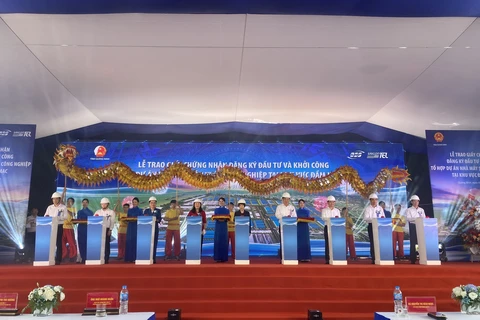
Local industrial parks and economic zones are accommodating 283 valid projects which are not invested by the State budget, including 90 foreign direct investment (FDI) ones worth over 4.3 billion USD and 193 domestic ones worth over 111.8 trillion VND (4.75 billion USD).
Vice Director of the provincial Department of Industry and Trade Le Hong Giang said his agency will continue to coordinate with relevant sectors to remove difficulties facing local import-export enterprises and update them on policies on management of border trade, thus facilitating import-export activities in the locality./.
In the first seven months of this year, the export turnover of enterprises in Quang Ninh reached an estimated 1.5 million USD, up 8.23% year-on-year, equivalent to 109.11% of the plan set for the year. Meanwhile, local firms spent 1.7 million USD on imports in the period.
Quang Ninh’s enterprises have expanded their export markets to over 70 countries and territories around the world, including China, Japan, the Republic of Korea, ASEAN countries, the Middle East, and countries in the Eurasian Economic Union.
In the coming time, local authorities will take measures to soon resume import-export activities, focusing on enhancing state management and attracting investment to processing and manufacturing sectors and hi-tech and high-value products.
Local businesses will be assisted to take advantage of incentives brought about by trade deals that Vietnam has joined, including the Regional Comprehensive Economic Partnership (RCEP) Agreement, the Comprehensive and Progressive Agreement for Trans-Pacific Partnership (CPTPP), the EU – Vietnam Free Trade Agreement (EVFTA), and the UK – Vietnam FTA (UKVFTA).
Quang Ninh will also continue to lure more investment projects into industrial parks and clusters that have been planned; and effectively connect seaports, economic zones and industrial zones with border gates in order to maximise advantages for import-export activities.
Local industrial parks and economic zones are accommodating 283 valid projects which are not invested by the State budget, including 90 foreign direct investment (FDI) ones worth over 4.3 billion USD and 193 domestic ones worth over 111.8 trillion VND (4.75 billion USD).
Vice Director of the provincial Department of Industry and Trade Le Hong Giang said his agency will continue to coordinate with relevant sectors to remove difficulties facing local import-export enterprises and update them on policies on management of border trade, thus facilitating import-export activities in the locality./.
VNA