Real estate market must be digitalised

Digital transformation is no longer an option but a mandatory trend for real estate enterprises to overcome difficulties and contribute to promoting the formation of a healthy, transparent, and sustainable market.
Real estate market must be digitalised ảnh 1A visitor experiencing Meey Map, a platform to search for real estate planning information. The real estate market needs more drastic measures to speed up the digitalisation process. (Photo: danviet.vn)
Hanoi (VNS/VNA) - Digital transformation is no longeran option but a mandatory trend for real estate enterprises to overcomedifficulties and contribute to promoting the formation of a healthy,transparent, and sustainable market.

Nguyen Manh Ha, Vice President of the Vietnam Real EstateAssociation, said the digital transformation in the real estate market of Vietnamwas taking place slowly because not all market participants were fully aware ofthe importance of technology.

In construction, for example, the digital transformation wasmainly used for energy saving and using green materials while the applicationof high technologies in development and operation remained modest, he said.

Hoang Mai Chung, Chairman of Meey Land Group, said that manytechnology platforms were developed and helped solve several social problems.However, the real estate market had not yet seen such technology platforms.

He said that property technology (protech) was born to meet thethree basic real estate market requirements, including providing information,supporting transactions and managing processes. However, protech in Vietnam hadnot managed to develop user data which was big enough.

Many protech companies were forced to close while others struggledto survive. However, the market was potential, Chung said, adding that thedifficulties mainly came from the human resources and technology capability.

"Technology is an inevitable trend in every industry, but thefact is that real estate is falling a step behind the common ground," hesaid.

Currently, each enterprise can only solve a narrow corner in thedigital transformation of the real estate market. Technology application wasstill mainly concentrated in the rental segment and had not been applied muchin other activities such as transactions and customer relations.

The slow application of technology in the real estate sector wouldresult in a slow increase in labour productivity and slow revenue growth, Chungsaid, adding that, like other economic sectors, the real estate market neededmore drastic measures to speed up the digitalisation process, including acomprehensive ecosystem and adequate capital resources to motivate enterprisesto make breakthroughs.

Nguyen Tran Linh, general director of SSLAND Joint Stock Company,said technologies were comprehensively changing the operation of real estatebusinesses.

Linh expected that the digital transformation would help improveproductivity, efficiency and value for customers with a more transparent market.

Bui Van Luat, General Director of Gold Star Holding AssetDevelopment Joint Stock Company, digital transformation was not an easy journeyfor businesses. He added that it would take time to change the habit and gainthe customers' confidence.

Real estate businesses must speed up the digital transformation ifthey do not want to lose the opportunities, he said, adding that attentionshould be paid to the training to enhance the knowledge and skills of staff aswell as analysis of customers' psychology to raise appropriate digitaltransformation strategy.

As technology developers in the real estate market struggled tofind new directions, digital transformation was not simply a technologicalrevolution. Still, it should also be a revolution in the institution.

The Government played a critical role in the success of digitaltransformation, said Bui Van Doanh, Director of the Vietnam Real EstateResearch Institute.

The digital transformation for the real estate market was a longprocess, Doanh said, adding that developing an ecosystem was vital for the realestate market to follow the sustainable development trend.

Nguyen Cong Chinh, who was in charge of digital transformation atDat Xanh Mien Bac Real Estate Service Joint Stock Company, said that there wasno definite template for digital transformation. Digital transformation was alengthy process, and the leaders' mindset was a significant factor.

Vo Tri Thanh, Director of the Institute of Branding andCompetition Strategy, highlighted four keys towards successful digitaltransformation in the real estate market.

The first was the vision and determination of leaders.

The second was that the digital transformation strategy must beclosely linked with the enterprises' business strategy.

Third, digital transformation should be started from the verybeginning and implemented in the best way.

Finally, enterprises should not try to handle everything alone.They should cooperate for mutual development, Thành stressed.

"Digital transformation in the real estate sector is not onlya purely technological revolution but also an institutional revolution to aimat positive and modern changes to improve policies, regulations and workingprocesses. The centre is the people, so whatever you do, you must create trustfor the market," Thanh said./.
VNA


See more

Smart products, chips and semiconductor materials are displayed at the launch ceremony of the national semiconductor chip prototyping support centre in Hanoi on June 26, 2026. (Photo: VNA)

Vietnam-Japan semiconductor cooperation paves the way for high-tech investment

The two countries are implementing five semiconductor research projects involving leading universities, with funding agreements signed in July. The projects cover three-dimensional integrated circuits, advanced semiconductor materials, secure artificial intelligence (AI) chips and power electronic components.

An exhibition space at the “Da Nang Semiconductors and High-Tech 2026” conference, organised by the Da Nang People’s Committee. (Illustrative photo: VNA)

Mobilising international resources to drive Vietnam’s technology development

Vietnam previously focused mainly on attracting overseas experts and intellectuals to work in the country over the long term, but this approach encountered certain difficulties. Cooperation methods are now shifting towards greater flexibility, allowing experts to take part in conferences and scientific seminars, contribute to addressing major national challenges, or participate in short-term training and research programmes.

Assoc. Prof. Dr. Dinh Ngoc Thach, lecturer and researcher in automatic control theory and robotics at the French National Conservatory of Arts and Crafts (Cnam) (Photo: VNA)

Core technologies key to sustainable robotics development in Vietnam: expert

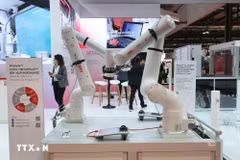
Vietnam should select suitable robotic platforms and gradually build capacity in core technologies, including sensing, environmental perception, positioning, state estimation, AI, control and system integration. This will help develop technologies applicable across multiple sectors while avoiding fragmented investment and dependence on a single product category.

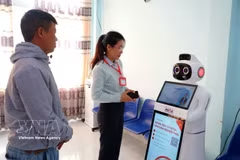
AI robots have become effective assistants in providing administrative services and reducing the workload of officials in Lam Dong province (Photo: VNA)

AI robots help streamline administrative procedures

Operating around the clock, AI robots provide information on administrative procedures, required documents, processing times, fees and relevant regulations, complementing assistance from civil servants.

High prospects for Vietnam-Italy cooperation in robotics industry

High prospects for Vietnam-Italy cooperation in robotics industry

Vietnam and Italy have highly complementary strengths in this robotics field. Italy has experience in machinery manufacturing, industrial robotics applications and an established business network, while Vietnam has a dynamic market, strong demand for production modernisation and a promising young engineering workforce.

General Secretary of the Communist Party of Vietnam (CPV) Central Committee and President To Lam and the foreign ambassadors at the meeting (Photo: VNA)

Top leader receives new foreign ambassadors

Vietnam wishes to step up cooperation with the countries in such areas as economy, trade and investment; cutting-edge science and technology applications, semiconductors, artificial intelligence, new materials, digital transformation, sustainable agriculture, the environment, energy and renewable energy, the marine economy and maritime transport.

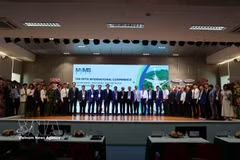
Delegates at the event (Photo: VNA)

Over 400 scientists attend international material conference

Discussions focus on six key areas, including advanced materials and their applications for sustainable development; environmentally friendly material processing technologies; product lifecycle engineering; sustainable machine design; low-carbon industries and the circular economy; and artificial intelligence and digital transformation in material and mechanical engineering.

Deputy Prime Minister Ho Quoc Dung (R) and Pierre Barnabé, Chief Operating Officer of French technology group Dassault Systèmes. (Photo: VNA)

Vietnam, France step up cooperation in AI, digital twin technology

At the meeting, the Deputy PM praised the group's contributions to promoting technology cooperation between Vietnam and France, particularly its collaboration with the Ministry of Finance and the National Innovation Centre (NIC) to establish a Centre of Excellence (CoE) for digital twins and artificial intelligence (AI) in Hanoi.

Rigobert Pinga Pinga, Acting Representative of OIF for Asia-Pacific speaks at the event. (Photo: VNA)

Franconomics 2026 explores human-centred technological transformation

Addressing the opening ceremony, Nguyen Anh Tuan, Rector of VNU-IS, said Franconomics was launched in 2019 as a multidisciplinary platform connecting scientists, policymakers, businesses and international organisations to discuss socio-economic issues relevant to Vietnam and the Francophone community.

A new technology exhibition area arranged within the framework of the International Research and Innovation Funders Forum in Hanoi (Photo: VNA)

Vietnam promotes int'l cooperation in science, technology and innovation

Science is opening up new opportunities in artificial intelligence, healthcare, semiconductors and clean energy, while challenges such as climate change, energy security and epidemics require international cooperation. Science, technology, innovation and digital transformation are central to Vietnam’s new growth model.

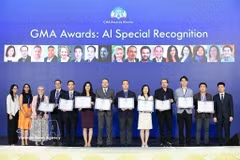
GMA Awards are presented to honour outstanding AI courses at the Global MOOC & Online Education Conference 2026. (Photo: VNA)

Responsible AI, teaching overhaul, global ties dominate GMC 2026

Panelists said AI can support knowledge delivery, information processing and personalised learning, but cannot replace teachers in building independent thinking, critical capacity, emotional intelligence and humanistic values. Universities therefore need to overhaul teaching, testing and assessment and redefine lecturers’ role in an AI-integrated environment.

An overview of the seminar (Photo: VNA)

Coordinated development of energy, AI and infrastructure needed for industrial growth

Vietnam is emerging as a regional bright spot for data infrastructure development, driven by growing demand for AI, cloud computing, 5G commercialisation and digital transformation. However, the country needs coordinated preparations, including green power supplies, international submarine cable connectivity and operational capabilities meeting global standards.