Real estate transactions fall on tightened property loan control

As the State Bank of Vietnam has tightened the control over real estate loans to ensure sustainable development of the market and safety of the banking sector, property transactions have fallen down in both Hanoi and Ho Chi Minh City in the first six months of the year, experts said at a recent meeting in Hanoi.
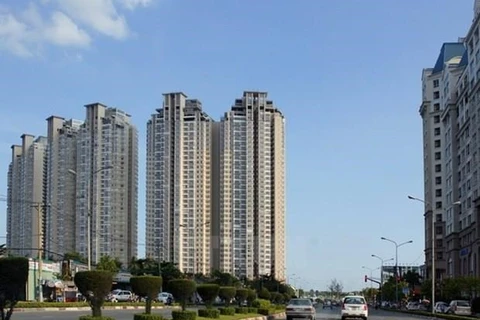
Real estate transactions fall on tightened property loan control ảnh 1A view of the Phu My Hung residential area in District 7, HCM City (Photo: VNA)

Hanoi (VNA) – As the State Bank of Vietnam has tightened the control overreal estate loans to ensure sustainable development of the market and safety ofthe banking sector, property transactions have fallen down in both Hanoi and HoChi Minh City in the first six months of the year, experts said at a recentmeeting in Hanoi.

Nearly13,000 housing products were rolled out in the Hanoi market duringJanuary-June, as compared to 8,899 in total number of successful transactions,accounting for 76.05 percent and 68.9 percent of the amount the same time lastyear, respectively.

However, the capital real estate market experienced a good absorption rate of68.6 percent, particularly housing products were sold fast in the secondquarter as the absorption rate reached 84.7 percent.

Ho Chi Minh City had the same trend when it saw a fall in both housing supplyand transactions in the period.

More than 10,700 products were put up for sale, making up only 39.1 percent ofthe amount offered in the first half of last year. Meanwhile, 8,560 units weretransacted, or 46.8 percent of the same time last year.

The country’s largest property market also had a high absorption rate of 79.9 percent.

Other localities with strong realty market development in recent time like DaNang city, Nha Trang city, Quang Ninh province, Binh Duong province and DongNai province also saw a fall in both supply and number of transactions. Thiswas due to the fact that local authorities and credit institutions enhancedsupervision over property projects and lending for them.

According to Nguyen Van Dinh, Chairman of the Vietnam Real Estate BrokerageAssociation, the real estate prices increased slightly in the six-month period;however, the market was still stable, and there was no sign of housing bubble.

Land lots were the most attractive product in the period, sold at stableprices, he said, adding that Hoa Binh, Yen Bai, Binh Dinh, Phu Yen and BinhThuan arouse as emerging markets.

Dinh said that housing supply and transactions in the second half will surgedramatically in the Hanoi market. Housing prices is predicted to fluctuateunder 5 percent, and the absorption rate will remain high as well.

The Ho Chi Minh City property market is promising during July-December as localpolicy is expected to boost both supply and transactions. Houses will be ongood sale, however, at high prices, he added.

Regaring the condotel segment, Dinh said most of the products offered in thefirst half were developed in 2018, and the absorption rate was only 25.02percent.

The segment has not been well developed due to limitation in new projects, alack in favourable policies, and shortage of customers’ confidence.

“Unfavourable policies and unsound management and operation of condodels havemade investors feel unsecured. Most of them have invested in projects developedby prestigious and experienced companies”, he said.-VNA
VNA
See more

Delegates perform the opening ceremony. (Photo: VNA)

Thailand Week 2026 opens in Hanoi

The event brings together more than 100 companies, including Thai enterprises and Vietnamese importers, across about 120 booths. It features a wide range of Thai products aligned with consumer trends in Vietnam, including food and beverages, health and beauty, mother-and-baby and pet products, fashion and jewellery, household goods and tourism services.

Illustrative image (Photo: VNA)

Vietnam remains Singapore’s third-largest seafood supplier in 2025

Data released by the Accounting and Corporate Regulatory Authority of Singapore (ACRA) show that Singapore spent 125.5 million SGD (97.7 million USD) importing seafood from Vietnam last year, up 10.7% year on year, accounting for 10.3% of the city-state’s total seafood import market.

Workers assemble mobile phone components at Diem Thuy Industrial Park in the northern province of Thai Nguyen. (Photo: VNA)

Electronics exports surpass 107 billion USD in 2025

With an export turnover of 107.75 billion USD in 2025, computers, electronic products and components not only maintained their position as Vietnam’s largest export by value, but also contributed more than half of the overall increase in the country’s export turnover in 2025.

Experts said that Vietnam’s economic outlook continues to be underpinned by stable foreign direct investment inflows and public investment, which is playing an important role in driving growth. (Photo: thoibaotaichinh.vn)

Foreign investors maintain strong confidence in Vietnam’s market

Looking ahead to 2026, prospects remain bright as manufacturing, economic growth and foreign investment in Vietnam are expected to stay robust, with the country forecast to post the highest growth rate in the region this year, according to Adam Sitkoff, Executive Director of the American Chamber of Commerce (AmCham) in Vietnam.

Toy production at a Hong Kong-invested factory (Photo: VNA)

Vietnam targets deeper market penetration in Hong Kong in 2026

Vietnam-Hong Kong trade hit 62.3 billion USD in the first 11 months of 2025, soaring 73.1% annually. Vietnamese exports to Hong Kong amounted to 36.8 billion USD, a 90.6% hike, ranking fourth among Hong Kong’s import sources, while imports from Hong Kong stood at 25.5 billion USD, up 52.9% and ranking third.

Vietnam’s start-up market enters restructuring phase

Vietnam’s start-up market enters restructuring phase

In 2026, venture capital inflows into Vietnam’s start-up ecosystem are expected to recover gradually, though in a more selective manner. VinVentures forecasts that capital will focus on start-ups that have survived the rigorous screening of 2024–2025, possess clear business models, strong commercialisation capacity, and the ability to generate real cash flows.