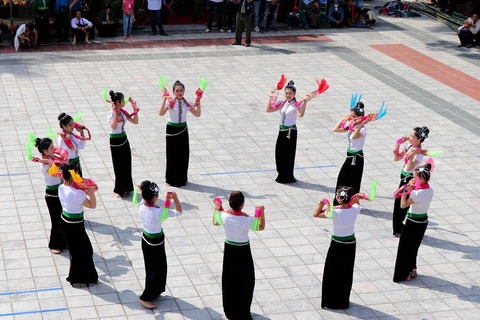
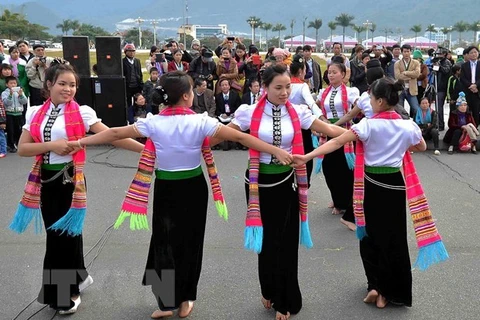
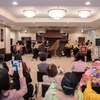
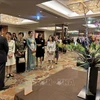
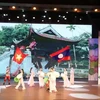
Tong Van Han and some of his research works about Thai culture. (Source: vietnamnet.vn)
 Dien Bien (VNS/VNA) - Tong Van Han has spent more than 20 years researching and preserving the cultural values of the Thai ethnic minority, particularly the Black Thai.
The 47-year-old from the northern mountainous province of Dien Bien is of Thai ethnicity and understands that cultural preservation has become an urgent task amid Vietnam's globalisation and development.
Han, an active member of the Vietnam Folk Arts Association since 2009, said the beauty of Thai culture has interested him since he was a teenager and when he entered high school, he started researching traditional Thai customs.
“The more I worked on researching, the more I was attracted to it. I have found the Thai cultural treasures are vast, fruitful and unique compared to other ethnic groups,” Han said.
Along with researching and collecting culturally significant items, Han also wrote articles for newspapers and magazines.
His stilt house in Lieng village, Noong Luong commune, Dien Bien district is filled with items related to Black Thai ethnic culture.
Around him on the wooden floor and on his working desk are piles of books, manuscripts and Black Thai traditional documents including those about customs, festivals, music and folk songs, and knowledge in the process of building the Thai community.
Currently, the man is also doing research and analysis on a book titled The Ancestor Worship of the Black Thai written in Thai language on the do (poonah) paper, which he inherited from his grandfather.
Han said he became a professional collector and researcher in 2003 after he focused on a methodical and intensive way of working.
“First, I focused on the religious practice of the Black Thai people because I thought in the concept and mind of the Black Thai people ‘everything has a soul or spirit’. That means all things and species which have been identified have their own immutable souls, thus those things such as forests, fields and houses have a spirit (God) to govern them,” said Han.
The researcher said during the process of migration, land reclamation, farming and setting up their community, Black Thai people have a culture of behaviour, interacting with nature with folk rituals that had been passed down through generations.
“Therefore, their knowledge of religious practices is a vast, colourful and unique domain. However, such religious practice is strongly influenced by a process of the community living conditions, cultural interference and the fluctuations and impacts of modern life that have led to the fact that their original own values are changing and could even be lost," Han said.
Since becoming a member of the Vietnam Folk Arts Association in 2009, his talent in the field of national cultural research has begun to show.
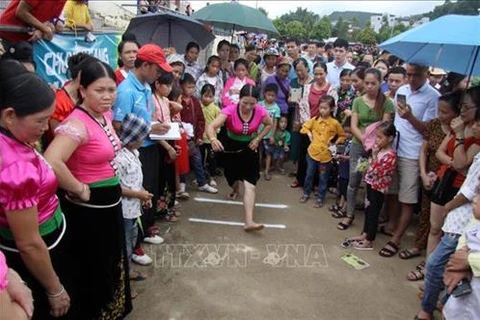
He published a project in 2012 about a Black Thai traditional game with qua con (sacred ball) as the key target. The project was his initial success in researching Black Thai culture.
With a rich knowledge about the Black Thai accumulated over the years, Han surprised many people with his research into the meaning of qua con, an object in shape of a ball made of colourful pieces of cloth and commonly used in the game called nem con (throwing a sacred ball through a ring) of Thai people in the northwestern region on special occasions.
Through his research, qua con he found also has a spiritual life as it comes through processes of forming, developing, carrying a soul and personality, conveying the narrative and emotional message of the ball holders who participate in the game.
The ball is also regarded as a "guarantee of love" at a wedding, a sacred object in the rituals of the Black Thai.
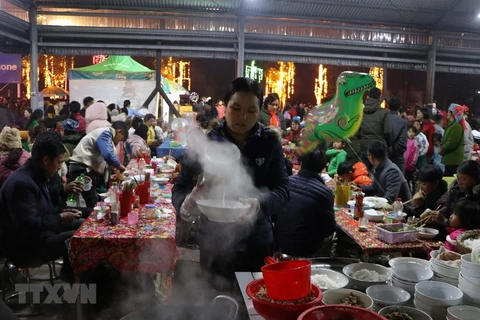
Following his first success, Han published two more books. One about the culinary culture of Black Thai in Dien Bien province published in 2012. The other was about the cross culture of the Black Thai in Dien Bien's Muong Thanh ward, published in 2014.
The two works are used by businesses running community tourism enterprises in Dien Bien province to enrich their menus to attract tourists to their homestays.
On his difficulties at work, Han said travelling is one of his biggest issues.
“To reach the most convincing, true and lively samples and materials of the Thai culture, I have to go to many places looking for artisans and the elderly who have folklore knowledge in villages. It sometimes takes a whole week for a trip but I could get nothing, I have faced misfortune after many trips because I could not get the necessary subjects or meet the right person.
"Time is passing and some festivals might have lost their origins. To revert them to a unified and complete work, I note things down, record everything I have collected then compare and filter before writing a logical and truthful book,” Han said.
The researcher reveals another challenge he faces is the translation from ethnic Thai language into Vietnamese.
He said if translators can not understand the linguistics and the original "beauty" of Thai language, they will significantly reduce the original value of the language and the meaning will also be narrow.
For nearly 20 years of researching Black Thai culture, Han has travelled through every village where Black Thai people live with his backpack containing just a cell phone, a recorder, pens and paper. In his backpack, Han also has some gifts to offer to the elderly.
Han has published 12 works about Thai culture and communities up to now. These books have helped revive part of the traditional cultural treasures of the Black Thai ethnic community in Dien Bien and the northwestern region.
Han also studies other ethnic cultures in Dien Bien such as those of the Cong people.
At a national contest to promote studying and following President Ho Chi Minh’s ideology, morality and lifestyle in 2016-2020, Han won second prize with his work about Thai folk songs in Muong Thanh./.
VNA