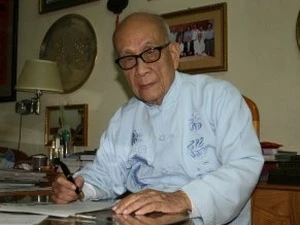
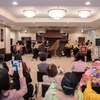
Researcher Giang Quan receives the “Bui Xuan Phai – Love for Hanoi” award (Photo: VNA)
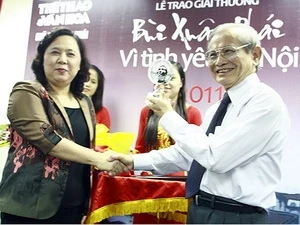
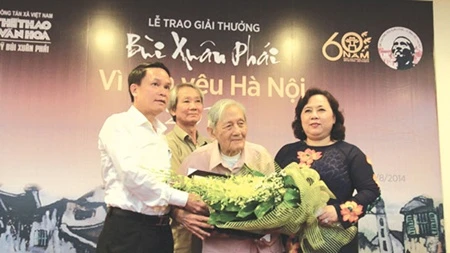
 Researcher Giang Quan, who has devoted his entire life to studying Hanoi, received the “Bui Xuan Phai – Love for Hanoi” award in the capital on September 23.
Deputy Director General of the Vietnam News Agency Ngo Ha Thai and Vice Chairman of the municipal People’s Committee Le Hong Son presented the award
Born in 1927, researcher Quan is regarded a “living encyclopaedia” on Hanoi. He is a familiar figure among Hanoians for engaging in the city’s traditional art and culture activities for over half a century.
Poet Bang Viet, head of the award jury, said Quan boasts profound knowledge about the capital, citing he has written over 30 books about Hanoi’s land and people over the past 70 years.
Popular pieces include “Kham Thien guong mat cuoc doi” (Kham Thien – the face of life); “Tro choi tro dien dan gian vung Ha Noi” (Hanoi’s folk games); “Tu dien duong pho Ha Noi” (Dictionary on Hanoi streets); “Ha Noi trong ca dao ngan ngu” (Hanoi in folk verses and proverbs); “Ky su dia chi Ha Noi” (Hanoi monographic chronicle); “Van hoa gia dinh Ha Noi” (Hanoi’s family culture); “Thang Long Ha Noi nghin nam truyen thong va thanh lich” (Thousand-year traditional, elegant Thang Long Hanoi).
Though born in Cam Giang in northern Hai Duong province, Quan’s love for Hanoi runs deep; he states his small contributions to the capital have brought him great happiness.
Quan was also recognised as an outstanding citizen of the capital.
At the age of nearly 90, Quan continues to write books on Hanoi and record his memories on the capital. His favourite book is about festival customs in expanded Hanoi areas, which will be introduced to readers in the near future.
Speaking at the granting ceremony, Quan expressed his honour to receive the award, saying he had 20 years of working with painter Bui Xuan Phai and admires Phai’s talent and working spirit.
Besides the main award, there were also Job Prize, Work Prize and Idea Prize.
The Work Prize went to the book “Hanoi: Capital City” by Dr. Michael Waibei from the Institute of Geography – Hamburg University, which has been published in three languages: German, Vietnamese and English, with over 600 illustrative images reflecting the Hanoi life.
The title was also presented to “A day roi Ha Noi 7 mon” (Here seven Hanoi dishes) and “Cau am” (Mandarin’s son) by Tran Chien, which depict the ups and downs of life in Hanoi.
The Idea Prize was granted to the research project on restoring the Kinh Thien temple at the Imperial Citadel of Thang Long conducted by the Thang Long – Hanoi Heritage Conservation Centre.
The Job Prize went to the Vietnam National University, Hanoi (VNU) and the Hanoi municipal People’s Committee for establishing the Hanoi studying and development centre to carry out scientific research and human resources activities for the capital.
The “Bui Xuan Phai – Love for Hanoi” Awards were launched in 2008 by the Vietnam News Agency’s The Thao&Van Hoa’ (Sports and Culture) newspaper and the late painter’s family. The awards are named after the famous painter Bui Xuan Phai (1920-1988) in honour of his career and aim to continue spreading his love for Hanoi.
In previous years, the awards have been granted to Hanoi researcher Nguyen Vinh Phuc, writer To Hoai, Professor Phan Huy Le, guitarist Van Vuong, photographer Quang Phung and researcher Vu Tan San.-VNA