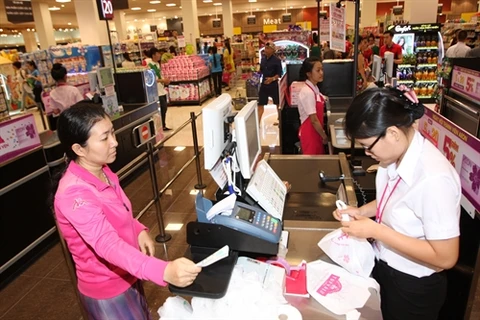
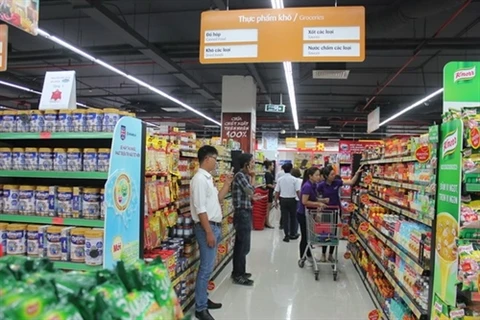
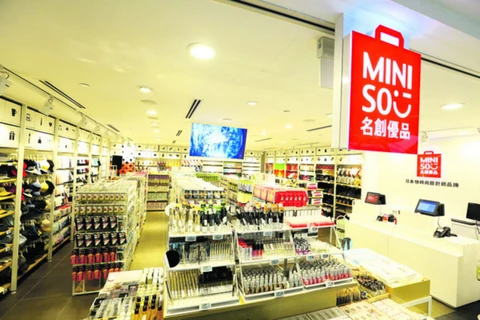
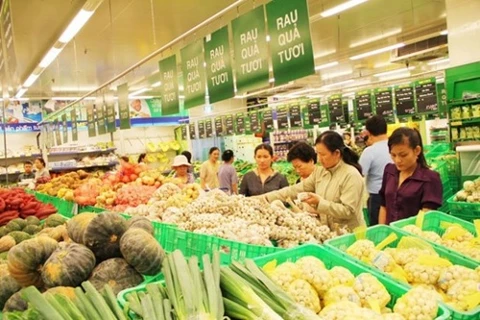
Customers shop at Aeon Supermarket in Hanoi (Photo: VNA)
 Hanoi (VNA) - Vietnamese retail firms are being forced to become more serious about their development strategy and improving their competitiveness following the penetration of foreign retailers into Vietnam with M&A deals.
Several deals, worth hundreds of millions of dollars, have been clinched the past two years.
One cannot deny that the entry of foreign retailers, such as Aeon from Japan, Lotte from the Republic of Korea, and TCC Holding and Central Group from Thailand has benefitted consumers and promoted the development of the modern retail industry.
The problem, however, lies in competing with these foreign retailers and developing and promoting the distribution of Vietnamese goods, which local retail firms must think about seriously, experts have said.
Experts agreed at on online forum held by Dien Dan Doanh Nghiep (Business Forum) on September 29 that M&A was an unavoidable trend and effective for foreigner retailers to penetrate Vietnam’s retail market, forecasting that the trend would continue for the next two to three years.
According to Dinh Thi My Loan, president of the Vietnam Retailers Association, it was unfortunate that the country did not have a national plan to promote the retail industry before participation in the World Trade Organisation.
“It is important now that local retail firms must grow and prepare for harsh competition in a rapidly integrating world,” Loan said.
Vo Hoang Anh, marketing manager of Co.op Mart, comprising more than 80 supermarkets and nearly 300 stores across the country, said competition from foreign retailers created pressure on local firms to take stronger steps in adjusting their development strategy and also gave them opportunities to learn.
Experts said local firms should develop multi-channels, which offer customers a choice of ways to buy products.
Hoang Anh said multi-channel retailing, which combined e-commerce and traditional distribution, was appropriate for Vietnam. Saigon Co.op, which owns Co.op Mart, will develop its e-commerce channel in 2017.
E-commerce is emerging as a shopping trend in Vietnam and is anticipated to post strong growth but still lacked appropriate conditions, such as payment methods and consumer trust, for a boom.
Loan agreed, stressing that multi-channel retailing would be an inevitable trend for local retailers.
According to Nguyen Thi Hai Thanh, deputy director of Hapro, the retailer will also focus on the rural market where there was large potential.
A survey by Kantar Worldpanel, a global expert in shopping behaviour, found that in 2015, traditional retailing still held a share of 82 percent in urban markets and 98 percent in rural markets. Household retail stores accounted for 60 percent of the retail market and the traditional market held 10 percent.
Experts also urged firms to cooperate with each other and with suppliers to promote the distribution of Vietnamese goods.
Vietnam with a population of 93 million has been ranked among the world’s top 30 most attractive emerging retail markets since 2008 in the Global Retail Development Index.
The revenue of the retail market of Vietnam totaled some 110 billion USD per year, but only around one fourth came from modern retail channels. Analysts expect retail revenue to hit 179 billion USD by 2020.-VNA