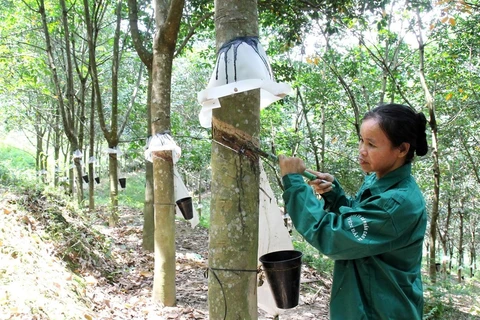
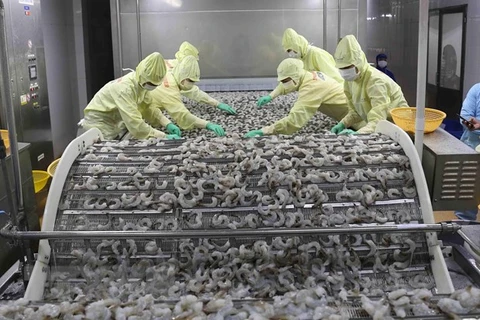
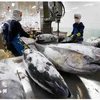
Rubber latex being processed for automobile tyre production at the MTV Rubber JSC under the Vietnam Rubber Group JSC in the central province of Quang Nam (Photo: VNA)
 Hanoi (VNA) - The Vietnam Rubber Group JSC (GVR) targets increases of 8 percent and 5 percent in revenue and post-tax profit this year, respectively.
The information was released during the 2020 Annual General Meeting of Shareholders (AGM) held in Ho Chi Minh City on June 12.
This was the group’s first AGM after moving its listing from the Unlisted Public Company Market (UPCoM) to the Ho Chi Minh Stock Exchange (HoSE) on March 17.
The group aimed to earn nearly 24.7 trillion VND (1.05 billion USD) in revenue and more than 4 trillion VND in profit.
It plans to pay 2019 dividend in cash at a rate of 6 percent, equivalent to 2.4 trillion VND. Dividend pay-out ratio for 2020 is expected to also stay at 6 percent.
According to the Board of Directors, the prices of key export products, such as rubber and wood, all fell sharply and products could not sell due to lower demand.
“The rubber industry is facing difficulties due to the impacts of climate change, natural disasters, floods and storms. The unpredictable development of the COVID-19 pandemic is also a challenge for the group,” said GVR General Director Huynh Van Bao.
The group plans to improve the quality of corporate governance, restructure its business activities, focusing on five main traditional business areas including planting, processing rubber latex; processing rubber wood; rubber industry products; industrial zone investment on rubber cultivation land and hi-tech agriculture.
The land fund which is unsuitable for rubber trees will be converted into cultivation land for other crops, the group said.
As of December 31, 2019, the group had divested capital from non-core member units and collected nearly 2.4 trillion VND.
Bao said the divestment helped the group earned a significant source of capital to balance investment.
He said the group would proceed to convert 20 limited liability companies, in which it is holding 100 percent of capital, into joint stock companies.
This created transparency for businesses, thereby attracting foreign investment more easily, Bao said./.
VNA