Rubber value soars in 2024: VRA

All Vietnam's rubber’s top 15 export markets saw growth in export values in 2024, with Malaysia recording the highest increase, expanding fivefold, followed by Sri Lanka at 3.7 times, according to the Vietnam Rubber Association (VRA).

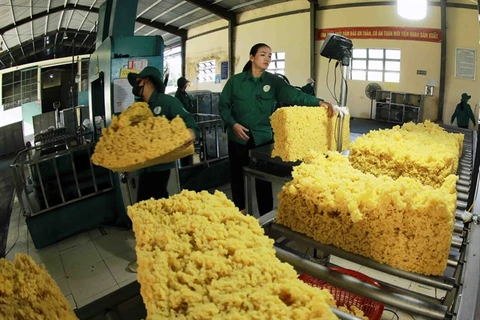
A worker extracts rubber latex at a plantation in the Central Highland province of Gia Lai. (Photo: VNA)

Hanoi (VNS/VNA) - All Vietnam's rubber’s top 15 export markets saw growth in export values in 2024, with Malaysia recording the highest increase, expanding fivefold, followed by Sri Lanka at 3.7 times, according to the Vietnam Rubber Association (VRA).

China, despite showing the lowest growth rate at 1.5%, remained Vietnam's largest export market for rubber, accounting for 67.6% of the total market share. Other key markets included India (7.7%), the EU (6%) and the Republic of Korea (2.5%).

According to the VRA, China’s demand is driven by its booming electric and hybrid vehicle industries, particularly for tyre production. However, Vietnam predominantly exports natural rubber blends and semi-processed products to China, with deeply processed rubber contributing minimally. In 2023, Vietnam exported 1.7 million tonnes of rubber to China, generating 2.27 billion USD, nearly 80% of the total export volume and 78.5% of total value.

To increase export value and reduce reliance on the Chinese market, the Vietnam Rubber Association has urged exporters to prioritise processed rubber and expand into new markets, particularly the EU.

Global trade in rubber and rubber products, valued at 240–250 billion USD, sees the EU as the largest importer and exporter. The EU accounts for 31–34.5% of global rubber exports and imports approximately 75 billion USD in rubber products annually.

In 2023, Vietnam exported nearly 470 million USD worth of raw and processed rubber to the EU, representing 6.5% of the industry's total export revenue.

Vietnam's rubber exports experienced mixed outcomes in the first 11 months of 2024, with a six% decline in volume but a 17.1% surge in value compared to the same period in 2023. This increase in export value is attributed to a 24.6% rise in the average export price, reaching 1,675 USD per tonne.

The Ministry of Agriculture and Rural Development reported that November's exports totalled 220,000 tonnes, valued at 424.3 million USD. Cumulatively, Vietnam exported 1.8 million tonnes of rubber during the period, generating 2.95 billion USD in revenue.

EU anti-deforestation standards

In a recent development, the Vietnam Rubber Group (VRG) announced steps to comply with the European Union's anti-deforestation regulations (EUDR), which take effect in January 2025 for large enterprises. Rubber is one of three Vietnamese exports affected, alongside timber and coffee.

VRG's Vice General Director, Truong Minh Trung, confirmed that 18 VRG member units had received sustainable forest management certifications under the VFCS/PEFC system, covering 120,000 hectares. Additionally, 38 factories had achieved PEFC-CoC certification, allowing them to produce over 100,000 tonnes of certified rubber annually.

Three VRG member companies, the Dong Nai Rubber Corporation, the Dau Tieng Rubber Company and the Chu Se Kampong Thom Rubber Company, had already fulfilled EUDR requirements, with their products accepted by European clients.

Vietnam's rubber supply chain faces traceability challenges, particularly from smallholder plantations, which lack land-use certification and involve complex intermediary processes. Imported rubber, primarily from Cambodia (80%) and Laos, presents similar difficulties.

With the EU delaying EUDR enforcement to January 2025, Vietnam continues to address compliance gaps. By focusing on value-added products and meeting international standards, the nation aims to strengthen its position in global rubber markets, particularly within the EU, a critical export destination./.

VNA

See more

Minister of Foreign Affairs Le Hoai Trung (Photo published by VNA)

Vietnam, India set 25 billion USD trade goal

Vietnam and India agreed to make better use of complementary strengths, ease market access difficulties and facilitate business activities toward achieving the 25 billion USD bilateral trade target.

Delegates at the meeting between Vietnamese businesses operating in Cambodia and the Council for the Development of Cambodia (CDC) on September 14. (Photo: VNA)

Vietnamese businesses seek to expand investment in Cambodia

Vietnam currently has 223 investment projects in Cambodia with total registered capital of nearly 3.4 billion USD. Vietnamese companies operate in agriculture, particularly large-scale farming, finance and banking, telecommunications, aviation, processing, trade and services.

Children visit President Ho Chi Minh's hometown and learn about his childhood. (Photo: VNA)

Vietnam's tourism sector faces labour shortage

A 2026 survey by Hoteljob.vn found that nearly 90% of tourism businesses planned to recruit. In Ho Chi Minh City alone, 89.7% of businesses were hiring, while 71.8% said recruitment was difficult or very difficult. The biggest shortages were among frontline workers, particularly in housekeeping, engineering, food service, front-office operations, and kitchens.

Octopus processing for export at Huy Nam Company in An Giang province. (Photo: VNA)

New opportunities for Vietnam’s seafood exports

The Vietnam-EFTA Free Trade Agreement brings together two groups of highly complementary economies. EFTA members Switzerland, Norway, Iceland and Liechtenstein have strengths in technology, innovation, finance, clean energy and sustainable development, while Vietnam is one of Asia’s most dynamic economies and is emerging as a major regional manufacturing, trade and investment hub.

The saponin content of Lai Chau ginseng can reach as high as 23.85% in its natural state, a remarkably high level compared to many other ginseng species. (Photo: baolaichau.vn)

Lai Chau ginseng development gains momentum

Blessed with rare and distinctive ecological values, the northern mountainous province of Lai Chau is stepping up efforts to conserve and develop its native ginseng, with the medicinal plant expected to play a growing role in the forest-based economy and local livelihoods.

The Vietnamese delegation poses for a group photo at the third meeting of the Vietnam-Canada Joint Economic Committee (Photo: VNA)

Vietnam, Canada broaden economic cooperation beyond trade

Vietnam is currently Canada’s largest trading partner in ASEAN. Building on the Comprehensive and Progressive Agreement for Trans-Pacific Partnership (CPTPP), the two countries are expanding bilateral economic ties into higher value-added areas such as clean energy, critical minerals, advanced technology, manufacturing and value-chain linkages.

The Index of Industrial Production (IIP) rises 14.4% in August and 11.9% in the first eight months compared to a year earlier. (Photo: VNA)

More momentum needed for economic growth in year-end race

To build momentum for the year-end race, one of the top priorities is to accelerate public investment disbursement, ensuring 100% of the allocated plan is disbursed without allowing funds to be concentrated in the final months of the year.

Vietnamese enterprises showcase products at the Vietnam Pavilion during the Foodist Istanbul 2026 fair. (Photo: Vietrade)

Vietnamese goods gain export opportunities in Türkiye, Spain

Vietrade said the programme helped businesses gain practical market information, identify potential products and partners, and better understand requirements on quality, pricing and distribution. Such direct connections are expected to help companies adapt their products and develop more effective export strategies.