Sales of Vietnamese cement products rise amid COVID-19 pandemic

The sale of Vietnamese cement products reached 70.7 million tonnes over the past eight months of 2021, up 4 percent year-on-year amid the COVID-19 pandemic which had negative impacts on many other industries.
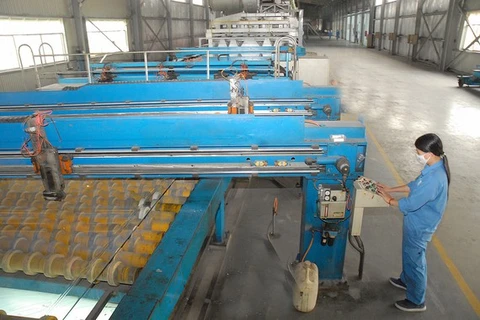
Sales of Vietnamese cement products rise amid COVID-19 pandemic ảnh 1A factory of Yen Binh Cement Co. in Yen Bai province. (Source: VNA)
Hanoi (VNS/VNA) - The sale of Vietnamese cement products reached 70.7 million tonnes over the past eight months of 2021, up 4 percent year-on-year amid the COVID-19 pandemic which had negative impacts on many other industries.

Of the total, export volume was 27.23 million tonnes, up 12 percent thanks to buying rebound seen in many large export outlets such as the US, Canada and China, Luong Duc Long, General Secretary of the Vietnam Cement Association (VNCA), said.

Long said demand for cement products in these markets had increased and cement prices there had a tendency to go up.

Meanwhile, domestic consumption saw a modest decline of 5 percent to about 43.54 million tonnes in the period, according to the association.

Chairman of VNCA Nguyen Quang Cung said the fourth wave of COVID-19 which broke out from the end of April, had suspended construction projects in Hanoi and HCM City and 19 southern localities, resulting in a decline in demand for cement in recent months.

The southern region had the strongest increase in consumption in the country with a year-on-year increase rate of 12.2 percent. Therefore, the prolonged social distancing in this region affected domestic cement consumption significantly, Cung explained. 

However, Long said, the vaccination rollout was being accelerated in many localities in order to effectively control the pandemic and gradually relax social distancing to bring daily life back to a new normal.

Therefore, domestic cement consumption was expected to flourish again in later months as the peak construction season began, Long forecast. 

According to experts, exports continued to be the growth engine of the cement industry in recent years. They attributed the strong increase in the country's cement exports to the fact that China has gradually closed cement factories, mainly for environmental purposes and increased imports from other countries, especially Vietnam.

In the second quarter alone, China was the largest importer of Vietnam’s cement and clinker with nearly 10.3 million tonnes, worth 368.6 million USD, accounting for 49.4 percent of total export volume and 45.6 percent of total turnover. It was followed by the Philippines with 3.85 million tonnes, worth 176 million USD, and Bangladesh with 1.93 million tonnes, valued at 65.4 million USD. 

Experts said the advantage of sea routes had facilitated Vietnam's exports of cement and clinker to China. 

Vietnam is currently the fifth biggest cement manufacturer in the world, after China, India, the US, and Russia. Its cement output has doubled within 10 years, from 45.5 million tonnes in 2009 to about 100 million tonnes, turning the country from a cement and clinker importer to the world’s largest exporter of these commodities.

Last year, the country shipped 101.5 million tonnes of these products to overseas markets, representing a rise of 1.5 percent over 2019.

However, in order to maintain exports, cement producers should apply advanced technologies in production to enhance quality and added value while reducing environmental harm, which would significantly help boost competitiveness, experts suggested.

They should also monitor the cement market and adjust their production plans accordingly to keep prices from falling. In addition, cement firms should also work out long-term development strategies./.
VNA
See more

A passenger poses for a photo besides a Vietjet aircraft (Photo: VNA)

Vietjet leads Southeast Asia in emissions efficiency

Under comparable operating conditions, Vietjet’s leading position highlights its ability to optimise performance across its entire operational chain, including aircraft configuration, route network design and load management.

Containers loaded at Cai Mep International Terminal (Photo: VNA)

Vietnam ranks 18th among world’s top exporters in 2025

Vietnam’s exports reached about 470 billion USD for the first time last year, up more than 16% year on year, with a trade surplus of over 20 billion USD, contributing significantly to maintaining macroeconomic stability.

Experts speak at the workshop (Photo: VNA)

Vietnam’s pet care market emerges as lucrative investment opportunity

​ Across the Asia-Pacific, 60% of respondents own pets, while Vietnam’s pet ownership rate stands at 79%, among the highest in the region. Notably, 55% of Vietnamese pet owners have two or more pets, signalling that pet ownership has evolved from a hobby into a modern lifestyle choice.

A view of the workshop on the application of AI and real-world data in food product research and development held in Ho Chi Minh City on April 22. (Photo: VNA)

AI emerges as key driver for Vietnam’s F&B sector breakthrough

Businesses start with projects that deliver quick results within six to 12 months, like quality control systems, demand forecasting, or customer service chatbots. In the long run, F&B companies are advised to move toward with AI-driven operating models to keep up with fast-changing market demands.

Trucks carrying imports enter Vietnam through Lao Cai International Border Gate. (Photo: VNA)

Smart border gates power growth in northern border provinces

With a borderline of about 182 km, Lao Cai aims to turn its border gate economic zone into a key growth engine by adopting a smart border gate model, viewing this as a breakthrough measure for improving management efficiency, reducing logistics expenses, and enhancing customs clearance capacity.

Ken Chau (right), Chairman of the Vietnam Canada Business Association, presents flowers to the organising committee of the Vietnamese Entrepreneurs Awards in Canada 2026 at the event. (Photo: Award organising board)

Vietnamese awards in Canada spotlight community strength

The gala brought together nearly 200 participants, including community leaders, entrepreneurs and guests from across the country, highlighting both the achievements of Vietnamese businesses and the community’s growing role in the socio-economic fabric of Vancouver and other Canadian cities.

Passenger numbers are expected to peak at the start of each break, particularly from the afternoon of April 24 to April 25, with a return wave on April 27 following the Hung Kings Commemoration Day. (Photo: VNA)

Transport sector ramps up capacity for holiday travel surge

Transport experts said the back-to-back holidays will create travel patterns different from previous years. While some people are expected to combine the two breaks into a longer holiday, others will travel during either period depending on personal plans. Passenger flows are therefore likely to be more evenly distributed, helping ease pressure on transport systems.

A worker at the factory of the TNG Investment and Trading Joint Stock Company in the Song Cong I Industrial Park, Thai Nguyen province. (Photo: VNA)

Imports accelerate, powering exports, public revenues

Previous years show that Vietnam typically runs a trade deficit in the first quarter before shifting to a surplus in the latter half of the year. The current deficit, therefore, is considered both normal and indicative of an economy “recharging” for growth.

Vietnamese Minister of Construction Tran Hong Minh and Korean Minister of Land, Infrastructure and Transport Kim Yun-duk hold talks on April 21 in Hanoi. (Photo: The Courtesy of the Ministry of Construction)

Vietnam, RoK step up cooperation in transport infrastructure

Minh noted that in transport, the RoK is currently Vietnam’s second-largest bilateral donor. Since 1996, the Korean Government has provided significant capital for Vietnam’s transport infrastructure, with nine projects completed to date, totalling over 1 billion USD, and six others underway worth nearly 600 million USD.

Illustrative image (Photo: VNA)

Technology bolsters growth confidence among Vietnam’s small businesses

The survey also indicates that this growth is expected to continue into 2026, with 89% of Vietnamese small businesses planning to expand operations. This outlook is fueled by a strong emphasis on embracing technology, expanding e-commerce, and enhancing corporate governance capabilities.