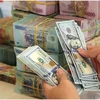
The State Bank of Vietnam has announced its plan to order major State-owned economic groups and corporations to sell 376 million USD in US dollar reserves to the commmercial banking system next week in order to reduce the accumulation of dollars in the economy.
"The deposits of these corporations are obviously accumulative," State Bank Governor Nguyen Van Giau told the Government's press conference on March 30, noting that 78 economic groups, corporations and enterprises held over 1.6 billion USD in US dollars on deposit, including 376 million USD in term deposits in March.
"Banks need those dollars to sell to enterprises with legitimate need," Giau said.
The March 30 announcement was the latest in a series of measures taken by the central bank in the past two months to try to regain control of unstable foreign exchange markets and to ease the downward pressure on the value of the Vietnamese dong – forces which have resulted in several currency devaluations, higher inflation and a widening trade deficit.
Consumer prices surged 13.89 percent in March compared to a year earlier, the fastest year-on-year pace since February of 2009, the General Statistics Office announced. Meanwhile, the trade deficit widened to 1.15 billion USD in March from a revised 1.11 billion USD a month earlier.
The last time the central bank ordered State-owned enterprises to sell dollars back to commercial banks, the order was intended to ease a shortage in the dollar supply, a situation that had increased tension on both official and black forex markets.
This time, by contrast, the order came at a time when the commercial banking system has plenty of dollars on hand and has been lowering deposit interest rates.
"I know that dollar sources are plentiful at many banks at this time," a member of the executive board of a State-owned bank in Hanoi told Vietnam News on condition of anonymity. "But the dollar sale instruction now, together with other measures, aims to absorb excess liquidity, restrict accumulation and bolster the dwindling foreign reserves."
Foreign reserves have slid from a level of nearly 24 billion USD at the end of 2008 to only about 12 billion USD currently, some foreign financial institutions have estimated.
To restrict the use of dollars in transactions, Giau also affirmed that the central bank was considering proposals that would allow banks to charge fees on dollar sales.
"The fee should be seen as a tool to discourage people to hold and spend dollars," Giau said.
The long love affair of the Vietnamese public with the greenback has caused numerous economic and social problems and interfered with effective policy management in recent years.
Earlier this month, Tran Du Lich, former head of HCM City Economic Institute, said Vietnam should follow the lead of other countries and impose a large gap between buy and sell rates so that people would only buy dollars for which they had an actual need.
National Monetary Policy Advisory Council member Tran Hoang Ngan advised that the central bank should cap the fee but otherwise allow banks to fix it based on supply and demand. /.
"The deposits of these corporations are obviously accumulative," State Bank Governor Nguyen Van Giau told the Government's press conference on March 30, noting that 78 economic groups, corporations and enterprises held over 1.6 billion USD in US dollars on deposit, including 376 million USD in term deposits in March.
"Banks need those dollars to sell to enterprises with legitimate need," Giau said.
The March 30 announcement was the latest in a series of measures taken by the central bank in the past two months to try to regain control of unstable foreign exchange markets and to ease the downward pressure on the value of the Vietnamese dong – forces which have resulted in several currency devaluations, higher inflation and a widening trade deficit.
Consumer prices surged 13.89 percent in March compared to a year earlier, the fastest year-on-year pace since February of 2009, the General Statistics Office announced. Meanwhile, the trade deficit widened to 1.15 billion USD in March from a revised 1.11 billion USD a month earlier.
The last time the central bank ordered State-owned enterprises to sell dollars back to commercial banks, the order was intended to ease a shortage in the dollar supply, a situation that had increased tension on both official and black forex markets.
This time, by contrast, the order came at a time when the commercial banking system has plenty of dollars on hand and has been lowering deposit interest rates.
"I know that dollar sources are plentiful at many banks at this time," a member of the executive board of a State-owned bank in Hanoi told Vietnam News on condition of anonymity. "But the dollar sale instruction now, together with other measures, aims to absorb excess liquidity, restrict accumulation and bolster the dwindling foreign reserves."
Foreign reserves have slid from a level of nearly 24 billion USD at the end of 2008 to only about 12 billion USD currently, some foreign financial institutions have estimated.
To restrict the use of dollars in transactions, Giau also affirmed that the central bank was considering proposals that would allow banks to charge fees on dollar sales.
"The fee should be seen as a tool to discourage people to hold and spend dollars," Giau said.
The long love affair of the Vietnamese public with the greenback has caused numerous economic and social problems and interfered with effective policy management in recent years.
Earlier this month, Tran Du Lich, former head of HCM City Economic Institute, said Vietnam should follow the lead of other countries and impose a large gap between buy and sell rates so that people would only buy dollars for which they had an actual need.
National Monetary Policy Advisory Council member Tran Hoang Ngan advised that the central bank should cap the fee but otherwise allow banks to fix it based on supply and demand. /.