Scheme on trade union institutions in industrial, processing zones ado

Scheme on trade union institutions in industrial, processing zones adopted

The Prime Minister has recently adopted a project on building trade union institutions in industrial and processing zones with an aim to improve trade unions’ role in their political ties with the Party and authorities.
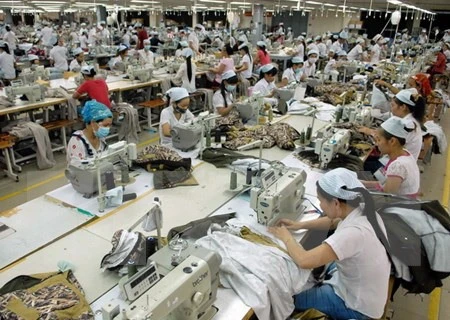
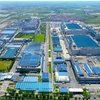
Scheme on trade union institutions in industrial, processing zones adopted ảnh 1Illustrative image (Source: VNA)
Hanoi (VNA) – The PrimeMinister has recently adopted a project on building trade union institutions inindustrial and processing zones with an aim to improve trade unions’ role intheir political ties with the Party and authorities.

The project targets buildingaccommodation, kindergartens, supermarkets, cultural and sport facilities forworkers in industrial and processing zones.

It looks to complete 10 institutionsbetween 2017 and 2018, and put into use 40 others from 2018-2020.

By 2030, all industrial andprocessing zones nationwide strive to issue their own trade union institutions,thereby improving union members and workers’ cultural and spiritual lives.

Authorities of centrally-runcities and provinces are tasked with creating favourable conditions in landaccess and administrative procedures, making it easier for workers to rent orbuy houses.

They are asked to improve thequality of housing for workers that meet requirements for technical and socialinfrastructure in terms of transport, health care, culture.-VNA
See more

A refilling station of Petrolimex (Photo: VNA)

Import tariffs on certain fuel products reduced to 0%

Rising tensions in the Middle East, particularly the conflict involving the US, Israel and Iran, have significantly affected the global energy market, especially shipping activity through the Strait of Hormuz – a strategic route for transporting crude oil from the region.

Fishermen raise the national flag before heading out to the sea to affirm Vietnam’s sovereignty over its seas and islands. (Photo: VNA)

Dong Thap promotes IUU awareness from start of fishing season

Gia Thuan commune, located in the eastern part of the province, is a key fishing locality with 563 fishing vessels, including 423 offshore boats and 140 nearshore vessels, producing an average annual catch of over 42,970 tonnes of seafood.

Industrial production surges in the first two months of 2026. (Photo: VNA)

Industrial production posts strong growth in first two months

According to the National Statistics Office (NSO) under the Ministry of Finance, the index of industrial production (IIP) in February was estimated to decrease 18.4% from the previous month but increase 1% year on year. Overall, in the January–February period, the IIP rose 10.4% compared with the same period last year.

A delegation from the Nghe An provincial People’s Committee inspects production and business activities at the VSIP Nghe An Industrial, Urban and Service Park. (Photo:nhandan.vn)

Nghe An steps up reforms to attract FDI

In 2025, the provincial People’s Committee licensed 25 new FDI projects and approved capital adjustments for 20 others, bringing the total newly registered and additional investment to more than 1 billion USD. Many large-scale projects in the Southeast Nghe An Economic Zone have already become operational, contributing to export growth, state budget revenues and job creation.

Nearly 35,500 enterprises are newly registered nationwide, with total registered capital reaching nearly 313.7 trillion VND and more than 167,500 registered workers. (Photo: VNA)

Nearly 35,500 new businesses set up in first two months

The enterprises registered combined capital of about 313.7 trillion VND and more than 167,500 employees. Compared with the same period last year, the number of new businesses surged by 70.7%, while registered capital rose by 36.1% and registered labour increased by 19.1%.

The yarn factory of Unitex Textile and Dyeing Company Limited applies new technology to optimise operations using an automated model. (Photo: VNA)

Resolution 68: International lessons for private sector development

A common feature in many successful economies is a fundamental shift in the perception of private enterprises. In countries such as Singapore, Germany, Republic of Korea (RoK) and China, private firms are viewed not mainly as entities requiring strict control but as development partners and key forces generating growth, jobs and innovation.