Seafood exporters' profit projected to fall in 2023

The seafood industry grew rapidly in the third quarter of last year, but there are signs of a slowdown in the fourth quarter and it is expected to continue this year, particularly in large markets.
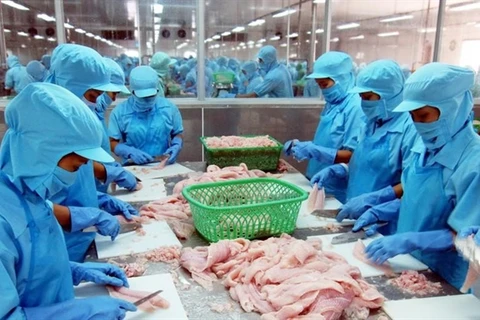
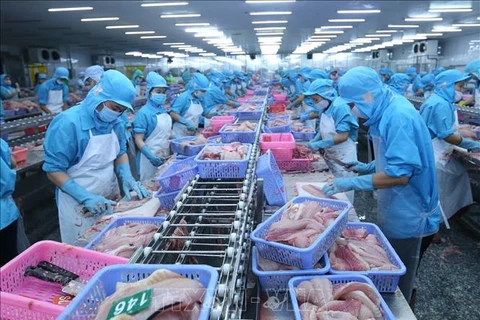
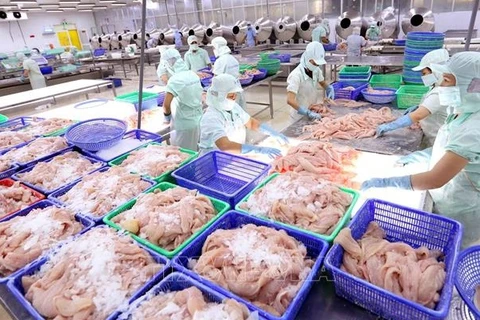
Seafood exporters' profit projected to fall in 2023 ảnh 1Workers process shrimp for export on a production line. (Photo: VNA)

Hanoi (VNS/VNA) - The seafood industry grew rapidly inthe third quarter of last year, but there are signs of a slowdown in the fourthquarter and it is expected to continue this year, particularly in largemarkets.

According to experts, even though rising inflation has a negative impact onimport markets and high material costs result in declining profit, seafoodbusinesses are still supported by some positive factors.

KB Vietnam Securities Company (KBSV) said that the seafood industry has alreadyhit its peak. The securities firm expected that seafood exports are notoptimistic as higher inflation caused stagnation in purchasing demand. 

Moreover, some enterprises’ profits hit peaks in 2022, which is a sign that theindustry is entering the declining cycle.

KBSV also sees the prices of raw shrimp and pangasius remaining high despiterecent declines. Although material prices are expected to fall in 2023, highfeeding costs and the faster decrease in selling prices will directly affectenterprises’ gross profits.

But there are still some positive factors that can support the seafood industryin 2023, including the reopening of Vietnam’s largest seafood export market,China, after lifting the "zero-COVID" policy, as it can boost demandat restaurants and hotels, KBSV said. 

While export volumes to China are expected to increase, rising inventories atthe factories' warehouses, high output, and a bearish trend in raw fish pricesmake it difficult for Vietnam’s pangasius exports to post a breakthrough.

Vietnamese pangasius also has to compete fiercely with China’s tilapia.Therefore, KBSV believes that the reopening of China just lessens the strain ongrowth rather than causing a boom in this sector.

In contrary, the lower freight charges help businesses reduce the burdenof logistics costs and offset profit margins when they have to discountselling prices, while seafood exporters to the US market such as Vinh Hoan andSao Ta Foods (HoSE: FMC), may benefit if the USD advances.

Meanwhile, an expert from SSI Securities Corporation (SSI) said that in 2023,inflation will continue to be a challenge amid slow inventory turnover.

The securities firm forecasts the inventory will be fully cleared sometime inthe third quarter of 2023, with orders beginning to be signed by that time.

It also warns that China is a price-sensitive market, and the average sellingprice to this market is always about 40% lower than the average selling priceto the US market.

Therefore, SSI believes that revenue from the Chinese market will partiallyoffset the decline in revenue from the US and EU markets, but not enough tohelp companies recover profits in the first half of 2023. This may be due tothe high level of comparative profitability in 2022.

SSI also forecasts that the profits of pangasius companies willdecrease in 2023.

The securities firm expects that the average selling price will decrease by20-30% year-on-year in 2023 and that the cost of aquafeed will also godown. 

With a slow increase in orders, there will be no shortage of supply for bothraw shrimp and fish; thereby, it is expected that the price of raw shrimp andfish will fall slightly due to weak demand until the end of the first half of2023.

SSI believes that the gross margin of seafood businesses will decrease in 2023.

With interest rates expected to remain high for the whole year, risingfinancial costs will continue to affect net profit margins, especially forcompanies with high leverage, such as I.D.I International Development &Investment Corporation (HoSE: IDI). Overall, SSI forecasts companies to postnegative earnings growth in 2023.

In fact, in 2022, the seafood industry had a very positive growth.Therefore, the decline in profit this year is due to a high comparative base.

Due to a negative business outlook and the downtrend in the stock market, theseafood industry's share prices fell 13% last year. The industry's sharesquickly fell when quarterly profit growth slowed. Shares of key companies fellduring the period, such as FMC was down 36%, and IDI was down 27%.

Seafood stock valuations could fall to the industry's historically low level of4x through the third quarter of 2023 as earnings are expected to edge down fromthe high base level for 2022, said SSI./.
VNA

See more

Standing Deputy Prime Minister Pham Gia Tuc chairs a meeting with representatives of US business associations and companies operating in Vietnam on July 17, 2026. (Photo: baochinhphu.vn)

Standing Deputy PM meets with US business community

Chairing a meeting with representatives of US business associations and companies operating in Vietnam, Tuc praised the US business community for its substantive contributions to Vietnam's socio-economic development as well as the two countries’ relations.

Workers assembles electronic components on the production line at the Bao Sen Co., Ltd. in Bac Ninh province. (Photo: VNA)

Vietnam's economy needs to shift from quantity to quality: ADB experts

Shantanu Chakraborty, ADB Country Director for Vietnam, noted that while achieving strong growth in a single year is encouraging, maintaining both the pace and quality of growth over many years will be essential if Vietnam is to achieve its goal of becoming a high-income country by 2045.

The Long Son Petrochemical Complex, an investment project of Thailand's SCG Group, is located in Long Son commune, Ho Chi Minh City. (Photo: VNA)

Vietnam reshapes FDI strategy with focus on technology, innovation

Politburo Resolution No. 10-NQ/TW, issued on June 8, 2026, recognises the foreign-invested sector as an important component of the national economy, signalling a major shift in the country's investment attraction strategy. Rather than prioritising labour-intensive projects, Vietnam is now seeking high-quality investments capable of driving technological progress, innovation, sustainable development and stronger participation in global value chains.

International tourists love shopping for souvenirs at Hanoi's Old Quarter night market (Photo: VNA)

Hanoi aims to raise tourists' night-time spending to 30%

Hanoi will establish and operate flagship night-time economy zones supported by preferential policies, including heritage and cultural districts in Hoan Kiem, Cua Nam, Ba Dinh, Son Tay and Soc Son; modern entertainment hubs in Tay Ho-West Lake West, My Dinh and Dong Anh; creative economy zones linked to cultural industries such as theatres, cinemas and museums; and cultural tourism and resort destinations in suburban craft villages including Bat Trang, Ba Vi and Huong Son.

Vietnamese Ambassador to Laos Nguyen Minh Tam and Lao Deputy Minister of Industry and Commerce Phouthavanh Nanthavong visit the Vietnamese pavilion at VIETLAO EXPO 2026 (Photo: VNA)

VIETLAO EXPO 2026 helps boost Vietnam-Laos strategic cohesion

The Vietnam-Laos Trade Fair 2026 (VIETLAO EXPO 2026) opened on July 16 in Vientiane, serving as a key platform for businesses from both countries to showcase products, seek partnerships, transfer technologies and expand investment cooperation.

The Vietnam-EFTA FTA is one of the longest-negotiated trade agreements in Vietnam's history. (Illustrative Photo: VNA)

Vietnam-EFTA deal set to further boost bilateral trade growth

The Vietnam-EFTA FTA is one of the longest-negotiated trade agreements in Vietnam's history, reflecting its broad scope of commitments covering trade in goods and services, investment, intellectual property, government procurement, environmental protection, sustainable development, small and medium-sized enterprises (SMEs), and other areas of cooperation.

Passengers and visitors check in at Terminal 1 of Noi Bai International Airport. (Photo: VNA)

Hanoi-Ho Chi Minh City route among world’s busiest

According to IATA’s ranking of global air passenger markets, the US remained the world’s largest market in 2025, with 890.1 million passengers, up 1.6% from 2024. China, the world’s second-largest market, recorded stronger growth of 4.8%, reaching 776.1 million passengers. China is widely forecast to overtake the US and become the world’s largest air passenger market in the 2030s.

An overview of the working session between the Kazakh delegation and the Can Tho City People's Committee on July 16. (Photo: VNA)

Kazakhstan explores agricultural by-product recycling project in Can Tho city

The proposed project would use rice husks as its primary feedstock, with an estimated one million tonnes processed annually using advanced technology developed in Kazakhstan. At present, the top priority is to secure a stable supply of raw materials from rice-producing provinces across the Mekong Delta.

Consumers buy fruit at a supermarket in Vietnam. (Photo: VNA)

US highlights potential in Vietnam’s fruit market

The US was Vietnam's second-largest supplier of agricultural products, with export turnover reaching 4.7 billion USD in 2025, a remarkable increase from less than 3.5 billion USD in 2024, Fruitnet said, citing a new report by the US Department of Agriculture (USDA).

Vietnamese Ambassador to Thailand Pham Viet Hung (thitd, left) attends the opening ceremony of Grand Halal Bangkok 2026 (Photo: VNA)

Vietnamese firms seek global Halal opportunities at Bangkok exhibition

Ambassador Pham Viet Hung described Grand Halal Bangkok 2026 as an important opportunity for Vietnamese businesses to connect not only with Thailand's Halal industry but also with Halal food producers worldwide, while learning from experience of Thailand and international partners.

Marnufacturing garments for export at Hung Yen Jute and Garment Joint Stock Company. (Photo: VNA)

GDP expands 8.18%, with new growth drivers taking shape

According to the National Statistics Office under the Ministry of Finance, GDP expanded by 8.39% in the second quarter, up from 8.14% a year earlier. Growth for the first six months reached 8.18%, exceeding the 7.63% recorded in the same period of 2025. The performance reflected broad-based contributions from both the supply and demand sides of the economy.