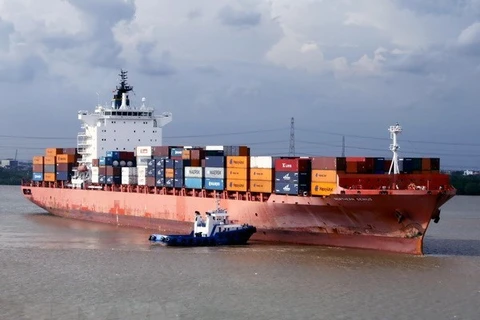
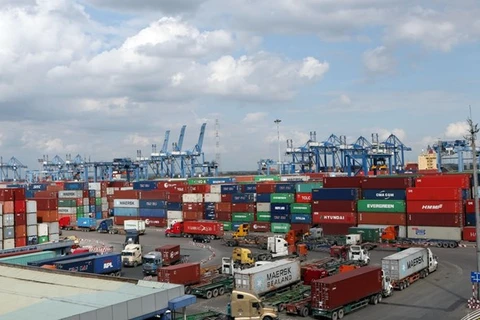
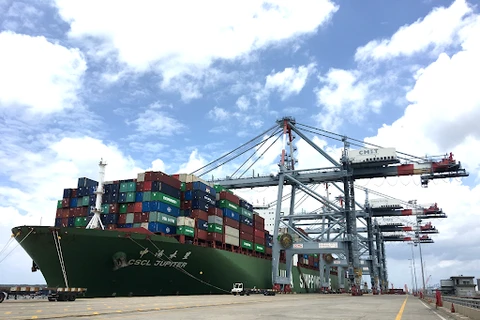
Illustrative image (Photo: VNA)
 Hanoi (VNS/VNA) - Container loading and unloading service charges should be increased to approach the regional level so investors would not feel hesitant when pouring money into developing seaports.
The proposal was raised at a recent online conference held by the Vietnam Maritime Administration to discuss measures to remove difficulties for seaport and marine transportation companies.
Statistics showed container loading and unloading services charges of seaports in Vietnam were much lower than other regional countries.
According to Nhu Dinh Thien, Deputy General Secretary of the Vietnam Ship Agents and Brokers Association, the charges were about 33-53 USD per 20ft container and 57-98 USD per 40ft container. In comparison, Thailand charges around 59 USD per 20ft container and 91 USD per 40ft container, Singapore 111 USD and 159 USD and Cambodia 65 USD and 95 USD, respectively.
Nguyen Tuong Anh, general director of Hai Phong Port, said with such low services charges, it would be difficult for ports to have funds for re-investment and improving services quality.
He said it was necessary to raise container loading and unloading services charges so seaports could have funds for expanding investment and improving quality.
The charges should also be attractive enough to draw investors to seaport development, he said.
He proposed container loading and unloading services charges be increased by 10 percent, starting from 2021, then a 10 percent increase every two years.
According to Thien, the charges should be raised by 10 percent from 2021 and another 10 percent in 2022 and 2023.
Phan Thong, General Secretary of Vietnam Shippers’ Council, said the increases in loading and unloading services charges should be appropriate to make up for the costs of seaport companies while not significantly pushing up logistics costs.
Bui Van Trung, General Secretary of Vietnam Shipowners’ Association, said appropriate container loading and unloading services changes were important to attract investment to develop seaports.
The charges should be adjusted to gradually approach regional levels, Trung said.
Deputy Minister of Transport Nguyen Van Cong said that increasing seaport services charges was necessary given the significant gaps in services fees with other countries in the region.
Cong said container loading and unloading charges needed to increase to be equivalent to 60-70 percent of the regional average by 2025 and to approach the regional level after that, or at least equivalent to Cambodia’s.
Cong stressed the increases were only in ceiling prices, meaning shipowners could have the room for negotiations.
He also asked the Vietnam Maritime Administration to develop an appropriate frame for seaport services charges to ensure companies would have funds for reinvestment and upgrades of infrastructure.
He said that the ministry would make efforts to complete the draft amending Circular 54/2018/TT-BGTVT about seaport services charges and submit it to the Government for issuance before January 1, 2021.
Mai Phuong Hong, from the Ministry of Finance’s Price Management Department, said the increases of seaport charges needed to be given careful consideration in the context of the COVID-19 pandemic to limit the impacts on business operation, imports and exports as well as the consumer price index.
In the first half of this year, more than 339 million tonnes of cargo were shipped through seaports in Vietnam, up by 7 percent against the same period last year, statistics of the Vietnam Maritime Administration showed.
The capacity of Vietnam's seaport system increased from 73 million tonnes of cargo in 2000 to currently 650-700 million tonnes./.
The proposal was raised at a recent online conference held by the Vietnam Maritime Administration to discuss measures to remove difficulties for seaport and marine transportation companies.
Statistics showed container loading and unloading services charges of seaports in Vietnam were much lower than other regional countries.
According to Nhu Dinh Thien, Deputy General Secretary of the Vietnam Ship Agents and Brokers Association, the charges were about 33-53 USD per 20ft container and 57-98 USD per 40ft container. In comparison, Thailand charges around 59 USD per 20ft container and 91 USD per 40ft container, Singapore 111 USD and 159 USD and Cambodia 65 USD and 95 USD, respectively.
Nguyen Tuong Anh, general director of Hai Phong Port, said with such low services charges, it would be difficult for ports to have funds for re-investment and improving services quality.
He said it was necessary to raise container loading and unloading services charges so seaports could have funds for expanding investment and improving quality.
The charges should also be attractive enough to draw investors to seaport development, he said.
He proposed container loading and unloading services charges be increased by 10 percent, starting from 2021, then a 10 percent increase every two years.
According to Thien, the charges should be raised by 10 percent from 2021 and another 10 percent in 2022 and 2023.
Phan Thong, General Secretary of Vietnam Shippers’ Council, said the increases in loading and unloading services charges should be appropriate to make up for the costs of seaport companies while not significantly pushing up logistics costs.
Bui Van Trung, General Secretary of Vietnam Shipowners’ Association, said appropriate container loading and unloading services changes were important to attract investment to develop seaports.
The charges should be adjusted to gradually approach regional levels, Trung said.
Deputy Minister of Transport Nguyen Van Cong said that increasing seaport services charges was necessary given the significant gaps in services fees with other countries in the region.
Cong said container loading and unloading charges needed to increase to be equivalent to 60-70 percent of the regional average by 2025 and to approach the regional level after that, or at least equivalent to Cambodia’s.
Cong stressed the increases were only in ceiling prices, meaning shipowners could have the room for negotiations.
He also asked the Vietnam Maritime Administration to develop an appropriate frame for seaport services charges to ensure companies would have funds for reinvestment and upgrades of infrastructure.
He said that the ministry would make efforts to complete the draft amending Circular 54/2018/TT-BGTVT about seaport services charges and submit it to the Government for issuance before January 1, 2021.
Mai Phuong Hong, from the Ministry of Finance’s Price Management Department, said the increases of seaport charges needed to be given careful consideration in the context of the COVID-19 pandemic to limit the impacts on business operation, imports and exports as well as the consumer price index.
In the first half of this year, more than 339 million tonnes of cargo were shipped through seaports in Vietnam, up by 7 percent against the same period last year, statistics of the Vietnam Maritime Administration showed.
The capacity of Vietnam's seaport system increased from 73 million tonnes of cargo in 2000 to currently 650-700 million tonnes./.
VNA