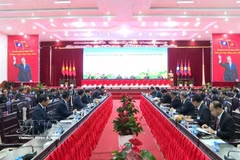
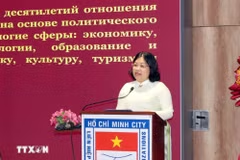
As many as 66 domestic and international delegates, including sixVietnamese, are gathering in Ho Chi Minh City for a two-dayinternational workshop on cooperation on the East Sea.
Themed, “East Sea : Cooperation for Regional Security and Development”, theinternational workshop is a follow-up of the previous workshop held inHanoi last year.
During this second workshop, delegateswill focus on a range of issues: the importance of the East Sea inthe context of changing strategic environments, as well as recentsituations in the East Sea , and international legal issues arounddisputes in the East Sea .
They will deal with experiencesand propensity for dispute settlement and conflict management in theEast Sea , trust-building measures and methods to promote regionalcooperation as well as cooperation in specific areas of the East Sea.
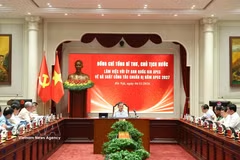
Addressing the opening session on Nov. 11, Prof. Dr Duong VanQuang, President of the Diplomatic Academy of Vietnam, said over thepast year the East Sea saw important changes, attracting specialattention from Vietnamese and international public opinions.
Basically,peace and stability were maintained on the East Sea , he said,adding, however, that a number of small-scale clashes took place, makingexisting differences more complicated.
In addition to existingarguments on sovereignty and territory, there were many clashes relatingto maritime security and safety, maritime resource management andexploitation, he said.
He hailed efforts at different levels tostrengthen information exchange and frank dialogue and direct talksbetween concerned parties in order to prevent newly arising tensions, aswell as the move to seek a mechanism for dispute settlement, legalframeworks and long-term solutions for all issues.
The workshopis taking place in the context that a series of important securityissues in the region, including the situation in the East Sea , wasraised at ASEAN meetings and meetings between the bloc and partnercountries. The issue on the East Sea was also dealt with at regionaldefence security officials’ meetings, such as Shangri-La dialogue, ASEANDefence Ministers’ Meeting – ADMM and ADMM plus.
The move showedthat the more concerned parties strengthen dialogue and exchange views,the more they understand the benefits. Despite existing dissimilaritiessuch as different policies and different stances on fundamental issues,the cooperative way to dialogue allows access to greater understanding,contributing to reducing doubts among dispute-related parties andincreasing trust.
Among the participants at theworkshop were 60 international delegates from ASEAN countries, China ,the United States , the Republic of Korea , the United Kingdom ,Germany , Canada , Australia , Russia , France , Japan , India ,Belgium and Sweden./.