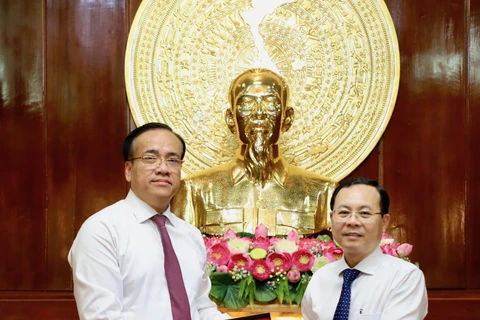
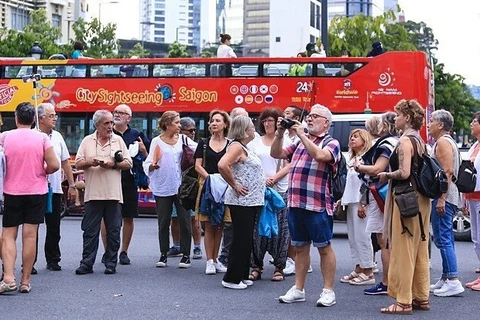
The seminar focuses on the application of information technology solutions to promote digital transformation for tourism businesses. (Photo: VNA)
 The event, organised by the Vietnam Chamber of Commerce and Industry (VCCI) in partnership with MobiFone Telecommunications Corporation, drew the participation of representatives from various sectors, including tourism, transportation, hospitality, and telecommunications.
In his opening remarks, VCCI Vice Chairman Bui Trung Nghia stressed the need for a radical shift in both the mindset and actions within the tourism industry. This change, he noted, should involve everyone from management agencies and local authorities to the businesses themselves.
Nghia emphasised that the digital transformation extends beyond just technological aspects — it encompasses management, trade promotion, and advertising as well. Alongside government investment, the transformation process also requires additional resources, both domestically and internationally.
The ultimate aims of digitally transforming the tourism industry, as Nghia highlighted, should be to continually improve service quality and to meet customer needs effectively.
At the seminar, experts advised that businesses should prioritise key strategies such as the development of foundational digital platforms specific to the tourism industry, and fostering close collaboration between the tourism and information technology sectors. These partnerships are envisioned to design technology solutions that cater to the needs of digital tourism business and management.
The experts also emphasised the importance of encouraging public-private partnership mechanisms as a means to mobilise resources for implementing digital transformation in tourism. Additionally, they underscored the need to augment training programmes on digital transformation for the industry's workforce, and to bolster international cooperation in tourism digital transformation, particularly with global technology corporations.
Le Nguyen Truong Giang, the Director of the Digital Transformation Strategy Institute under the Vietnam Digital Media Association, presented the Smart Tourism Development Model during the seminar.
Giang highlighted that the digital transformation of the tourism industry necessitates a profound shift in how tourism activities are organised and how tourism products are designed. This entails adopting new, digital ways of thinking and developing new digital capabilities to ensure an effective digital transformation of tourism activities.
Furthermore, Giang stressed that digital transformation in the tourism sector represents a revolution in thinking. He explained that through the integration of digital technologies, the tourism industry can enable customers to experience tourism activities via dedicated applications, thereby enriching their travel experience.
Chu Quang Thai, a representative of the National Center for Creative Startup Support in the South branch (Ministry of Science and Technology), highlighted a deficit in the management role of State agencies in this context.
Thai suggested that the Ministry of Culture, Sports and Tourism should take responsibility for creating a comprehensive, nationwide tourism database. This approach would circumvent the current situation where each locality and individual business develops its own separate technology solutions, he explained.
He also called for government regulations governing the use of this unified database by businesses as they develop their own digital tourism products based on the database.
Furthermore, Thai emphasised the need for determined leadership within tourism businesses as they pursue digital transformation. In addition to leadership, he identified resource preparation, supply chain management, and system synchronisation as essential components to successfully execute this digital transformation.
Thai added that businesses must understand that the future of tourism extends beyond traditional vacation travel. It is increasingly intertwined with other forms of travel and experience, such as working tourism, eco-tourism, rural tourism, and leisure tourism. In light of this evolving landscape, Thai urged businesses to pinpoint the core value of their enterprise and their position within the tourism product supply chain. Based on this understanding, they can then formulate a precise digital transformation plan that is centred on their core value and key products.
Nguyen Huu Viet, head of the Tourism Promotion Department at the Center for Investment, Trade and Tourism Promotion of Hanoi, commented that the application of digital technology in Hanoi's tourism sector has been unsynchronised, which has had a negative impact on the city's sustainable tourism development.
He mentioned that Hanoi has introduced a digital transformation support package for businesses, with a funding pool of 300 billion VND. This package, which is accessible to tourism businesses, offers consultation services for application development and facilitates connections with application suppliers.
However, Viet noted that only around 1,300 businesses have availed themselves of this scheme so far, a figure he views as disappointingly low. He therefore encouraged other businesses in need of assistance with their digital transformation journey to apply for this support package.
Furthermore, Viet revealed that Hanoi is in the process of developing a smartphone application that aims to make it easier for visitors to find information about tourist destinations, public transport stations, restaurants, and hotels, as well as to book tickets.
This application is also designed to provide information on tourist events and activities, delve into Hanoi's culture and history, and offer navigation maps to visitors. Viet anticipates that the application will be available on smartphones before 2025.
In addition, he shared that the capital city is planning to expand the use of virtual reality (VR) and augmented reality (AR) technologies. This initiative aims to enable virtual experiences that will bring Hanoi’s tourist destinations to life for potential visitors, irrespective of their physical location.
Additionally, the city plans to organise online tourism events aimed at stimulating tourism interest among individuals who have not yet visited the capital. To further this goal, Hanoi intends to intensify its tourism promotion efforts by utilising a variety of tools, including social media platforms, travel blogs, and online videos. These tools will be employed to disseminate information, photographs, and videos showcasing travel experiences and attractions in Hanoi.
During this event, experts from MobiFone presented the 'MobiFone Smart Travel' solutions, designed to offer information and support to tourists.
A representative from MobiFone also shared that the telecommunications company has developed a range of digital products to enhance the travel experience for thousands of tourists. These products include a Tourism Portal; a Digital Map; a 3D Virtual Tour System; a Travel SIM System; and a Smart AI Switchboard, as outlined by the MobiFone spokesperson./.
VNA