Seventh to 12th graders in Hanoi to resume in-person learning

Vice Director of the Hanoi Department of Education and Training Tran Luu Hoa on March 18 signed a document on the safe, flexible adaptation to and effective control of COVID-19 during the organisation of in-person classes for students from 7th to 12th grades in the city.
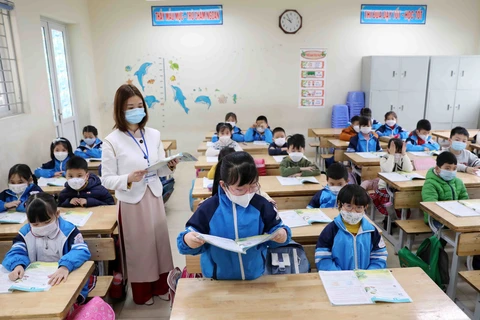
Seventh to 12th graders in Hanoi to resume in-person learning ảnh 1Illustrative image (Source: VNA)
Hanoi (VNA) – Vice Director of the Hanoi Department of Education and Training Tran Luu Hoa on March 18 signed a document on the safe, flexible adaptation to and effective control of COVID-19 during the organisation of in-person classes for students from 7th to 12th grades in the city.

Under the document, relevant agencies and schools were asked to apply measures to control COVID-19 during the face-to-face learning process and handle infections in time to ensure utmost safety for students and teachers.

They were requested to get regularly updated about pandemic prevention and control regulations in schools from the Ministry of Health, Ministry of Education and Training and the city, while actively building their plans to resume face-to-face learning for students from 7th to 12th grades and submit them to the People’s Committees of districts ans townships for approval.

The department assigned the Education-Training Divisions of districts and townships to give advice to the People’s Committees on the approval of the plans.

Seventh to 12th graders across the city have been allowed to return to school from early February following the department's decision issued on January 25. However, students in some high-risk areas have had to study online due to the complicated developments of the pandemic./.
VNA
See more

Hanoi has over 1,100 libraries and numerous cultural and educational spaces in the community. (Photo: VNA)

Spreading value of books, building foundations of learning society

Each weekend in Hanoi, the “Reading with Children” Club brings together students to practise reading, explore language, and express ideas creatively. According to founder of the club Nguyen Thuy Anh, the club encourages children to reflect, retell stories, and connect books with personal experiences, making reading more vivid and meaningful.

Automated ticketing system is used on the urban railway Cat Linh-Ha Dong line in Hanoi. (Photo: VNA)

Digital transformation powers Hanoi metro expansion

Beyond convenience, stable fares and the elimination of fuel, parking and maintenance costs have made urban rail increasingly attractive. The growing preference for metro travel is also contributing to a greener, more modern urban lifestyle.

Delegates cut the ribbon to inaugurate the operation of electric bus route No. 43. (Photo: VNA)

Hanoi accelerates shift to green buses, targets 100% by 2030

In the 2027–2030 period, the city will accelerate the transition towards the complete phase-out of fossil fuel-powered buses. The share of electric and green energy-fueled buses is projected to reach 79–89% by 2029 and 100% by 2030.

At the second session of the Ho Chi Minh City People’s Council (Photo: VNA)

Ho Chi Minh City greenlights central square, administrative centre in Thu Thiem

The new central city square and administrative centre will create a modern, centralised political-administrative complex for Ho Chi Minh City, designed to house around 8,000 officials, civil servants, and employees. It will also handle daily traffic of 1,500- 2,000 citizens and business representatives through a unified one-stop-shop administrative service system.

A working session at the job fair (Photo: VNA)

Vietnamese students flock to Seoul Job Fair 2026

The second annual Job Fair 2026 was held for Vietnamese students in the Republic of Korea. Organisers pitched it as a straight-up bridge between eager students and bosses hungry for young talent who can actually handle multicultural workplaces.

Defendants at the court (Photo: VNA)

Ho Chi Minh City court opens trial over Agribank lending scandal

The investigation revealed that multiple credit files were incomplete or riddled with inaccurate information, while some pledged assets lacked proper legal standing yet were accepted and grossly overvalued. As a result, the loans became high-risk and largely unrecoverable, leading to losses surpassing 1 trillion VND.