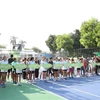
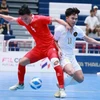
Soldiers play a football game in their own “Old Trafford” stadium in Sinh Ton Dong island of Truong Sa archipelago (Photo: VietnamPlus)
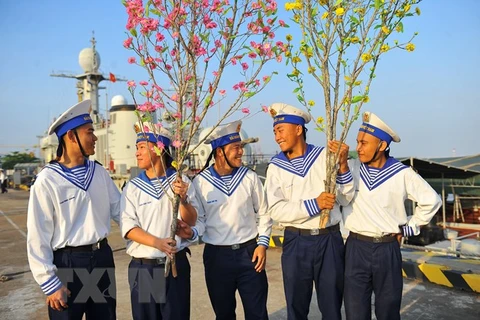
 Hanoi (VNA) – Physical exercise and sport playing is an indispensable part of the life of soldiers based on Truong Sa (Spratly) archipelago, helping them to improve their health conditions and easing their homesick.
In the afternoon every day, officers, soldiers and islanders on Truong Sa enjoy physical exercise and sport activities, which they describe as the food for their mind.
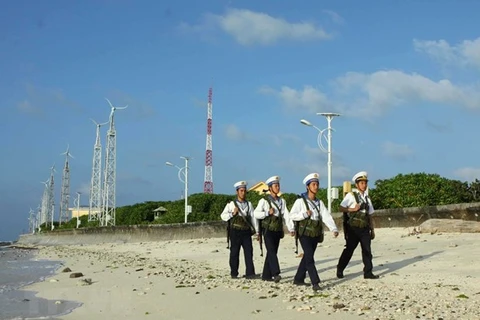
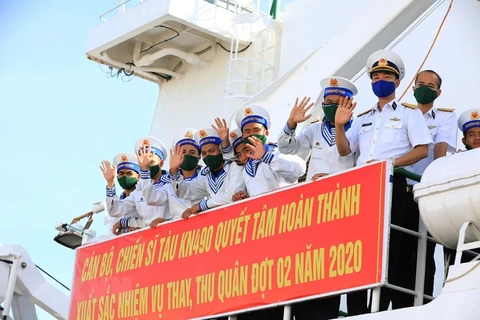
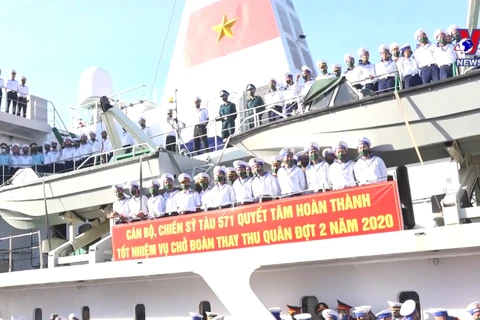
In my first visit to Truong Sa aboard KN-490 vessel together with a working team from the Naval Region 4, I had a chance to tour a number of islands including Sinh Ton, Da Lon, Co Lin, Len Dao, Sinh Ton Dong and Tien Nu.
Despite my short time spending on the island, I got an insight into the daily work and life of naval soldiers who are safeguarding the fatherland’s seas and islands.
On the island, doing physical exercise is part of the soldiers’ tasks in order to be strong enough to perform their missions in national protection. Therefore, all officers and soldiers there have regularly done exercise and played sports that they feel most suitable to them after each working day.
On Sinh Ton island, the most favourable sport of soldiers and islanders are walking and volleyball. At 4:30pm every day, they gather to play sport.
Major Dinh Cao Toan, Vice Political Commissar on Sinh Ton island, said that physical exercise is an important task of all officers and soldiers on the island, which aims to ensure and improve our health conditions.
“Besides daily activities, we often organise tournaments to increase exchanges among officers and soldiers, especially in celebration of major events of the year,” said Toan.
Meanwhile, in submerged islands, although team sports are not feasible, physical exercise and sport is still an important part of the soldiers’ life.
Modern sport equipment have been installed on islands such as Co Lin and Len Dao, including those for weight-lifting and table tennis, enabling soldiers to exercise and play their favourite sports.
Corporal Nguyen Ly, a management officer on Co Lin, said that many choose to play weightlifting, but I prefer table tennis. “Because the sport requires a perfect collaboration between players, while the combat nature is maintained, that’s why I love table tennis,” said Ly.
 The leverage system for weightlifting has been installed to serve physical exercise activities of officers and soldiers on the islands (Photo: VietnamPlus)
Throughout my journey with the working team, I realised that in any circumstances, officers and soldiers on the islands have received great care and attention, especially to their health conditions.
On Sinh Ton Dong island, I was surprised at a football field with a concreted ground. Although it is not as large as those on Truong Sa Lon and Song Tu Tay, but it can host mini games of 4- or 5-strong teams. The mini stadium is funnily called by local soldiers as the “Old Trafford” of Sinh Ton Dong.
Each afternoon, the soldiers gathered in the field for playing. When the number of soldiers gets too large for a game, they held a small tournament in which the losers will be immediately replaced by another team. Of cause, some betting will make the games more attractive, so that the soldiers bet with each other for simple things. For example, the losing team will have to push up or water the vegetable garden.
Sergeant Phan Tien Huy, an artilleryman of the combat cluster No.2 of Sinh Ton Dong, said: “I am happy to play football games with my fellow soldiers every afternoon. Although it is hard to display my skills in the concrete ground, the ground makes balls quicker and attacks more beautiful”.
It can be seen that physical exercise is an indispensable part of the daily life of officers and soldiers performing their tasks on islands in Truong Sa archipelago. The activities not only help them improve their health, but also ease their homesick and help them better perform their tasks./.