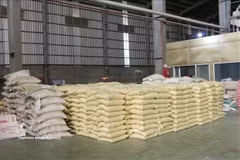
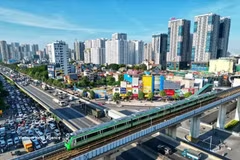
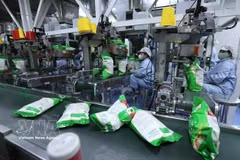
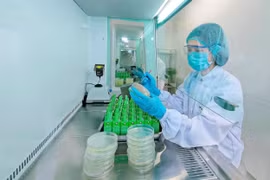
The transportation cost has accounted for 61 percent of total logistics cost for fruit and vegetable products. (Photo: kinhtedothi.vn)
Hanoi (VNA) - The State should develop solutions to reduce highlogistics costs in trading agricultural products to improve the competitivenessof Vietnamese farm produce on the market, according to experts.
The logistics costs have accounted for 12.2 percent of seafood product value,19.8 percent of rice product value and 29.5 percent of fruit and vegetablevalue, Nguyen Duy Minh, vice chairman and general secretary of the VietnamLogistics Business Association (VLA), said.
Especially, Minh said the transportation cost has accounted for 61 percent oftotal logistics cost for fruit and vegetable products, followed by handlingcosts with nearly 20 percent of the logistics costs.
At an online conference on the logistics costs in the value chain of Vietnameseagricultural products held recently in Hanoi, the experts said that the factorsbehind the high logistics cost included high transportation cost, high fees andcharges of foreign shipping companies and restrictions on ports andinfrastructure.
Besides that, new rates of infrastructure fees set by localities and theimplementation of special inspection or quarantine quality inspection were alsoreasons for the high logistics costs, they said.
Le Van Quang, Chairman of the Minh Phu Group Joint Stock Company, said that thetransportation cost of a shrimp container was only 41 million VND from Vietnamto the US and 16 million VND from Vietnam to Japan but this cost was 80 millionVND from HCM City to Hanoi.
Similarly, the transportation cost for a shrimp container from HCM City to aborder gate with China in the northern region was 100 million VND, while ashrimp container shipped from Ecuador to China was just half, even though thedistance between Ecuador and China is far greater than from Vietnam.
Quang said that the cause of this was too many toll stations on land.Therefore, the State needs to have solutions to cut domestic transportationcosts.
Tran Thanh Hai, Deputy Director of the Import and Export Department under theMinistry of Industry and Trade, said that value of agricultural products is lowwhile transportation costs are high. Besides that, agricultural products needcold storage and professional transport vehicles. These two factors have alsoput great pressure on logistics activities for agricultural products.
He said the high logistics cost has caused weak transportation infrastructureand uneven distribution of ports. The central region has low demand fortransporting goods but has many ports while the Mekong Delta region has highdemand for goods transport but lacks ports.
In addition, there are many problems in the connection between transport vehiclesand logistics centres and between seaports.
To solve those problems, Hai said an important solution is investment indeveloping large agricultural logistics centres to ensure the quality of farmproduce in storage.
Besides that, the State needs to put more investment in improving transportinfrastructure on waterways, including ports, because transportation is cheap,he said.
Minh said the State should plan regional logistics centres to create favourableconditions for production and trading of farming products. Technology also hasan important role in traceability, monitoring the quality of goods andconnecting transport companies online.
Director of the Department of Agricultural Product Processing and MarketDevelopment Nguyen Quoc Toan said the planning of developing logistics centresaccording to regions would promote linkages between localities./.
VNA