Stock, real estate markets to become more attractive thanks to low interest rates

Cash flow always looks to more attractive investment channels with higher returns, so when interest rates decrease, cash flow will shift from the savings channel to the stock and real estate markets, according to experts.
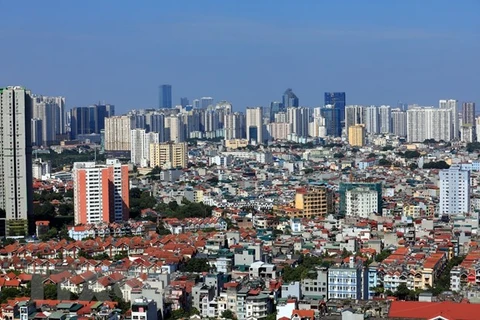
Stock, real estate markets to become more attractive thanks to low interest rates ảnh 1A residential area in Hanoi. Real estate becomes more attractive under the low interest rate context. (Photo: VNA)
Hanoi (VNS/VNA) - Cash flow always looks to moreattractive investment channels with higher returns, so when interest ratesdecrease, cash flow will shift from the savings channel to the stock and realestate markets, according to experts.

According to Huynh Minh Tuan,Investment Director at Mirae Asset Securities &Investments Company, when interest rates are low, savers will begin to considerand shift their asset allocation. Cash flow is always "smart money"and always looks for more attractive investments with higher returns.

The money can move from the savings channel to other investmentmarkets, such as real estate and stock markets, but there will be a delay. Itmay be a few months late for the real estate channel, but for the stockchannel, it will be faster, maybe from next month, Tuan said.

The activity of transferring savings books has also flourishedrecently. There was a firm that last weekend announced to buy back 1,500billion bonds but only bought back 600 bonds. That shows that investors want tokeep high-yielding assets while deposit interest rates fall deeply. Theinterest rate on this bond is 10.5%, which is 30% higher than current savingsrates.

According to Tuan, some industries will benefit from the interestrate reduction trend.

With the stock market, statistics in the past showed stocksincreased when interest rates were lower. In particular, capital-intensiveindustries such as real estate, securities, banking, and construction materialswill benefit, Tuan said.

According to Tuan, the stock market does not reflect the currenteconomy but shows the economy's expectations for the future. When interestrates decrease, industries, which are expected to be positive, are real estate,securities, building materials, and consumer goods, but all need time.

As for the banking industry, it is necessary to look furtherbecause when interest rates are reduced for a while, bad debts will stabiliseagain.

As for the stock market, experts said the positive point in thecurrent period is that although foreign investors net sold 10 trillion VND, thesecurities market is still sideways or moving in a narrow range. That provesdomestic investors are buying stocks and mainly individual customers, or thecash flow is gradually returning to the market.

According to Tuan, in the current sideways time, investors lookingfor stocks with cheap valuations but cheap prices must be considered by eachindustry and asset. When the stock market moves in a narrow range, it's a goodopportunity to select stocks.

Talking more about stock selection, Nguyen Nhat Khanh, head ofMirae Asset Securities & Investments Company’s Investment AdvisoryDivision, said under the current narrow sideways market, it is advisable tochoose stocks with their own story and belong to the group of small- andmedium-cap because cash flow will not have to spend too much force to push upthe prices of these stock groups.

At the same time, it is not always possible to choose the leadingstocks in the industry, but it is possible to consider choosing stocks thatattract less interest, then the profitable bet will be higher./.
VNA

See more

A refilling station of Petrolimex (Photo: VNA)

Import tariffs on certain fuel products reduced to 0%

Rising tensions in the Middle East, particularly the conflict involving the US, Israel and Iran, have significantly affected the global energy market, especially shipping activity through the Strait of Hormuz – a strategic route for transporting crude oil from the region.

Fishermen raise the national flag before heading out to the sea to affirm Vietnam’s sovereignty over its seas and islands. (Photo: VNA)

Dong Thap promotes IUU awareness from start of fishing season

Gia Thuan commune, located in the eastern part of the province, is a key fishing locality with 563 fishing vessels, including 423 offshore boats and 140 nearshore vessels, producing an average annual catch of over 42,970 tonnes of seafood.

Industrial production surges in the first two months of 2026. (Photo: VNA)

Industrial production posts strong growth in first two months

According to the National Statistics Office (NSO) under the Ministry of Finance, the index of industrial production (IIP) in February was estimated to decrease 18.4% from the previous month but increase 1% year on year. Overall, in the January–February period, the IIP rose 10.4% compared with the same period last year.

A delegation from the Nghe An provincial People’s Committee inspects production and business activities at the VSIP Nghe An Industrial, Urban and Service Park. (Photo:nhandan.vn)

Nghe An steps up reforms to attract FDI

In 2025, the provincial People’s Committee licensed 25 new FDI projects and approved capital adjustments for 20 others, bringing the total newly registered and additional investment to more than 1 billion USD. Many large-scale projects in the Southeast Nghe An Economic Zone have already become operational, contributing to export growth, state budget revenues and job creation.

Nearly 35,500 enterprises are newly registered nationwide, with total registered capital reaching nearly 313.7 trillion VND and more than 167,500 registered workers. (Photo: VNA)

Nearly 35,500 new businesses set up in first two months

The enterprises registered combined capital of about 313.7 trillion VND and more than 167,500 employees. Compared with the same period last year, the number of new businesses surged by 70.7%, while registered capital rose by 36.1% and registered labour increased by 19.1%.

The yarn factory of Unitex Textile and Dyeing Company Limited applies new technology to optimise operations using an automated model. (Photo: VNA)

Resolution 68: International lessons for private sector development

A common feature in many successful economies is a fundamental shift in the perception of private enterprises. In countries such as Singapore, Germany, Republic of Korea (RoK) and China, private firms are viewed not mainly as entities requiring strict control but as development partners and key forces generating growth, jobs and innovation.