Hanoi (VNS/VNA) - With an average elderly person having three chronic diseases and at risk of functional decline, building a strong foundation for healthcare and quality of life for the senior population becomes the responsibility of not only the Government but the entire society.
Vietnamese people’s life expectancy now stands at 73.6, but their healthy years are only until 63.2 for men and 70 for women, according to the World Health Organisation (WHO).
This means that older men and women spend up to 11 years living with illnesses.
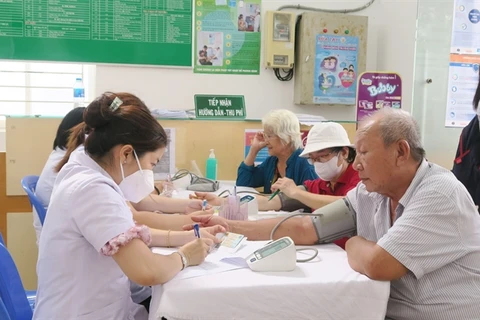
Statistics also revealed that nearly 46% of the senior population is diagnosed with hypertension, 34% of them have arthritis and many others suffer from cardiovascular diseases, bronchitis, urinary diseases or musculoskeletal disorders.
As a result, instead of enjoying their retirement, they have to spend most of their time visiting hospitals.
Their health also naturally deteriorates as they age, including their immune system. Therefore, they are more susceptible to acquiring diseases which often turn chronic or recurrent.
At 68, Hoang Van Thanh still works as a motorbike taxi driver in Hanoi, making around 50,000-100,000 VND (2-4 USD) a day.
His wife, 65, also works as an hourly housekeeper for several households in the city, but suffering from low blood pressure means she often has to take days off.
They make enough to cover their food expenses and rely on their children for the rest.
While more fortunate with their pensions, some elderly people have to spend a large portion of their pensions on regular check-ups and medications, meaning they have to tighten their belt on living expenses.
Dr Pham Vu Hoang, Deputy Director of the General Office for Population and Family Planning under the Ministry of Health, said that the current healthcare system has not kept pace with the growing needs of the elderly.
Most elderly people in the country live with their families and wish to be cared for at home by their children or relatives. However, Vietnam’s prevalent family model is shifting from the traditional extended households (families with three or more generations living together) to nuclear families (two generation families including parents and children).
Caregivers for the elderly at home are other people in the senior population group, many of them women.
Developing elderly-friendly spaces and long-term healthcare services within communities also faces multiple challenges and requires much more effort.
Multiple changes have been made to population management and related policies in response to the current context.
The 6th National Congress of the 12th Party Central Committee set the goals in its Resolution No 21-NQ/TW to “comprehensively and cohesively address issues related to population size, structure, distribution and quality in alignment with socio-economic development.”
To realise this resolution, the Government has assigned 39 projects and missions to 11 ministries and departments in Resolution No 137/NQ-CP. Many of them are in direct response to an ageing population, such as the Vietnam Population Strategy to 2030, the Healthcare Programme for the Elderly to 2030, the Project on Taking Advantage of the Golden Population and Adapting to Population Ageing, as well as the National Action Programme for the Elderly.
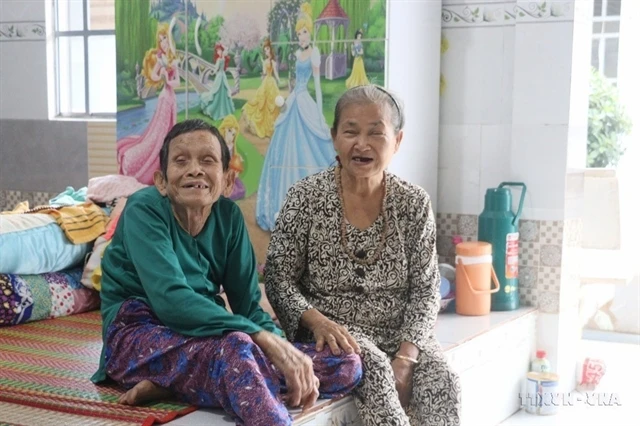
The nationwide health insurance programme, in which senior citizens can enjoy insurance benefits at a discounted premium or free of charge, facilitates their access to healthcare services, especially those living in disadvantaged areas.
Elderly people without pensions or who have low incomes are given welfare assistance, while public nursing homes are under development to provide care and accommodation for those without families.
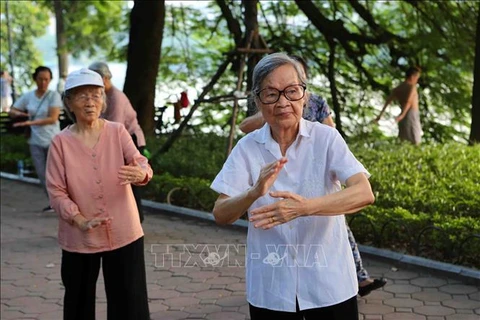
Vietnam is making efforts to improve the quality of life for the elderly, but better results require strong coordination between the Government, social organisations and the community./.
See more
Legal assistance project nears finish line with 95% of goals met
legal support policies only matter when citizens know they exist, can tap into them, and receive quality service. That’s especially true for the poor, the disabled, ethnic minorities, children, domestic violence victims, and those battered by disasters and disease outbreaks.
National Wage Council agrees on 7.8% regional minimum wage increase from January 1, 2027
Under the proposal, which will be submitted to the Government for approval, the regional minimum wage will increase by between 310,000 VND (11.81 USD) and 390,000 VND per month, depending on the region.
PM urges better care for revolutionary contributors, upholding tradition of gratitude
During a visit to the Kim Bang Invalids Nursing Centre in the northern province of Ninh Binh ahead of the 79th anniversary of War Invalids and Martyrs’ Day (July 27, 1947–2026), PM Le Minh Hung extended his warm regards and profound appreciation to invalids, sick soldiers and revolutionary contributors across the country.
Efforts to safeguard religious values in digital age
Digital transformation is changing not only how people work and communicate but also how they practice their faith. A Buddhist sermon can now attract tens of thousands of online viewers. A Protestant believer in a remote area can join a Bible study class via smartphone. Religious activities once closely tied to places of worship are increasingly taking place in cyberspace.
Digital, AI competencies made mandatory for university graduates
Under Circular No. 54/2026/TT-BGDDT on higher education curricula, learning outcomes must be defined as measurable and assessable competencies, providing the basis for curriculum design, teaching, assessment, quality improvement, credit recognition and degree awarding.
Lam Dong expands community-led models to combat IUU fishing
The initiatives place fishermen at the centre of enforcement efforts, promoting community self-management while strengthening coordination between local authorities and relevant agencies in managing offshore fishing activities.
Publishers detained over alleged anti-State propanganda
The move was made as part of an expanded investigation into a criminal case involving Nguyen Thanh Nam, who is accused of “making, storing, distributing or spreading information, documents and items aimed at sabotaging the State of the Socialist Republic of Vietnam.”
Gia Lai digitises fishing fleet to strengthen fight against IUU fishing
Under Directive No. 16/CT-UBND, recently issued by the provincial People's Committee, combating IUU fishing has been identified as an urgent political priority requiring concentrated resources to address shortcomings in fishing fleet management, while holding agency heads and local leaders accountable for the results achieved.
Quang Ninh completes DNA sampling of unidentified war martyrs' remains
The northeastern coastal province of Quang Ninh has completed DNA sample collection from the remains of all unidentified war martyrs buried at 18 cemeteries across 15 localities, achieving full completion by July 14.
Vietnam repatriates remains of 81 volunteer soldiers, experts from Cambodia
The remains of 81 Vietnamese volunteer soldiers and military experts were recovered during the 2025–2026 dry-season search campaign, all of them yet to be identified.
Vietnamese community organisation network completed across Laos
The official establishment of the Vietnamese Community Management Committee and the Vietnamese Association in Vientiane province on July 14 has completed the organisational network serving the Vietnamese community in all 18 provinces and centrally administered cities of Laos.
Senior Party official visits, presents gifts to wounded, sick veteran soldiers in Nghe An
The leader stressed that over the past 79 years, the Party and State have consistently attached great importance to caring for people who rendered service to the revolution, noting that gratitude should be reflected not only through policies but also through the responsibility of authorities at all levels, organisations and every citizen.
Top leader calls for better care for invalids, revolutionary contributors
Party General Secretary and State President To Lam on July 15 affirmed that caring for revolutionary contributors is both a political responsibility and a moral obligation, calling for more comprehensive and timely policies to ensure that those who sacrificed for the nation receive the care and respect they deserve.
Prime Minister Le Minh Hung pays tribute to fallen soldiers in Lang Son
Prime Minister Le Minh Hung on July 15 offered incense and laid flowers in tribute to fallen soldiers at the Lang Son martyrs' cemetery during a working visit to the northern province of the same name.
Over one million visitors visit President Ho Chi Minh Mausoleum in H1
More than one million people visited the President Ho Chi Minh Mausoleum in the first half of 2026, including over 256,000 international visitors.
Phu Quoc tightens inland waterway safety, traffic management
Operators of inland ports and terminals must carry out regular inspections, maintenance and repairs to ensure facilities remain safe and operational. They are also required to work with competent authorities and the Inland Waterway Port Authority to verify that vessels operating at ports and terminals meet all safety requirements.
Lao Cai brings fallen soldiers closer to home after more than half century
Each DNA sample represents a renewed hope and another step towards reuniting the nation's fallen heroes with their families and hometowns.
Vietnam receives remains of 14 volunteer soldiers, experts repatriated from Cambodia
Under the signed record, the Takeo Special Task Committee handed over the remains of 14 Vietnamese volunteer soldiers and experts to its An Giang counterpart, including 10 sets of remains recovered in Kirivong district and four in Tram Kak district.
Vietnamese students shine at int'l mathematics competition in Japan
The value of studying mathematics goes far beyond winning medals. He noted that mathematics helps develop logical thinking, perseverance, critical inquiry and the ability to approach problems from different perspectives.
Attracting high-quality talent to strategic science, technology fields
Under the decree, students admitted to eligible programmes who meet entrance score requirements or are directly admitted, and rank among the top 30% of entrants, will be eligible for Government scholarships. The scholarships will be renewed annually based on academic performance and conduct.