Hanoi (VNA) - A group of sugar producers has asked for Government intervention as the industry struggles to compete with corn syrup imports.
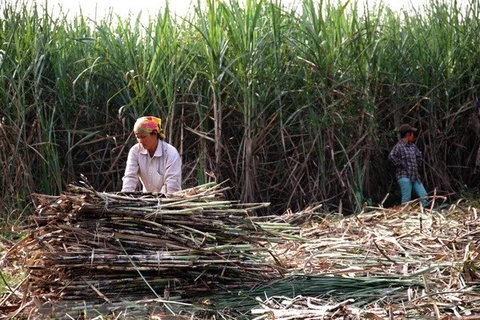
The Vietnam Sugarcane and Sugar Association (VSSA) asked the Government to intervene in adjusting tax incentive policies on imported High-Fructose Corn Syrup (HFCS), or liquid sugar extracted from corn, to create a fair playing ground with locally-produced sugarcane products.
The association also asked the Ministry of Industry and Trade to consider investigating the possibility of applying special safeguard methods on HFCS.
The recommendations were released as sugarcane businesses face challenges in the level of consumption of local sugar products as well as pressure from competition posed by increasing imports of HFCS products into the country, which they say cause serious damage to the domestic sugar industry.
According to a report from the Vietnam General Department of Customs, the volume of imported HFCS dramatically accelerated between 2015 and 2017, with imports in 2017 totalling 89,343 tonnes, up 31.7 percent from 2015.
These were mainly imports from China and the Republic of Korea, representing more than 90 percent of total output and import value.
HFCS is much cheaper than local sugar, and prices are expected to decline further due to improvements in production technology. In 2015, the price of white sugar was 630 USD per tonne compared to 496 USD per tonne of HFCS. In 2017, it was 702 USD and 398 USD per tonne of sugar and HFCS, respectively.
The difference between the average selling price of HFCS and sugar has remained high through recent years, increasing by 21.26 percent in 2015, 36.63 percent in 2016 and 43.3 percent in 2017.
VSSA Chairman Pham Quoc Doanh said given this difference in prices, HFCS poses a major challenge to the domestic sugarcane industry.
Doanh said HFCS enjoyed a preferential import tax rate of zero percent and no quota impositions, while preferential tariffs on sugar under quota stood at 5 percent, and tariffs on non-quota white sugar and raw sugar were 85 percent and 80 percent, respectively.
In addition to damaging sugar production in the country, he said the inconsistent application of tax policies between sugar and HFCS products has caused damage to the State budget.
“If HFCS is seen as similar to sugar made from sugarcane, the import tax rate should be similar, not discriminatory,” Doanh said. “The level of incentive import duty imposed on HFCS must be at the level applied on sugar.”-VNA
The Vietnam Sugarcane and Sugar Association (VSSA) asked the Government to intervene in adjusting tax incentive policies on imported High-Fructose Corn Syrup (HFCS), or liquid sugar extracted from corn, to create a fair playing ground with locally-produced sugarcane products.
The association also asked the Ministry of Industry and Trade to consider investigating the possibility of applying special safeguard methods on HFCS.
The recommendations were released as sugarcane businesses face challenges in the level of consumption of local sugar products as well as pressure from competition posed by increasing imports of HFCS products into the country, which they say cause serious damage to the domestic sugar industry.
According to a report from the Vietnam General Department of Customs, the volume of imported HFCS dramatically accelerated between 2015 and 2017, with imports in 2017 totalling 89,343 tonnes, up 31.7 percent from 2015.
These were mainly imports from China and the Republic of Korea, representing more than 90 percent of total output and import value.
HFCS is much cheaper than local sugar, and prices are expected to decline further due to improvements in production technology. In 2015, the price of white sugar was 630 USD per tonne compared to 496 USD per tonne of HFCS. In 2017, it was 702 USD and 398 USD per tonne of sugar and HFCS, respectively.
The difference between the average selling price of HFCS and sugar has remained high through recent years, increasing by 21.26 percent in 2015, 36.63 percent in 2016 and 43.3 percent in 2017.
VSSA Chairman Pham Quoc Doanh said given this difference in prices, HFCS poses a major challenge to the domestic sugarcane industry.
Doanh said HFCS enjoyed a preferential import tax rate of zero percent and no quota impositions, while preferential tariffs on sugar under quota stood at 5 percent, and tariffs on non-quota white sugar and raw sugar were 85 percent and 80 percent, respectively.
In addition to damaging sugar production in the country, he said the inconsistent application of tax policies between sugar and HFCS products has caused damage to the State budget.
“If HFCS is seen as similar to sugar made from sugarcane, the import tax rate should be similar, not discriminatory,” Doanh said. “The level of incentive import duty imposed on HFCS must be at the level applied on sugar.”-VNA
VNA