Support delivered to Vietnamese-Cambodians under quarantine in Cambodia

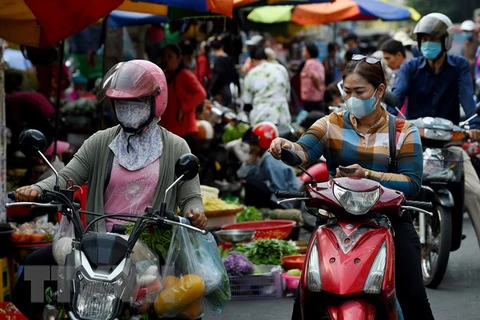
A working delegation of the Vietnamese Embassy and the Khmer-Vietnam Association in Cambodia handed over donations to Cambodians of Vietnamese origin living in lockdown areas in Kandal and Prey Veng provinces on March 14 and 15, where over 150 COVID-19 cases have been found, including 10 Vietnamese-Cambodians.
Support delivered to Vietnamese-Cambodians under quarantine in Cambodia ảnh 1Transporting rice for Vietnamese in Cambodia (Photo: VNA)

Phnom Penh (VNA) - A working delegation ofthe Vietnamese Embassy and the Khmer-Vietnam Association in Cambodia handedover donations to Cambodians of Vietnamese origin living in lockdown areas in Kandal and Prey Vengprovinces on March 14 and 15, where over 150 COVID-19 cases have been found,including 10 Vietnamese-Cambodians.

They delivered over 14 tonnes of rice, 530 boxes ofinstant noodles, and 50 boxes of canned fish to support 230 households in PrekTamlop commune in Kandal and 100 households in Prek Sai Kho commune in Prey Veng.

The delegation also presented medical supplies to local authorities at aworking session with officials and forces involved in pandemic control work at Prek Tamlop commune, including 5,000 masks,50 bottles of hand sanitiser, and 100 protective suits.

Theauthorities pledged to continue working closely with the Khmer-Vietnam Association’slocal branch to offer timely support to the community of Vietnamese-Cambodians. 

Manyphilanthropists, businesses, and Vietnamese representative agencies in Cambodiahave also donated food and medical supplies in recent times to disadvantaged Cambodians of Vietnamese origin in lockdown areas in the country./.
VNA

See more

The copyright crackdown is broadly viewed as an inevitable step in Vietnam’s cultural industry development. (Illustrative photo: VNA)

Healthy digital content market in the making

The sharper crackdown is rapidly redrawing how online entertainment is distributed and consumed, while gradually reshaping public awareness and responsibility toward copyright protection.

A view of Place Ho Chi Minh in Persan, France. (Photo: VNA)

Place preserving memories of President Ho Chi Minh in France

Although there is little publicly available documentation confirming exactly when Place Ho Chi Minh was established, French urban historians suggest that most streets and public spaces named after the Vietnamese leader in France emerged between the 1960s and 1980s, during the height of anti-war movements and solidarity campaigns supporting Vietnam across working-class towns and left-leaning suburbs around Paris.

Vietnamese Ambassador to Bangladesh Nguyen Manh Cuong speaks at the seminar. (Photo: VNA)

President Ho Chi Minh’s thought on national unity remains relevant today

President Ho Chi Minh's ideology of national unity continues to carry profound significance amid growing global challenges, including conflicts, social divisions and economic instability. His message of solidarity, consensus and placing national interests above sectional differences remains a valuable lesson for many developing nations.

Assoc. Prof. Dr. Nguyen Duc Son presents the decision establishing the Vietnamese Language Proficiency Test Council in Japan to a representative of the Vietnam Studies Centre in Japan. (Photo: VNA)

Japan hosts first standardised Vietnamese language proficiency test

As bilateral ties between Vietnam and Japan continue to expand, demand for Vietnamese language learning in Japan has also grown rapidly among OVs, educational institutions, businesses and Japanese people interested in Vietnam. Against this backdrop, the introduction of a standardised proficiency test is expected to provide an official and widely recognised benchmark for Vietnamese language skills.

The “I Love My Fatherland" Journey 2026 kicks off in Nghe An province on May 16. (Photo: VNA)

"I Love My Fatherland” journey features diverse activities

The “I Love My Fatherland” journey will span seven stages across historical and cultural sites and “red addresses” nationwide. There will be a combination of education on traditions, field-based programmes, and digital communications.