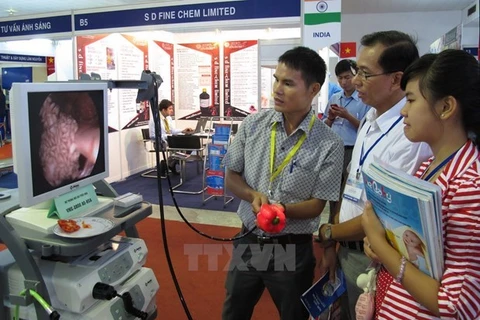
Domestic pharmaceutical firms will play an increasingly dominant role in Vietnam. (Photo: gmp.com.vn)
 Hanoi (VNS/VNA) - The Vietnamese Government's support for the local pharmaceutical industry will remain steadfast, according to Fitch Solutions.
Under a report released last week, the UK-based financial information group said this was in part driven by the authorities' push to meet domestic healthcare needs. In addition, the economic potential of the pharmaceutical sector will incentivise continued Government support for the domestic industry.
Although the Government aims to increase the share of locally produced pharmaceuticals to 80 percent, an average of 55 percent of medicines in Vietnam are imported every year.
One of the reasons for Vietnam’s reliance on imports is that most domestic companies lack research and development capabilities, and do not meet the European Union Good Manufacturing Practice (EU-GMP) or Pharmaceutical Inspection Co-operation Scheme Good Manufacturing Practice (PIC/S-GMP) standards required to manufacture high-quality generic drugs. Further, Vietnam imports more than 90 percent of drug inputs, half of which are from China.
According to Fitch, partnerships with local firms are integral. As a result of Government initiatives, domestic pharmaceutical firms will play an increasingly dominant role in Vietnam.
“This accentuates the need for multinational pharmaceutical companies to partner with local drugmakers to adapt to this trend. Finding a local company to start such a joint venture is an important first step to enter the market in Vietnam,” Fitch said.
Foreign companies often work with domestic companies, such as Diethelm Vietnam, Zuellig Pharma Vietnam, and Mega Lifesciences, to fill in different needs in the supply chain.
Fitch forecast a shift from pharmaceutical production to a more research-based industry was likely. The boost in attractiveness of the Vietnamese market comes at a time when the business environment for drugmakers in neighbouring countries has not been favourable. In December 2018, Indonesia enacted a regulation for the compulsory licensing of every medical product that is not being made in the country.
“This is expected to have significant negative consequences for foreign direct investment in the country, with Vietnam being the one of the beneficiaries of pharmaceutical companies shying away from Indonesia. This, combined with the geopolitical position of Vietnam, place the country in a favourable position to become a regional pharmaceutical research and export hub,” Fitch said.
In July 2019, Pharma Group, the Pharmaceutical Sector Committee of the European Chamber of Commerce in Vietnam, highlighted that the country has the ability to reach a higher position in the value chain of the science and life sector in comparison with other countries in the ASEAN region. However, it was noted that further deliberation is required before the positive steps taken by the country can materialise.
However, Fitch noted, Vietnam’s pharmaceutical industry also faced challenges in foreign investment.
“We note that despite our positive outlook on the pharmaceutical market, significant risks remain. There are a number of shortcomings, including underdeveloped infrastructure, lack of staff and finance, and low healthcare access among people in rural and remote areas. Access to medicines will remain a key challenge for pharmaceutical companies seeking to capture the commercial prospects in Vietnam as the population is highly ruralised. Patients continue to face challenges over medical access and rising out-of-pocket healthcare costs.”
Moreover, it said, there are large regional variations with regards to the number of healthcare facilities, doctors and beds between the rural and urban regions of the country, which exacerbates these access issues./.
VNA