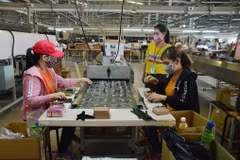
The Malaysian economy is anticipated to start moderating due to impact of global economic instability in the first months of 2023, the country’s Department of Statistics (DOSM) said on December 29.
Despite difficulties posed by COVID-19, the industrial production value, excluding oil and gas, of the southern province of Ba Ria-Vung Tau was estimated to increase 8.44 percent in the first half of this year compared to the 6.47 percent growth in the same period last year.
Retail sales in Singapore fell by 10.8 percent year-on-year in September, a steeper decline compared to the 5.4 percent drop in August, according to the country's Department of Statistics (SingStat).
Singapore’s retail sales in July fell by 8.5 percent year-on-year, an improvement from June’s 27.7 percent plunge, according to the Department of Statistics (SingStat).
Exports by Ho Chi Minh City companies in the first eight months of the year reached 28.4 billion USD, a 4 percent increase year-on-year, according to the municipal Department of Industry and Trade.
Singapore’s total retail sales decreased by 52.1 percent in May – the highest decrease since 1986, the country’s Department of Statistics released on July 3.
Ho Chi Minh City’s gross regional domestic product (GRDP) has been estimated at 335.6 trillion VND (14.26 billion USD) in the first quarter of 2020, up 0.42 percent year-on-year.
Singapore’s retail sales in February fell by 8.6 percent year-on-year, compared to the 5.3 percent reduction in the previous month, according to the country’s Department of Statistics.
The consumer price index (CPI) of Ho Chi Minh City in November fell 0.25 percent against the previous month but increased 2.98 percent year-on-year, announced the city’s Department of Statistics on November 29.
The flows of foreign direct investment (FDI) in Malaysia fell 12.77 percent year-on-year to 41 billion ringgit (10.09 billion USD) in 2017, after reaching a new high of 47 billion ringgit in the previous year, the Department of Statistics Malaysia reported.