Teachers' wages must top administrative, non-productive salary scale system: Politburo

The Politburo has concluded that teachers' salaries must be placed on the top of the salary scale system for the administrative and non-productive sector, with additional allowances tailored to the work's nature and regions.

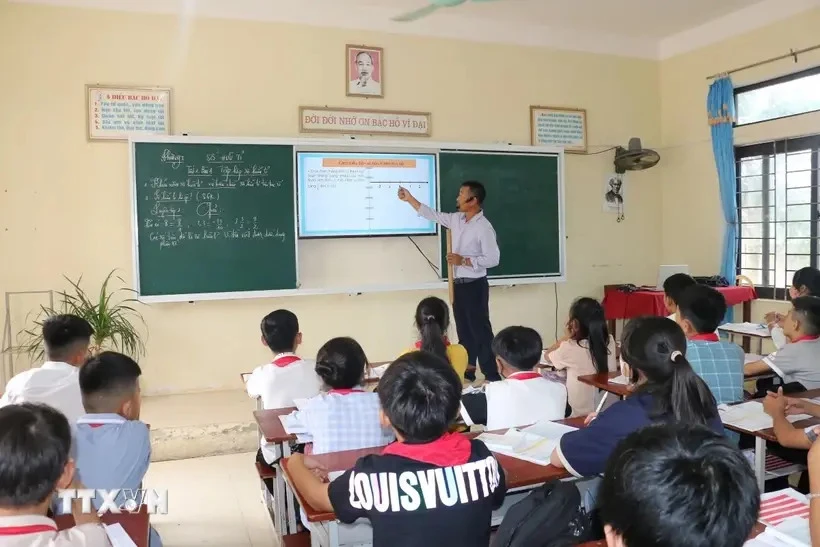
At a classroom in Nghe An province (Photo: VNA)

Hanoi (VNA) – The Politburo has concluded that teachers' salaries must be placed on the top of the salary scale system for the administrative and non-productive sector, with additional allowances tailored to the work's nature and regions.

Signed by permanent member of the Party Central Committee’s Secretariat Luong Cuong, the conclusion is for the continued implementation of the 11th Party Central Committee’s Resolution No.29- NQ/TW dated November 4, 2013 on “Fundamental and Comprehensive Innovation in Education and Training, Serving Industrialisation and Modernisation in a Socialist-Oriented Market Economy During International Integration”.

It stressed the urgent need to continue advancing fundamental and comprehensive innovation in education and training to meet the nation's development needs in the new era. The move aims to respond to the fourth industrial revolution and the rapid advancement of digital technology and artificial intelligence, with the hope of elevating Vietnam's education and training to an advanced level in Asia by 2030 and to a global standard by 2045.

The Politburo called on Party committees, administrations, the Vietnam Fatherland Front, and socio-political organisations to continue thoroughly grasping and rigorously following the viewpoints, goals, tasks, and solutions outlined in Resolution 29-NQ/TW, the resolution of the 13th National Party Congress and other Party resolutions on education and training.

In particular, the conclusion underscores the necessity to review, amend, and perfect relevant mechanisms, policies, and laws, including the expedient building of a law on teachers, a law on lifelong learning, an education development strategy, and regulations on education management and school governance reform.

Investment in education, described as "the top national policy," will be put at the top in socio-economic development plans. The focus will be on enhancing comprehensive education quality at all levels, modernising vocational and higher education, and boosting scientific research capacity within educational institutions. Emerging fields such as artificial intelligence, data science, and semiconductors will be key areas of focus, serving the knowledge-based, digital, green, and circular economy.

To achieve these goals, the state budget allocated for education-training should account for at least 20% of the total state budget expenditure, as stipulated in Resolution No. 29-NQ/TW. Ethnic minority, mountainous, border, and island areas will also be given priority./.
VNA

See more

The copyright crackdown is broadly viewed as an inevitable step in Vietnam’s cultural industry development. (Illustrative photo: VNA)

Healthy digital content market in the making

The sharper crackdown is rapidly redrawing how online entertainment is distributed and consumed, while gradually reshaping public awareness and responsibility toward copyright protection.

A view of Place Ho Chi Minh in Persan, France. (Photo: VNA)

Place preserving memories of President Ho Chi Minh in France

Although there is little publicly available documentation confirming exactly when Place Ho Chi Minh was established, French urban historians suggest that most streets and public spaces named after the Vietnamese leader in France emerged between the 1960s and 1980s, during the height of anti-war movements and solidarity campaigns supporting Vietnam across working-class towns and left-leaning suburbs around Paris.

Vietnamese Ambassador to Bangladesh Nguyen Manh Cuong speaks at the seminar. (Photo: VNA)

President Ho Chi Minh’s thought on national unity remains relevant today

President Ho Chi Minh's ideology of national unity continues to carry profound significance amid growing global challenges, including conflicts, social divisions and economic instability. His message of solidarity, consensus and placing national interests above sectional differences remains a valuable lesson for many developing nations.

Assoc. Prof. Dr. Nguyen Duc Son presents the decision establishing the Vietnamese Language Proficiency Test Council in Japan to a representative of the Vietnam Studies Centre in Japan. (Photo: VNA)

Japan hosts first standardised Vietnamese language proficiency test

As bilateral ties between Vietnam and Japan continue to expand, demand for Vietnamese language learning in Japan has also grown rapidly among OVs, educational institutions, businesses and Japanese people interested in Vietnam. Against this backdrop, the introduction of a standardised proficiency test is expected to provide an official and widely recognised benchmark for Vietnamese language skills.

The “I Love My Fatherland" Journey 2026 kicks off in Nghe An province on May 16. (Photo: VNA)

"I Love My Fatherland” journey features diverse activities

The “I Love My Fatherland” journey will span seven stages across historical and cultural sites and “red addresses” nationwide. There will be a combination of education on traditions, field-based programmes, and digital communications.

At the handover of 33 Chinese nationals who had violated Vietnamese law to Chinese authorities in Quang Ninh on May 15, 2026. (Photo: VNA)

Vietnam hands over 33 law violators to China

Investigations found that the individuals had violated Vietnamese laws relating to illegal entry and unlawful residence in Vietnam. The handover was conducted safely and in compliance with Vietnamese law and international practice.